

Pressure
Hydrotreating feeds with a significant amount of coker naphtha material typically
contain higher amounts of nitrogen, which requires the hydrotreating reactor to
operate at higher pressures to ensure the appropriate denitrogenation reactions take
place to meet the 0.5 wppm nitrogen specification for reformer feed.
LHSV
In addition to higher sulfur and nitrogen contaminant levels in coker naphtha feed
blends, the presence of Si also requires the addition of trapping material, which
lowers the liquid hourly space velocity (LHSV) in the hydrotreating unit. Liquid
hourly space velocity is the liquid feed rate divided by the catalyst volume and is
expressed in units of inverse time. LHSV is inversely proportional to the liquid
residence time in the catalyst. The amount of Si trap required depends on the
concentration of Si in the feed blend, the trapping capacity of the hydrotreating
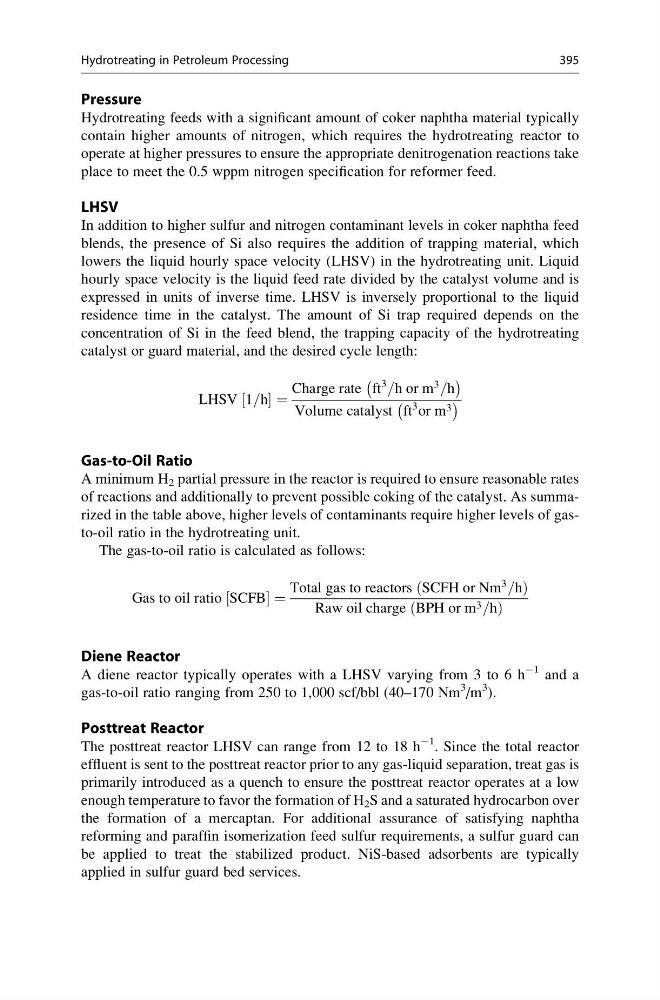
catalyst or guard material, and the desired cycle length:
LHSV 1=h
½
¼
Charge rate ft
3
=h or m
3
=h
À
Á
Volume catalyst ft
3 or m 3
À
Á
Gas-to-Oil Ratio
A minimum H 2 partial pressure in the reactor is required to ensure reasonable rates
of reactions and additionally to prevent possible coking of the catalyst. As summarized in the table above, higher levels of contaminants require higher levels of gasto-oil ratio in the hydrotreating unit.
The gas-to-oil ratio is calculated as follows:
Gas to oil ratio SCFB
½
¼
Total gas to reactors SCFH or Nm
3
=h
ð
Þ
Raw oil charge BPH or m 3 =h
ð
Þ
Diene Reactor
A diene reactor typically operates with a LHSV varying from 3 to 6 h
À1 and a
gas-to-oil ratio ranging from 250 to 1,000 scf/bbl (40–170 Nm
3 /m
3 ).
Posttreat Reactor
The posttreat reactor LHSV can range from 12 to 18 h
À1 . Since the total reactor
effluent is sent to the posttreat reactor prior to any gas-liquid separation, treat gas is
primarily introduced as a quench to ensure the posttreat reactor operates at a low
enough temperature to favor the formation of H 2 S and a saturated hydrocarbon over
the formation of a mercaptan. For additional assurance of satisfying naphtha
reforming and paraffin isomerization feed sulfur requirements, a sulfur guard can
be applied to treat the stabilized product. NiS-based adsorbents are typically
applied in sulfur guard bed services.
Hydrotreating in Petroleum Processing
395
Hydrotreating feeds with a significant amount of coker naphtha material typically
contain higher amounts of nitrogen, which requires the hydrotreating reactor to
operate at higher pressures to ensure the appropriate denitrogenation reactions take
place to meet the 0.5 wppm nitrogen specification for reformer feed.
LHSV
In addition to higher sulfur and nitrogen contaminant levels in coker naphtha feed
blends, the presence of Si also requires the addition of trapping material, which
lowers the liquid hourly space velocity (LHSV) in the hydrotreating unit. Liquid
hourly space velocity is the liquid feed rate divided by the catalyst volume and is
expressed in units of inverse time. LHSV is inversely proportional to the liquid
residence time in the catalyst. The amount of Si trap required depends on the
concentration of Si in the feed blend, the trapping capacity of the hydrotreating
catalyst or guard material, and the desired cycle length:
LHSV 1=h
½
¼
Charge rate ft
3
=h or m
3
=h
À
Á
Volume catalyst ft
3 or m 3
À
Á
Gas-to-Oil Ratio
A minimum H 2 partial pressure in the reactor is required to ensure reasonable rates
of reactions and additionally to prevent possible coking of the catalyst. As summarized in the table above, higher levels of contaminants require higher levels of gasto-oil ratio in the hydrotreating unit.
The gas-to-oil ratio is calculated as follows:
Gas to oil ratio SCFB
½
¼
Total gas to reactors SCFH or Nm
3
=h
ð
Þ
Raw oil charge BPH or m 3 =h
ð
Þ
Diene Reactor
A diene reactor typically operates with a LHSV varying from 3 to 6 h
À1 and a
gas-to-oil ratio ranging from 250 to 1,000 scf/bbl (40–170 Nm
3 /m
3 ).
Posttreat Reactor
The posttreat reactor LHSV can range from 12 to 18 h
À1 . Since the total reactor
effluent is sent to the posttreat reactor prior to any gas-liquid separation, treat gas is
primarily introduced as a quench to ensure the posttreat reactor operates at a low
enough temperature to favor the formation of H 2 S and a saturated hydrocarbon over
the formation of a mercaptan. For additional assurance of satisfying naphtha
reforming and paraffin isomerization feed sulfur requirements, a sulfur guard can
be applied to treat the stabilized product. NiS-based adsorbents are typically
applied in sulfur guard bed services.
Hydrotreating in Petroleum Processing
395