

chromatography (GC), or “two-dimensional” GC, commonly referred to as
GCxGC. While the description of the method may be found elsewhere, the results
offer much greater insights into the chemical composition of petroleum fractions
than was possible previously. A comprehensive GC 3D representation of the
hydrocarbon structures present in a distillate is shown in Fig. 6.
The paraffinic structures appear as spikes along the x-axis with increasing
molecular weight.
Single-ring aromatics appear as families of spikes angling at a 45
o angle to the
right, again with increasing molecular weight as one progresses to the right from
one family to the next, e.g., from C 3 benzenes to C 4 benzenes. The larger spikes,
beyond the indane “range,” are the di-aromatics (naphthalenes) again arranged in
“families” of increasing molecular weight. The next, smaller, series of spikes are
three-ring aromatics, followed by traces of multi-ring aromatics. All compounds
may be identified and quantified to fully characterize the composition of the
distillate.
A similar GCxGC analysis focusing on sulfur compounds is shown in Fig. 7.
The type of compound is shown, e.g., thiophene, benzothiophene, or
dibenzothiophene, as well as the extent of substitution on the ring.
The same can be accomplished for nitrogen species (Fig. 8).
Catalysts and Reactions
Both Co/Mo and Ni/Mo catalysts have been employed in the hydrotreatment of
distillate fuels. While, in the early stages of development, the Ni/Mo catalysts
were judged to be slightly more active in hydrodesulfurizing diesel fuels to
ULSD (<10 wppm Sulfur) specifications, more recent developments have provided
Co/Mo catalysts with equivalent activity to ULSD. The observations that
Ni/Mo catalysts may be more active for ULSD is in accord with the theory that
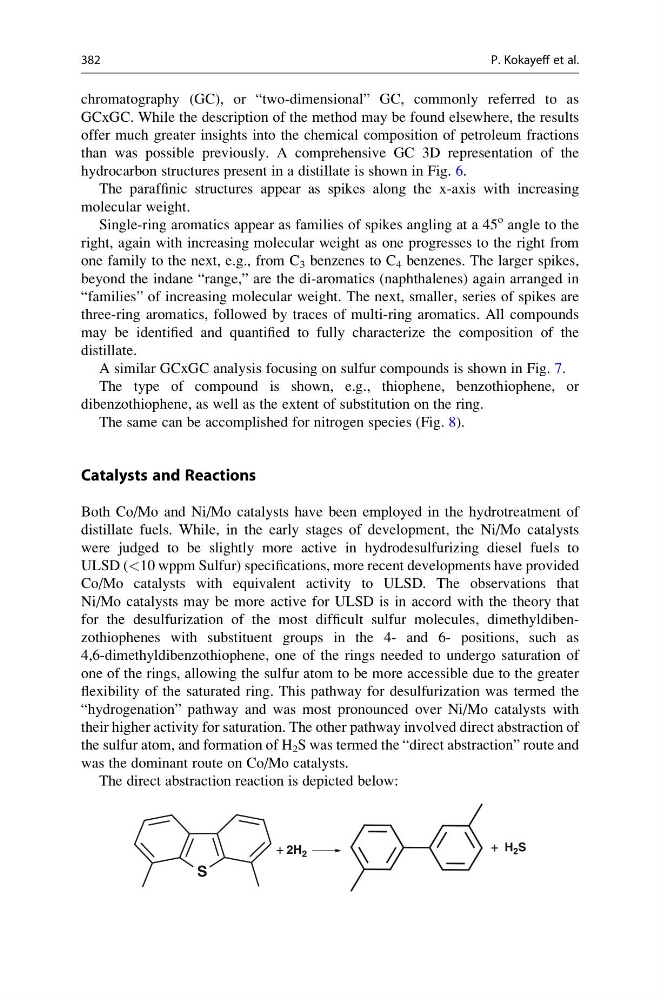
for the desulfurization of the most difficult sulfur molecules, dimethyldibenzothiophenes with substituent groups in the 4- and 6- positions, such as
4,6-dimethyldibenzothiophene, one of the rings needed to undergo saturation of
one of the rings, allowing the sulfur atom to be more accessible due to the greater
flexibility of the saturated ring. This pathway for desulfurization was termed the
“hydrogenation” pathway and was most pronounced over Ni/Mo catalysts with
their higher activity for saturation. The other pathway involved direct abstraction of
the sulfur atom, and formation of H 2 S was termed the “direct abstraction” route and
was the dominant route on Co/Mo catalysts.
The direct abstraction reaction is depicted below:
+ 2H 2
+ H 2 S
S
382
P. Kokayeff et al.
GCxGC. While the description of the method may be found elsewhere, the results
offer much greater insights into the chemical composition of petroleum fractions
than was possible previously. A comprehensive GC 3D representation of the
hydrocarbon structures present in a distillate is shown in Fig. 6.
The paraffinic structures appear as spikes along the x-axis with increasing
molecular weight.
Single-ring aromatics appear as families of spikes angling at a 45
o angle to the
right, again with increasing molecular weight as one progresses to the right from
one family to the next, e.g., from C 3 benzenes to C 4 benzenes. The larger spikes,
beyond the indane “range,” are the di-aromatics (naphthalenes) again arranged in
“families” of increasing molecular weight. The next, smaller, series of spikes are
three-ring aromatics, followed by traces of multi-ring aromatics. All compounds
may be identified and quantified to fully characterize the composition of the
distillate.
A similar GCxGC analysis focusing on sulfur compounds is shown in Fig. 7.
The type of compound is shown, e.g., thiophene, benzothiophene, or
dibenzothiophene, as well as the extent of substitution on the ring.
The same can be accomplished for nitrogen species (Fig. 8).
Catalysts and Reactions
Both Co/Mo and Ni/Mo catalysts have been employed in the hydrotreatment of
distillate fuels. While, in the early stages of development, the Ni/Mo catalysts
were judged to be slightly more active in hydrodesulfurizing diesel fuels to
ULSD (<10 wppm Sulfur) specifications, more recent developments have provided
Co/Mo catalysts with equivalent activity to ULSD. The observations that
Ni/Mo catalysts may be more active for ULSD is in accord with the theory that
for the desulfurization of the most difficult sulfur molecules, dimethyldibenzothiophenes with substituent groups in the 4- and 6- positions, such as
4,6-dimethyldibenzothiophene, one of the rings needed to undergo saturation of
one of the rings, allowing the sulfur atom to be more accessible due to the greater
flexibility of the saturated ring. This pathway for desulfurization was termed the
“hydrogenation” pathway and was most pronounced over Ni/Mo catalysts with
their higher activity for saturation. The other pathway involved direct abstraction of
the sulfur atom, and formation of H 2 S was termed the “direct abstraction” route and
was the dominant route on Co/Mo catalysts.
The direct abstraction reaction is depicted below:
+ 2H 2
+ H 2 S
S
382
P. Kokayeff et al.