

converted to the corresponding hydrocarbon and hydrogen halide. The typical
reaction is shown below:
-CH 2 -CH 2 -CH 2 -Cl
+ 4H 2
-CH 2 -CH 2 -CH 3
+ HCll
With the above to serve as an introduction and overview, a number of important
hydrotreating applications are presented below in greater detail.
Distillate Hydrotreating
As specifications for diesel fuels became ever more stringent, especially with regard
to sulfur but also with regard to aromatics and density, improved hydrotreating
technology is needed to satisfy the new specifications. This has led to the development of ever more active catalysts, e.g., Type II hydrotreating catalysts, and an
intensification of research and development efforts aimed at improving
hydrotreating fundamentals understanding.
Catalytic Chemistry of Diesel Desulfurization
Full-range diesel has a rather broad boiling range, from ~300
F to ~700
F, and
contains a very broad range of sulfur compounds ranging from lower-molecularweight alkyl sulfides and benzothiophenes through dibenzothiophene, substituted
dibenzothiophenes, and higher-molecular-weight naphthobenzothiophenes. Generally,
all sulfur compounds boiling lower than 4-methyldibenzothiophene undergo rapid
desulfurization at conditions required for production of 10 wppm sulfur diesel (ULSD).
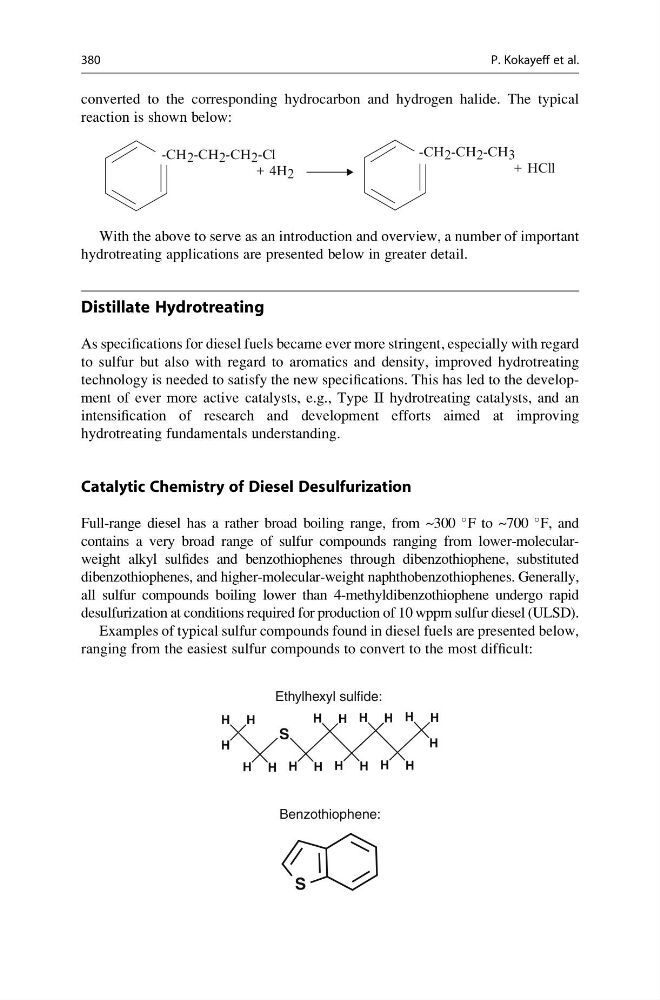
Examples of typical sulfur compounds found in diesel fuels are presented below,
ranging from the easiest sulfur compounds to convert to the most difficult:
Ethylhexyl sulfide:
Benzothiophene:
380
P. Kokayeff et al.
reaction is shown below:
-CH 2 -CH 2 -CH 2 -Cl
+ 4H 2
-CH 2 -CH 2 -CH 3
+ HCll
With the above to serve as an introduction and overview, a number of important
hydrotreating applications are presented below in greater detail.
Distillate Hydrotreating
As specifications for diesel fuels became ever more stringent, especially with regard
to sulfur but also with regard to aromatics and density, improved hydrotreating
technology is needed to satisfy the new specifications. This has led to the development of ever more active catalysts, e.g., Type II hydrotreating catalysts, and an
intensification of research and development efforts aimed at improving
hydrotreating fundamentals understanding.
Catalytic Chemistry of Diesel Desulfurization
Full-range diesel has a rather broad boiling range, from ~300
F to ~700
F, and
contains a very broad range of sulfur compounds ranging from lower-molecularweight alkyl sulfides and benzothiophenes through dibenzothiophene, substituted
dibenzothiophenes, and higher-molecular-weight naphthobenzothiophenes. Generally,
all sulfur compounds boiling lower than 4-methyldibenzothiophene undergo rapid
desulfurization at conditions required for production of 10 wppm sulfur diesel (ULSD).
Examples of typical sulfur compounds found in diesel fuels are presented below,
ranging from the easiest sulfur compounds to convert to the most difficult:
Ethylhexyl sulfide:
Benzothiophene:
380
P. Kokayeff et al.