

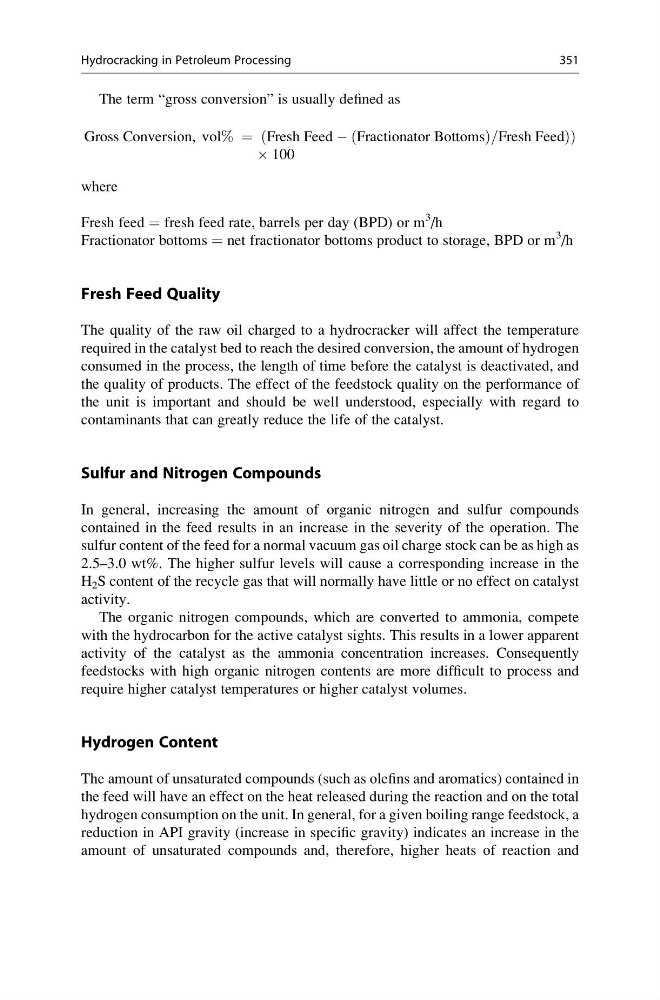
The term “gross conversion” is usually defined as
Gross Conversion, vol% ¼ Fresh Feed À Fractionator Bottoms
ð
Þ =Fresh Feed
ð
Þ Þ
 100
where
Fresh feed = fresh feed rate, barrels per day (BPD) or m
3 /h
Fractionator bottoms = net fractionator bottoms product to storage, BPD or m
3 /h
Fresh Feed Quality
The quality of the raw oil charged to a hydrocracker will affect the temperature
required in the catalyst bed to reach the desired conversion, the amount of hydrogen
consumed in the process, the length of time before the catalyst is deactivated, and
the quality of products. The effect of the feedstock quality on the performance of
the unit is important and should be well understood, especially with regard to
contaminants that can greatly reduce the life of the catalyst.
Sulfur and Nitrogen Compounds
In general, increasing the amount of organic nitrogen and sulfur compounds
contained in the feed results in an increase in the severity of the operation. The
sulfur content of the feed for a normal vacuum gas oil charge stock can be as high as
2.5–3.0 wt%. The higher sulfur levels will cause a corresponding increase in the
H 2 S content of the recycle gas that will normally have little or no effect on catalyst
activity.
The organic nitrogen compounds, which are converted to ammonia, compete
with the hydrocarbon for the active catalyst sights. This results in a lower apparent
activity of the catalyst as the ammonia concentration increases. Consequently
feedstocks with high organic nitrogen contents are more difficult to process and
require higher catalyst temperatures or higher catalyst volumes.
Hydrogen Content
The amount of unsaturated compounds (such as olefins and aromatics) contained in
the feed will have an effect on the heat released during the reaction and on the total
hydrogen consumption on the unit. In general, for a given boiling range feedstock, a
reduction in API gravity (increase in specific gravity) indicates an increase in the
amount of unsaturated compounds and, therefore, higher heats of reaction and
Hydrocracking in Petroleum Processing
351
Gross Conversion, vol% ¼ Fresh Feed À Fractionator Bottoms
ð
Þ =Fresh Feed
ð
Þ Þ
 100
where
Fresh feed = fresh feed rate, barrels per day (BPD) or m
3 /h
Fractionator bottoms = net fractionator bottoms product to storage, BPD or m
3 /h
Fresh Feed Quality
The quality of the raw oil charged to a hydrocracker will affect the temperature
required in the catalyst bed to reach the desired conversion, the amount of hydrogen
consumed in the process, the length of time before the catalyst is deactivated, and
the quality of products. The effect of the feedstock quality on the performance of
the unit is important and should be well understood, especially with regard to
contaminants that can greatly reduce the life of the catalyst.
Sulfur and Nitrogen Compounds
In general, increasing the amount of organic nitrogen and sulfur compounds
contained in the feed results in an increase in the severity of the operation. The
sulfur content of the feed for a normal vacuum gas oil charge stock can be as high as
2.5–3.0 wt%. The higher sulfur levels will cause a corresponding increase in the
H 2 S content of the recycle gas that will normally have little or no effect on catalyst
activity.
The organic nitrogen compounds, which are converted to ammonia, compete
with the hydrocarbon for the active catalyst sights. This results in a lower apparent
activity of the catalyst as the ammonia concentration increases. Consequently
feedstocks with high organic nitrogen contents are more difficult to process and
require higher catalyst temperatures or higher catalyst volumes.
Hydrogen Content
The amount of unsaturated compounds (such as olefins and aromatics) contained in
the feed will have an effect on the heat released during the reaction and on the total
hydrogen consumption on the unit. In general, for a given boiling range feedstock, a
reduction in API gravity (increase in specific gravity) indicates an increase in the
amount of unsaturated compounds and, therefore, higher heats of reaction and
Hydrocracking in Petroleum Processing
351