

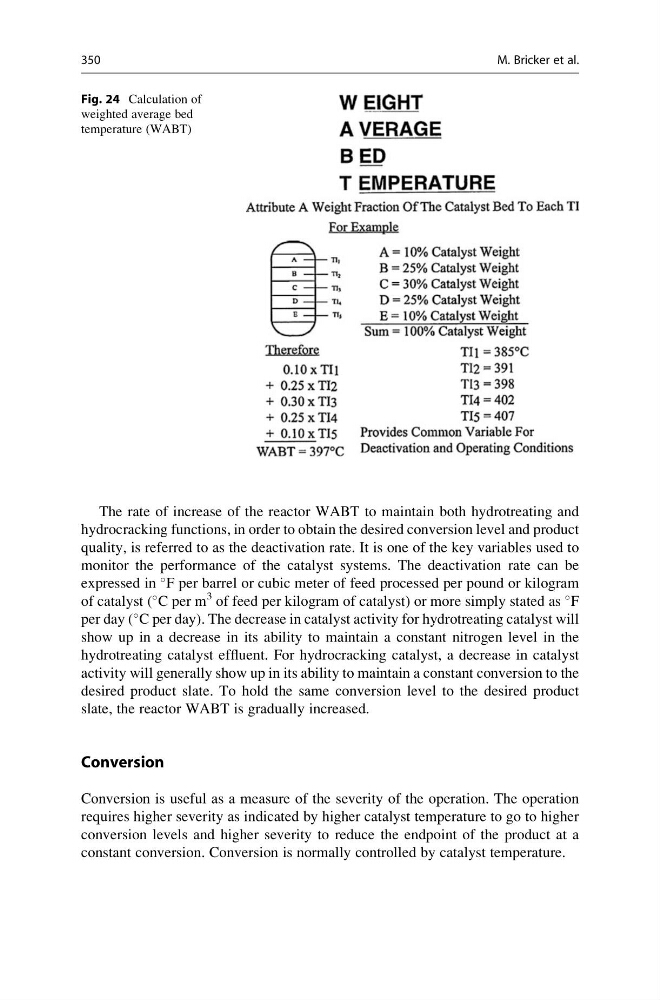
The rate of increase of the reactor WABT to maintain both hydrotreating and
hydrocracking functions, in order to obtain the desired conversion level and product
quality, is referred to as the deactivation rate. It is one of the key variables used to
monitor the performance of the catalyst systems. The deactivation rate can be
expressed in
F per barrel or cubic meter of feed processed per pound or kilogram
of catalyst (
C per m
3 of feed per kilogram of catalyst) or more simply stated as
F
per day (
C per day). The decrease in catalyst activity for hydrotreating catalyst will
show up in a decrease in its ability to maintain a constant nitrogen level in the
hydrotreating catalyst effluent. For hydrocracking catalyst, a decrease in catalyst
activity will generally show up in its ability to maintain a constant conversion to the
desired product slate. To hold the same conversion level to the desired product
slate, the reactor WABT is gradually increased.
Conversion
Conversion is useful as a measure of the severity of the operation. The operation
requires higher severity as indicated by higher catalyst temperature to go to higher
conversion levels and higher severity to reduce the endpoint of the product at a
constant conversion. Conversion is normally controlled by catalyst temperature.
Fig. 24 Calculation of
weighted average bed
temperature (WABT)
350
M. Bricker et al.
hydrocracking functions, in order to obtain the desired conversion level and product
quality, is referred to as the deactivation rate. It is one of the key variables used to
monitor the performance of the catalyst systems. The deactivation rate can be
expressed in
F per barrel or cubic meter of feed processed per pound or kilogram
of catalyst (
C per m
3 of feed per kilogram of catalyst) or more simply stated as
F
per day (
C per day). The decrease in catalyst activity for hydrotreating catalyst will
show up in a decrease in its ability to maintain a constant nitrogen level in the
hydrotreating catalyst effluent. For hydrocracking catalyst, a decrease in catalyst
activity will generally show up in its ability to maintain a constant conversion to the
desired product slate. To hold the same conversion level to the desired product
slate, the reactor WABT is gradually increased.
Conversion
Conversion is useful as a measure of the severity of the operation. The operation
requires higher severity as indicated by higher catalyst temperature to go to higher
conversion levels and higher severity to reduce the endpoint of the product at a
constant conversion. Conversion is normally controlled by catalyst temperature.
Fig. 24 Calculation of
weighted average bed
temperature (WABT)
350
M. Bricker et al.