

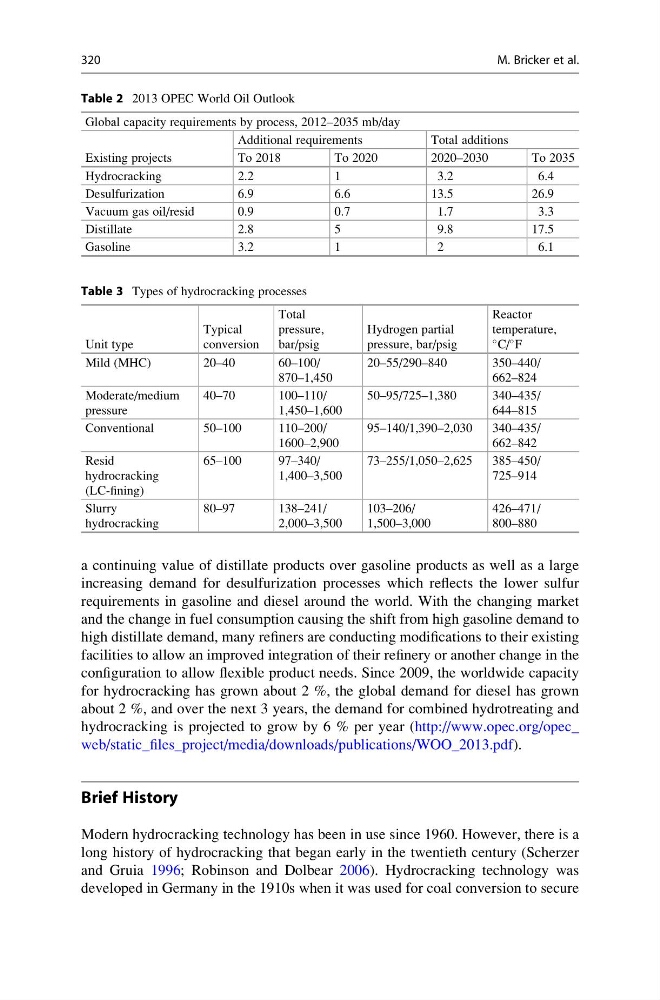
a continuing value of distillate products over gasoline products as well as a large
increasing demand for desulfurization processes which reflects the lower sulfur
requirements in gasoline and diesel around the world. With the changing market
and the change in fuel consumption causing the shift from high gasoline demand to
high distillate demand, many refiners are conducting modifications to their existing
facilities to allow an improved integration of their refinery or another change in the
configuration to allow flexible product needs. Since 2009, the worldwide capacity
for hydrocracking has grown about 2 %, the global demand for diesel has grown
about 2 %, and over the next 3 years, the demand for combined hydrotreating and
hydrocracking is projected to grow by 6 % per year (http://www.opec.org/opec_
web/static_files_project/media/downloads/publications/WOO_2013.pdf).
Brief History
Modern hydrocracking technology has been in use since 1960. However, there is a
long history of hydrocracking that began early in the twentieth century (Scherzer
and Gruia 1996; Robinson and Dolbear 2006). Hydrocracking technology was
developed in Germany in the 1910s when it was used for coal conversion to secure
Table 2 2013 OPEC World Oil Outlook
Global capacity requirements by process, 2012–2035 mb/day
Existing projects
Additional requirements
Total additions
To 2018
To 2020
2020–2030
To 2035
Hydrocracking
2.2
1
3.2
6.4
Desulfurization
6.9
6.6
13.5
26.9
Vacuum gas oil/resid
0.9
0.7
1.7
3.3
Distillate
2.8
5
9.8
17.5
Gasoline
3.2
1
2
6.1
Table 3 Types of hydrocracking processes
Unit type
Typical
conversion
Total
pressure,
bar/psig
Hydrogen partial
pressure, bar/psig
Reactor
temperature,
C/
F
Mild (MHC)
20–40
60–100/
870–1,450
20–55/290–840
350–440/
662–824
Moderate/medium
pressure
40–70
100–110/
1,450–1,600
50–95/725–1,380
340–435/
644–815
Conventional
50–100
110–200/
1600–2,900
95–140/1,390–2,030
340–435/
662–842
Resid
hydrocracking
(LC-fining)
65–100
97–340/
1,400–3,500
73–255/1,050–2,625
385–450/
725–914
Slurry
hydrocracking
80–97
138–241/
2,000–3,500
103–206/
1,500–3,000
426–471/
800–880
320
M. Bricker et al.
increasing demand for desulfurization processes which reflects the lower sulfur
requirements in gasoline and diesel around the world. With the changing market
and the change in fuel consumption causing the shift from high gasoline demand to
high distillate demand, many refiners are conducting modifications to their existing
facilities to allow an improved integration of their refinery or another change in the
configuration to allow flexible product needs. Since 2009, the worldwide capacity
for hydrocracking has grown about 2 %, the global demand for diesel has grown
about 2 %, and over the next 3 years, the demand for combined hydrotreating and
hydrocracking is projected to grow by 6 % per year (http://www.opec.org/opec_
web/static_files_project/media/downloads/publications/WOO_2013.pdf).
Brief History
Modern hydrocracking technology has been in use since 1960. However, there is a
long history of hydrocracking that began early in the twentieth century (Scherzer
and Gruia 1996; Robinson and Dolbear 2006). Hydrocracking technology was
developed in Germany in the 1910s when it was used for coal conversion to secure
Table 2 2013 OPEC World Oil Outlook
Global capacity requirements by process, 2012–2035 mb/day
Existing projects
Additional requirements
Total additions
To 2018
To 2020
2020–2030
To 2035
Hydrocracking
2.2
1
3.2
6.4
Desulfurization
6.9
6.6
13.5
26.9
Vacuum gas oil/resid
0.9
0.7
1.7
3.3
Distillate
2.8
5
9.8
17.5
Gasoline
3.2
1
2
6.1
Table 3 Types of hydrocracking processes
Unit type
Typical
conversion
Total
pressure,
bar/psig
Hydrogen partial
pressure, bar/psig
Reactor
temperature,
C/
F
Mild (MHC)
20–40
60–100/
870–1,450
20–55/290–840
350–440/
662–824
Moderate/medium
pressure
40–70
100–110/
1,450–1,600
50–95/725–1,380
340–435/
644–815
Conventional
50–100
110–200/
1600–2,900
95–140/1,390–2,030
340–435/
662–842
Resid
hydrocracking
(LC-fining)
65–100
97–340/
1,400–3,500
73–255/1,050–2,625
385–450/
725–914
Slurry
hydrocracking
80–97
138–241/
2,000–3,500
103–206/
1,500–3,000
426–471/
800–880
320
M. Bricker et al.