

Hydrodesulfurization HDS • Hydrodenitrogenation HDN • Catalyst manufacture • Cetane number • Smoke point • Cold flow properties
Introduction
Hydrocracking is a flexible catalytic refining process that can upgrade a large
variety of petroleum fractions. Hydrocracking is commonly applied to upgrade
the heavier fractions obtained from the distillation of crude oils, including residue.
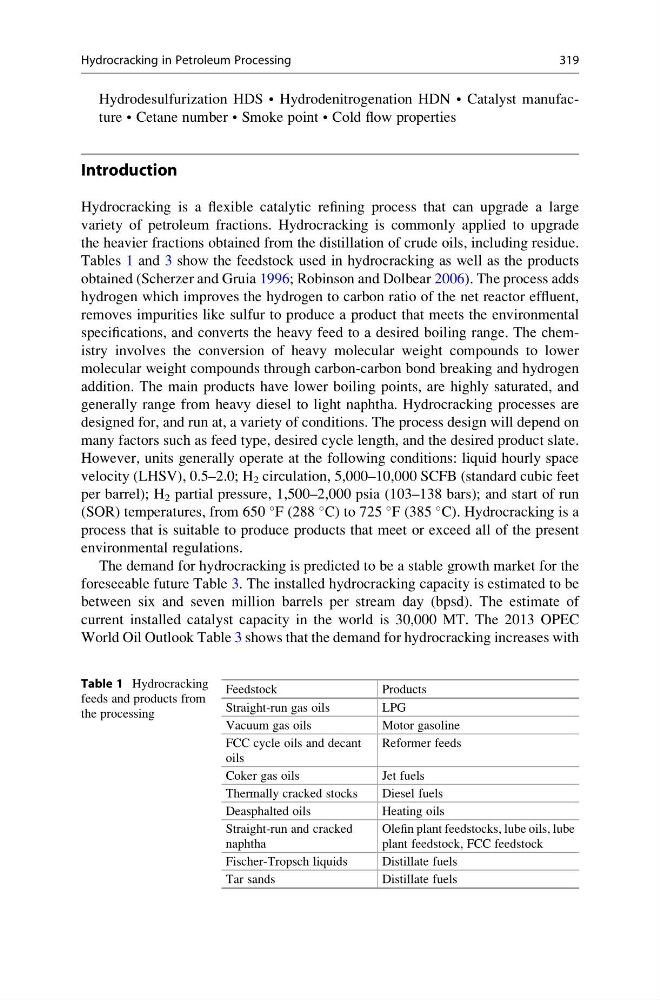
Tables 1 and 3 show the feedstock used in hydrocracking as well as the products
obtained (Scherzer and Gruia 1996; Robinson and Dolbear 2006). The process adds
hydrogen which improves the hydrogen to carbon ratio of the net reactor effluent,
removes impurities like sulfur to produce a product that meets the environmental
specifications, and converts the heavy feed to a desired boiling range. The chemistry involves the conversion of heavy molecular weight compounds to lower
molecular weight compounds through carbon-carbon bond breaking and hydrogen
addition. The main products have lower boiling points, are highly saturated, and
generally range from heavy diesel to light naphtha. Hydrocracking processes are
designed for, and run at, a variety of conditions. The process design will depend on
many factors such as feed type, desired cycle length, and the desired product slate.
However, units generally operate at the following conditions: liquid hourly space
velocity (LHSV), 0.5–2.0; H 2 circulation, 5,000–10,000 SCFB (standard cubic feet
per barrel); H 2 partial pressure, 1,500–2,000 psia (103–138 bars); and start of run
(SOR) temperatures, from 650
F (288
C) to 725
F (385
C). Hydrocracking is a
process that is suitable to produce products that meet or exceed all of the present
environmental regulations.
The demand for hydrocracking is predicted to be a stable growth market for the
foreseeable future Table 3. The installed hydrocracking capacity is estimated to be
between six and seven million barrels per stream day (bpsd). The estimate of
current installed catalyst capacity in the world is 30,000 MT. The 2013 OPEC
World Oil Outlook Table 3 shows that the demand for hydrocracking increases with
Table 1 Hydrocracking
feeds and products from
the processing
Feedstock
Products
Straight-run gas oils
LPG
Vacuum gas oils
Motor gasoline
FCC cycle oils and decant
oils
Reformer feeds
Coker gas oils
Jet fuels
Thermally cracked stocks
Diesel fuels
Deasphalted oils
Heating oils
Straight-run and cracked
naphtha
Olefin plant feedstocks, lube oils, lube
plant feedstock, FCC feedstock
Fischer-Tropsch liquids
Distillate fuels
Tar sands
Distillate fuels
Hydrocracking in Petroleum Processing
319
Introduction
Hydrocracking is a flexible catalytic refining process that can upgrade a large
variety of petroleum fractions. Hydrocracking is commonly applied to upgrade
the heavier fractions obtained from the distillation of crude oils, including residue.
Tables 1 and 3 show the feedstock used in hydrocracking as well as the products
obtained (Scherzer and Gruia 1996; Robinson and Dolbear 2006). The process adds
hydrogen which improves the hydrogen to carbon ratio of the net reactor effluent,
removes impurities like sulfur to produce a product that meets the environmental
specifications, and converts the heavy feed to a desired boiling range. The chemistry involves the conversion of heavy molecular weight compounds to lower
molecular weight compounds through carbon-carbon bond breaking and hydrogen
addition. The main products have lower boiling points, are highly saturated, and
generally range from heavy diesel to light naphtha. Hydrocracking processes are
designed for, and run at, a variety of conditions. The process design will depend on
many factors such as feed type, desired cycle length, and the desired product slate.
However, units generally operate at the following conditions: liquid hourly space
velocity (LHSV), 0.5–2.0; H 2 circulation, 5,000–10,000 SCFB (standard cubic feet
per barrel); H 2 partial pressure, 1,500–2,000 psia (103–138 bars); and start of run
(SOR) temperatures, from 650
F (288
C) to 725
F (385
C). Hydrocracking is a
process that is suitable to produce products that meet or exceed all of the present
environmental regulations.
The demand for hydrocracking is predicted to be a stable growth market for the
foreseeable future Table 3. The installed hydrocracking capacity is estimated to be
between six and seven million barrels per stream day (bpsd). The estimate of
current installed catalyst capacity in the world is 30,000 MT. The 2013 OPEC
World Oil Outlook Table 3 shows that the demand for hydrocracking increases with
Table 1 Hydrocracking
feeds and products from
the processing
Feedstock
Products
Straight-run gas oils
LPG
Vacuum gas oils
Motor gasoline
FCC cycle oils and decant
oils
Reformer feeds
Coker gas oils
Jet fuels
Thermally cracked stocks
Diesel fuels
Deasphalted oils
Heating oils
Straight-run and cracked
naphtha
Olefin plant feedstocks, lube oils, lube
plant feedstock, FCC feedstock
Fischer-Tropsch liquids
Distillate fuels
Tar sands
Distillate fuels
Hydrocracking in Petroleum Processing
319