

cyclones and the stacked reactor-regenerator configuration. A special ZSM-5 additive is used along with the FCC catalyst.
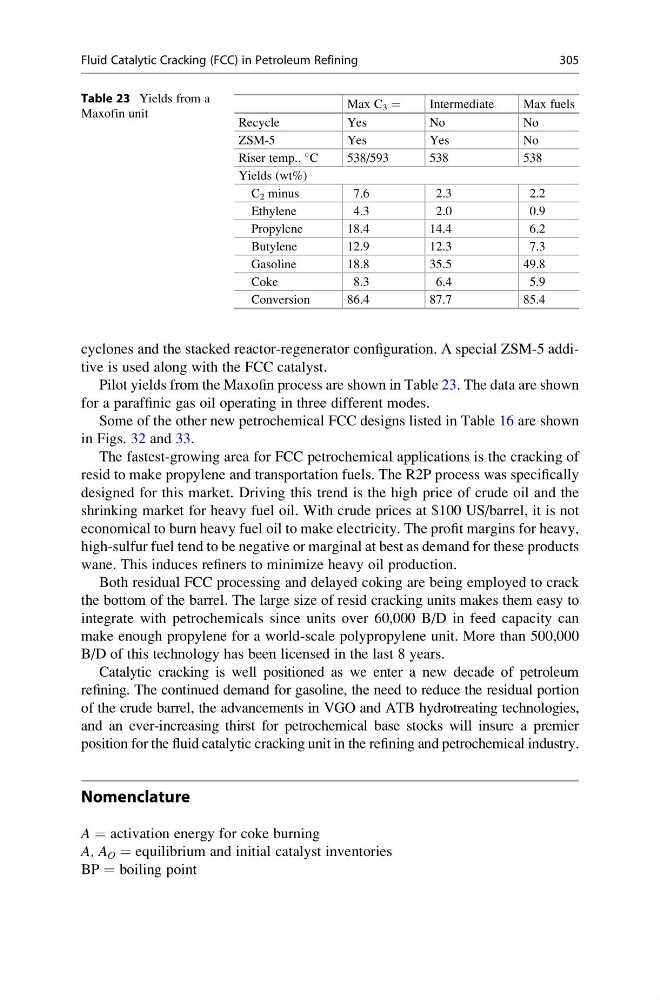
Pilot yields from the Maxofin process are shown in Table 23. The data are shown
for a paraffinic gas oil operating in three different modes.
Some of the other new petrochemical FCC designs listed in Table 16 are shown
in Figs. 32 and 33.
The fastest-growing area for FCC petrochemical applications is the cracking of
resid to make propylene and transportation fuels. The R2P process was specifically
designed for this market. Driving this trend is the high price of crude oil and the
shrinking market for heavy fuel oil. With crude prices at $100 US/barrel, it is not
economical to burn heavy fuel oil to make electricity. The profit margins for heavy,
high-sulfur fuel tend to be negative or marginal at best as demand for these products
wane. This induces refiners to minimize heavy oil production.
Both residual FCC processing and delayed coking are being employed to crack
the bottom of the barrel. The large size of resid cracking units makes them easy to
integrate with petrochemicals since units over 60,000 B/D in feed capacity can
make enough propylene for a world-scale polypropylene unit. More than 500,000
B/D of this technology has been licensed in the last 8 years.
Catalytic cracking is well positioned as we enter a new decade of petroleum
refining. The continued demand for gasoline, the need to reduce the residual portion
of the crude barrel, the advancements in VGO and ATB hydrotreating technologies,
and an ever-increasing thirst for petrochemical base stocks will insure a premier
position for the fluid catalytic cracking unit in the refining and petrochemical industry.
Nomenclature
A = activation energy for coke burning
A, A O = equilibrium and initial catalyst inventories
BP = boiling point
Table 23 Yields from a
Maxofin unit
Max C 3 =
Intermediate
Max fuels
Recycle
Yes
No
No
ZSM-5
Yes
Yes
No
Riser temp.,
C
538/593
538
538
Yields (wt%)
C 2 minus
7.6
2.3
2.2
Ethylene
4.3
2.0
0.9
Propylene
18.4
14.4
6.2
Butylene
12.9
12.3
7.3
Gasoline
18.8
35.5
49.8
Coke
8.3
6.4
5.9
Conversion
86.4
87.7
85.4
Fluid Catalytic Cracking (FCC) in Petroleum Refining
305
Pilot yields from the Maxofin process are shown in Table 23. The data are shown
for a paraffinic gas oil operating in three different modes.
Some of the other new petrochemical FCC designs listed in Table 16 are shown
in Figs. 32 and 33.
The fastest-growing area for FCC petrochemical applications is the cracking of
resid to make propylene and transportation fuels. The R2P process was specifically
designed for this market. Driving this trend is the high price of crude oil and the
shrinking market for heavy fuel oil. With crude prices at $100 US/barrel, it is not
economical to burn heavy fuel oil to make electricity. The profit margins for heavy,
high-sulfur fuel tend to be negative or marginal at best as demand for these products
wane. This induces refiners to minimize heavy oil production.
Both residual FCC processing and delayed coking are being employed to crack
the bottom of the barrel. The large size of resid cracking units makes them easy to
integrate with petrochemicals since units over 60,000 B/D in feed capacity can
make enough propylene for a world-scale polypropylene unit. More than 500,000
B/D of this technology has been licensed in the last 8 years.
Catalytic cracking is well positioned as we enter a new decade of petroleum
refining. The continued demand for gasoline, the need to reduce the residual portion
of the crude barrel, the advancements in VGO and ATB hydrotreating technologies,
and an ever-increasing thirst for petrochemical base stocks will insure a premier
position for the fluid catalytic cracking unit in the refining and petrochemical industry.
Nomenclature
A = activation energy for coke burning
A, A O = equilibrium and initial catalyst inventories
BP = boiling point
Table 23 Yields from a
Maxofin unit
Max C 3 =
Intermediate
Max fuels
Recycle
Yes
No
No
ZSM-5
Yes
Yes
No
Riser temp.,
C
538/593
538
538
Yields (wt%)
C 2 minus
7.6
2.3
2.2
Ethylene
4.3
2.0
0.9
Propylene
18.4
14.4
6.2
Butylene
12.9
12.3
7.3
Gasoline
18.8
35.5
49.8
Coke
8.3
6.4
5.9
Conversion
86.4
87.7
85.4
Fluid Catalytic Cracking (FCC) in Petroleum Refining
305