

End Points
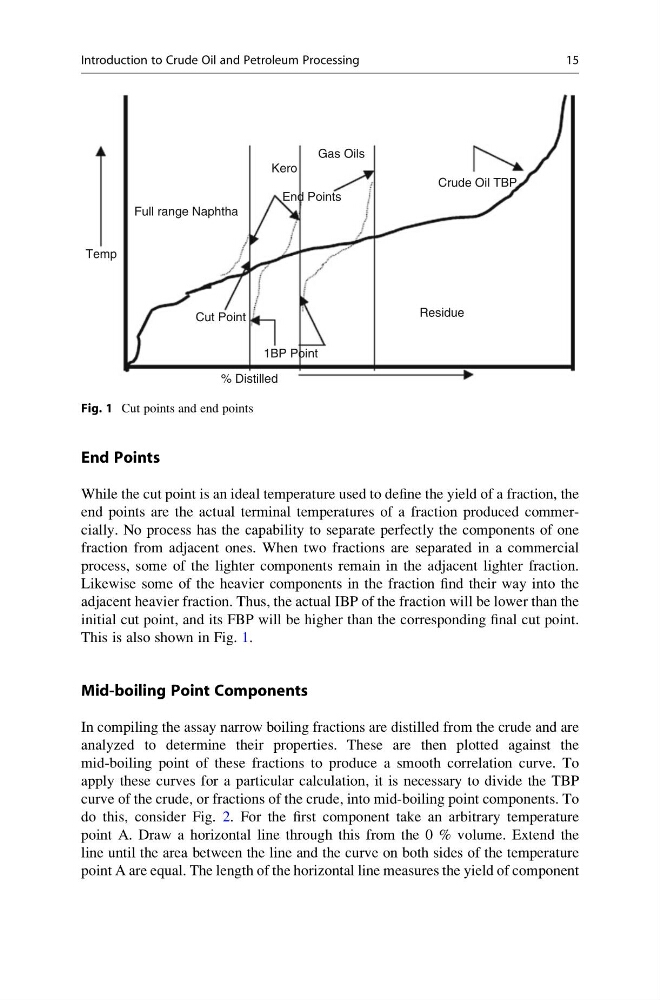
While the cut point is an ideal temperature used to define the yield of a fraction, the
end points are the actual terminal temperatures of a fraction produced commercially. No process has the capability to separate perfectly the components of one
fraction from adjacent ones. When two fractions are separated in a commercial
process, some of the lighter components remain in the adjacent lighter fraction.
Likewise some of the heavier components in the fraction find their way into the
adjacent heavier fraction. Thus, the actual IBP of the fraction will be lower than the
initial cut point, and its FBP will be higher than the corresponding final cut point.
This is also shown in Fig. 1.
Mid-boiling Point Components
In compiling the assay narrow boiling fractions are distilled from the crude and are
analyzed to determine their properties. These are then plotted against the
mid-boiling point of these fractions to produce a smooth correlation curve. To
apply these curves for a particular calculation, it is necessary to divide the TBP
curve of the crude, or fractions of the crude, into mid-boiling point components. To
do this, consider Fig. 2. For the first component take an arbitrary temperature
point A. Draw a horizontal line through this from the 0 % volume. Extend the
line until the area between the line and the curve on both sides of the temperature
point A are equal. The length of the horizontal line measures the yield of component
Full range Naphtha
Kero
Gas Oils
End Points
Cut Point
1BP Point
Residue
Crude Oil TBP
% Distilled
Temp
Fig. 1 Cut points and end points
Introduction to Crude Oil and Petroleum Processing
15
While the cut point is an ideal temperature used to define the yield of a fraction, the
end points are the actual terminal temperatures of a fraction produced commercially. No process has the capability to separate perfectly the components of one
fraction from adjacent ones. When two fractions are separated in a commercial
process, some of the lighter components remain in the adjacent lighter fraction.
Likewise some of the heavier components in the fraction find their way into the
adjacent heavier fraction. Thus, the actual IBP of the fraction will be lower than the
initial cut point, and its FBP will be higher than the corresponding final cut point.
This is also shown in Fig. 1.
Mid-boiling Point Components
In compiling the assay narrow boiling fractions are distilled from the crude and are
analyzed to determine their properties. These are then plotted against the
mid-boiling point of these fractions to produce a smooth correlation curve. To
apply these curves for a particular calculation, it is necessary to divide the TBP
curve of the crude, or fractions of the crude, into mid-boiling point components. To
do this, consider Fig. 2. For the first component take an arbitrary temperature
point A. Draw a horizontal line through this from the 0 % volume. Extend the
line until the area between the line and the curve on both sides of the temperature
point A are equal. The length of the horizontal line measures the yield of component
Full range Naphtha
Kero
Gas Oils
End Points
Cut Point
1BP Point
Residue
Crude Oil TBP
% Distilled
Temp
Fig. 1 Cut points and end points
Introduction to Crude Oil and Petroleum Processing
15