

Without all these characteristics, the zeolite will not stand up to the high
temperatures in the regenerator or let in large molecules so that the interior of the
crystal can be utilized. Rapid coking is mitigated by the three-dimensional structure. The acidity or activity of the zeolite is associated with the hydroxyl groups
attached to the aluminum atoms in the crystal structure.
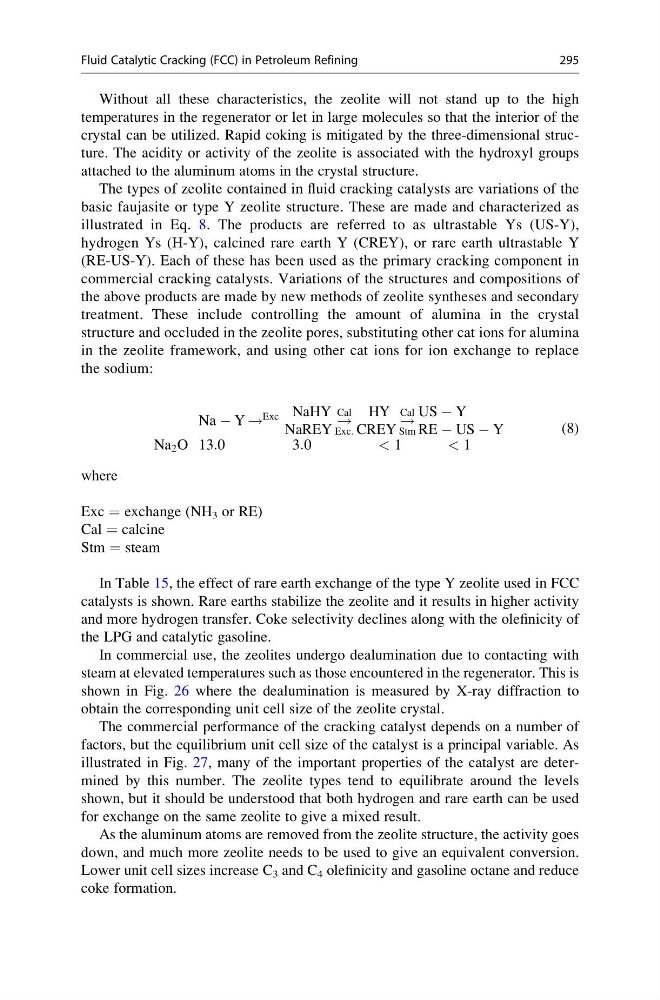
The types of zeolite contained in fluid cracking catalysts are variations of the
basic faujasite or type Y zeolite structure. These are made and characterized as
illustrated in Eq. 8. The products are referred to as ultrastable Ys (US-Y),
hydrogen Ys (H-Y), calcined rare earth Y (CREY), or rare earth ultrastable Y
(RE-US-Y). Each of these has been used as the primary cracking component in
commercial cracking catalysts. Variations of the structures and compositions of
the above products are made by new methods of zeolite syntheses and secondary
treatment. These include controlling the amount of alumina in the crystal
structure and occluded in the zeolite pores, substituting other cat ions for alumina
in the zeolite framework, and using other cat ions for ion exchange to replace
the sodium:
Na À Y !
Exc NaHY
NaREY
!
Cal
Exc:
HY
CREY
!
Cal
Stm
US À Y
RE À US À Y
Na 2 O 13:0
3 :0
< 1
< 1
(8)
where
Exc = exchange (NH 3 or RE)
Cal = calcine
Stm = steam
In Table 15, the effect of rare earth exchange of the type Y zeolite used in FCC
catalysts is shown. Rare earths stabilize the zeolite and it results in higher activity
and more hydrogen transfer. Coke selectivity declines along with the olefinicity of
the LPG and catalytic gasoline.
In commercial use, the zeolites undergo dealumination due to contacting with
steam at elevated temperatures such as those encountered in the regenerator. This is
shown in Fig. 26 where the dealumination is measured by X-ray diffraction to
obtain the corresponding unit cell size of the zeolite crystal.
The commercial performance of the cracking catalyst depends on a number of
factors, but the equilibrium unit cell size of the catalyst is a principal variable. As
illustrated in Fig. 27, many of the important properties of the catalyst are determined by this number. The zeolite types tend to equilibrate around the levels
shown, but it should be understood that both hydrogen and rare earth can be used
for exchange on the same zeolite to give a mixed result.
As the aluminum atoms are removed from the zeolite structure, the activity goes
down, and much more zeolite needs to be used to give an equivalent conversion.
Lower unit cell sizes increase C 3 and C 4 olefinicity and gasoline octane and reduce
coke formation.
Fluid Catalytic Cracking (FCC) in Petroleum Refining
295
temperatures in the regenerator or let in large molecules so that the interior of the
crystal can be utilized. Rapid coking is mitigated by the three-dimensional structure. The acidity or activity of the zeolite is associated with the hydroxyl groups
attached to the aluminum atoms in the crystal structure.
The types of zeolite contained in fluid cracking catalysts are variations of the
basic faujasite or type Y zeolite structure. These are made and characterized as
illustrated in Eq. 8. The products are referred to as ultrastable Ys (US-Y),
hydrogen Ys (H-Y), calcined rare earth Y (CREY), or rare earth ultrastable Y
(RE-US-Y). Each of these has been used as the primary cracking component in
commercial cracking catalysts. Variations of the structures and compositions of
the above products are made by new methods of zeolite syntheses and secondary
treatment. These include controlling the amount of alumina in the crystal
structure and occluded in the zeolite pores, substituting other cat ions for alumina
in the zeolite framework, and using other cat ions for ion exchange to replace
the sodium:
Na À Y !
Exc NaHY
NaREY
!
Cal
Exc:
HY
CREY
!
Cal
Stm
US À Y
RE À US À Y
Na 2 O 13:0
3 :0
< 1
< 1
(8)
where
Exc = exchange (NH 3 or RE)
Cal = calcine
Stm = steam
In Table 15, the effect of rare earth exchange of the type Y zeolite used in FCC
catalysts is shown. Rare earths stabilize the zeolite and it results in higher activity
and more hydrogen transfer. Coke selectivity declines along with the olefinicity of
the LPG and catalytic gasoline.
In commercial use, the zeolites undergo dealumination due to contacting with
steam at elevated temperatures such as those encountered in the regenerator. This is
shown in Fig. 26 where the dealumination is measured by X-ray diffraction to
obtain the corresponding unit cell size of the zeolite crystal.
The commercial performance of the cracking catalyst depends on a number of
factors, but the equilibrium unit cell size of the catalyst is a principal variable. As
illustrated in Fig. 27, many of the important properties of the catalyst are determined by this number. The zeolite types tend to equilibrate around the levels
shown, but it should be understood that both hydrogen and rare earth can be used
for exchange on the same zeolite to give a mixed result.
As the aluminum atoms are removed from the zeolite structure, the activity goes
down, and much more zeolite needs to be used to give an equivalent conversion.
Lower unit cell sizes increase C 3 and C 4 olefinicity and gasoline octane and reduce
coke formation.
Fluid Catalytic Cracking (FCC) in Petroleum Refining
295