

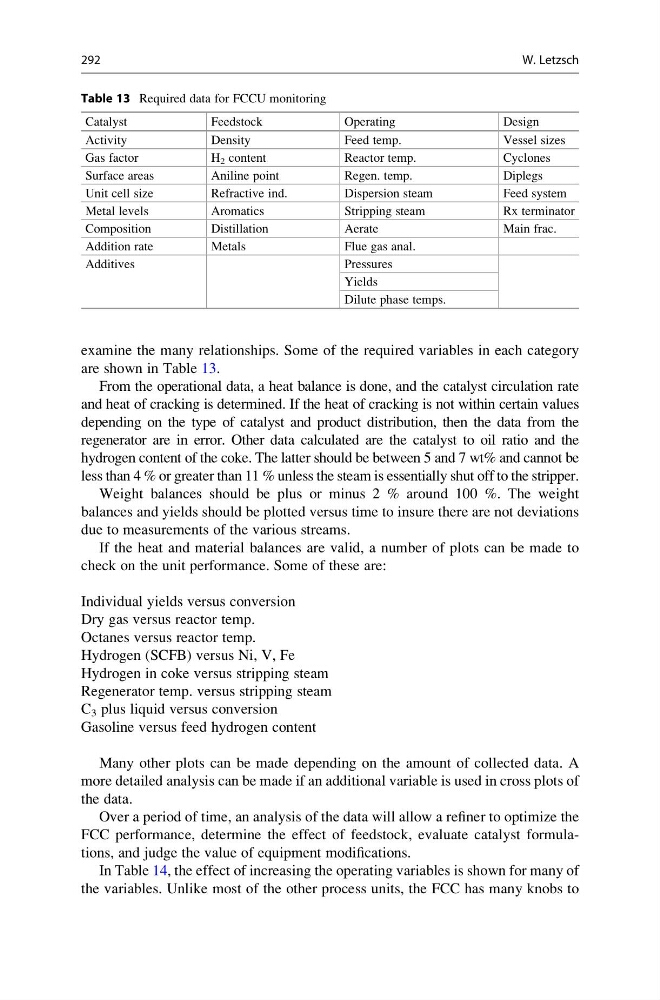
examine the many relationships. Some of the required variables in each category
are shown in Table 13.
From the operational data, a heat balance is done, and the catalyst circulation rate
and heat of cracking is determined. If the heat of cracking is not within certain values
depending on the type of catalyst and product distribution, then the data from the
regenerator are in error. Other data calculated are the catalyst to oil ratio and the
hydrogen content of the coke. The latter should be between 5 and 7 wt% and cannot be
less than 4 % or greater than 11 % unless the steam is essentially shut off to the stripper.
Weight balances should be plus or minus 2 % around 100 %. The weight
balances and yields should be plotted versus time to insure there are not deviations
due to measurements of the various streams.
If the heat and material balances are valid, a number of plots can be made to
check on the unit performance. Some of these are:
Individual yields versus conversion
Dry gas versus reactor temp.
Octanes versus reactor temp.
Hydrogen (SCFB) versus Ni, V, Fe
Hydrogen in coke versus stripping steam
Regenerator temp. versus stripping steam
C 3 plus liquid versus conversion
Gasoline versus feed hydrogen content
Many other plots can be made depending on the amount of collected data. A
more detailed analysis can be made if an additional variable is used in cross plots of
the data.
Over a period of time, an analysis of the data will allow a refiner to optimize the
FCC performance, determine the effect of feedstock, evaluate catalyst formulations, and judge the value of equipment modifications.
In Table 14, the effect of increasing the operating variables is shown for many of
the variables. Unlike most of the other process units, the FCC has many knobs to
Table 13 Required data for FCCU monitoring
Catalyst
Feedstock
Operating
Design
Activity
Density
Feed temp.
Vessel sizes
Gas factor
H 2 content
Reactor temp.
Cyclones
Surface areas
Aniline point
Regen. temp.
Diplegs
Unit cell size
Refractive ind.
Dispersion steam
Feed system
Metal levels
Aromatics
Stripping steam
Rx terminator
Composition
Distillation
Aerate
Main frac.
Addition rate
Metals
Flue gas anal.
Additives
Pressures
Yields
Dilute phase temps.
292
W. Letzsch
are shown in Table 13.
From the operational data, a heat balance is done, and the catalyst circulation rate
and heat of cracking is determined. If the heat of cracking is not within certain values
depending on the type of catalyst and product distribution, then the data from the
regenerator are in error. Other data calculated are the catalyst to oil ratio and the
hydrogen content of the coke. The latter should be between 5 and 7 wt% and cannot be
less than 4 % or greater than 11 % unless the steam is essentially shut off to the stripper.
Weight balances should be plus or minus 2 % around 100 %. The weight
balances and yields should be plotted versus time to insure there are not deviations
due to measurements of the various streams.
If the heat and material balances are valid, a number of plots can be made to
check on the unit performance. Some of these are:
Individual yields versus conversion
Dry gas versus reactor temp.
Octanes versus reactor temp.
Hydrogen (SCFB) versus Ni, V, Fe
Hydrogen in coke versus stripping steam
Regenerator temp. versus stripping steam
C 3 plus liquid versus conversion
Gasoline versus feed hydrogen content
Many other plots can be made depending on the amount of collected data. A
more detailed analysis can be made if an additional variable is used in cross plots of
the data.
Over a period of time, an analysis of the data will allow a refiner to optimize the
FCC performance, determine the effect of feedstock, evaluate catalyst formulations, and judge the value of equipment modifications.
In Table 14, the effect of increasing the operating variables is shown for many of
the variables. Unlike most of the other process units, the FCC has many knobs to
Table 13 Required data for FCCU monitoring
Catalyst
Feedstock
Operating
Design
Activity
Density
Feed temp.
Vessel sizes
Gas factor
H 2 content
Reactor temp.
Cyclones
Surface areas
Aniline point
Regen. temp.
Diplegs
Unit cell size
Refractive ind.
Dispersion steam
Feed system
Metal levels
Aromatics
Stripping steam
Rx terminator
Composition
Distillation
Aerate
Main frac.
Addition rate
Metals
Flue gas anal.
Additives
Pressures
Yields
Dilute phase temps.
292
W. Letzsch