

Slide valves have gone to cold-wall construction and some designs feature a
boltless configuration. Much work has been done to reduce the areas of concern
through redesign using finite element analysis. The gas purges have been improved
and have made valve failures during the scheduled run unusual.
Refractory has been improved over the years. Dual refractories have been
supplemented by monolithic materials that have both insulating properties and
abrasion resistance. Better quality control and installation techniques such as
vibracast play a vital role in the improvements in performance. Proper curing is
essential to trouble-free operation. Much care has to be given to repair methods to
avoid premature failures.
Cyclones can run 5 years if they are installed properly, have a proven hanger
system, and are run near their design conditions. Regenerator superficial velocities
need to be controlled to limit the catalyst loading. Velocities of 3.5 ft/s or higher
result in entrainment rates of catalyst to the regenerator cyclones that approach or
exceed the rate of catalyst circulation between the reactor and regenerator.
Other factors leading to long run lengths include better equipment designs,
improved equipment inspections, better instrumentation, and continuous monitoring of all the unit’s components. Smart equipment includes all of the large rotating
units as well as pumps. More extensive measurement of temperatures and pressures
can identify fouling and allow actions to be taken before a critical failure. Spares
can be included in the design to further insure plant reliability.
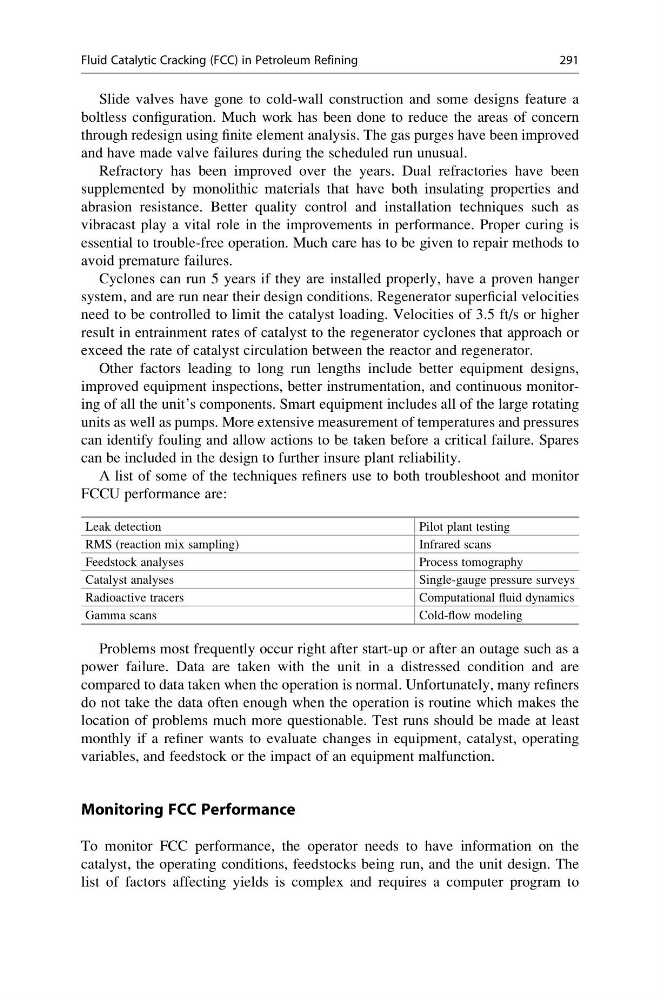
A list of some of the techniques refiners use to both troubleshoot and monitor
FCCU performance are:
Leak detection
Pilot plant testing
RMS (reaction mix sampling)
Infrared scans
Feedstock analyses
Process tomography
Catalyst analyses
Single-gauge pressure surveys
Radioactive tracers
Computational fluid dynamics
Gamma scans
Cold-flow modeling
Problems most frequently occur right after start-up or after an outage such as a
power failure. Data are taken with the unit in a distressed condition and are
compared to data taken when the operation is normal. Unfortunately, many refiners
do not take the data often enough when the operation is routine which makes the
location of problems much more questionable. Test runs should be made at least
monthly if a refiner wants to evaluate changes in equipment, catalyst, operating
variables, and feedstock or the impact of an equipment malfunction.
Monitoring FCC Performance
To monitor FCC performance, the operator needs to have information on the
catalyst, the operating conditions, feedstocks being run, and the unit design. The
list of factors affecting yields is complex and requires a computer program to
Fluid Catalytic Cracking (FCC) in Petroleum Refining
291
boltless configuration. Much work has been done to reduce the areas of concern
through redesign using finite element analysis. The gas purges have been improved
and have made valve failures during the scheduled run unusual.
Refractory has been improved over the years. Dual refractories have been
supplemented by monolithic materials that have both insulating properties and
abrasion resistance. Better quality control and installation techniques such as
vibracast play a vital role in the improvements in performance. Proper curing is
essential to trouble-free operation. Much care has to be given to repair methods to
avoid premature failures.
Cyclones can run 5 years if they are installed properly, have a proven hanger
system, and are run near their design conditions. Regenerator superficial velocities
need to be controlled to limit the catalyst loading. Velocities of 3.5 ft/s or higher
result in entrainment rates of catalyst to the regenerator cyclones that approach or
exceed the rate of catalyst circulation between the reactor and regenerator.
Other factors leading to long run lengths include better equipment designs,
improved equipment inspections, better instrumentation, and continuous monitoring of all the unit’s components. Smart equipment includes all of the large rotating
units as well as pumps. More extensive measurement of temperatures and pressures
can identify fouling and allow actions to be taken before a critical failure. Spares
can be included in the design to further insure plant reliability.
A list of some of the techniques refiners use to both troubleshoot and monitor
FCCU performance are:
Leak detection
Pilot plant testing
RMS (reaction mix sampling)
Infrared scans
Feedstock analyses
Process tomography
Catalyst analyses
Single-gauge pressure surveys
Radioactive tracers
Computational fluid dynamics
Gamma scans
Cold-flow modeling
Problems most frequently occur right after start-up or after an outage such as a
power failure. Data are taken with the unit in a distressed condition and are
compared to data taken when the operation is normal. Unfortunately, many refiners
do not take the data often enough when the operation is routine which makes the
location of problems much more questionable. Test runs should be made at least
monthly if a refiner wants to evaluate changes in equipment, catalyst, operating
variables, and feedstock or the impact of an equipment malfunction.
Monitoring FCC Performance
To monitor FCC performance, the operator needs to have information on the
catalyst, the operating conditions, feedstocks being run, and the unit design. The
list of factors affecting yields is complex and requires a computer program to
Fluid Catalytic Cracking (FCC) in Petroleum Refining
291