

regeneration air goes through the top regenerator and a CO boiler to reduce the CO
content of the flue gas to permitted levels.
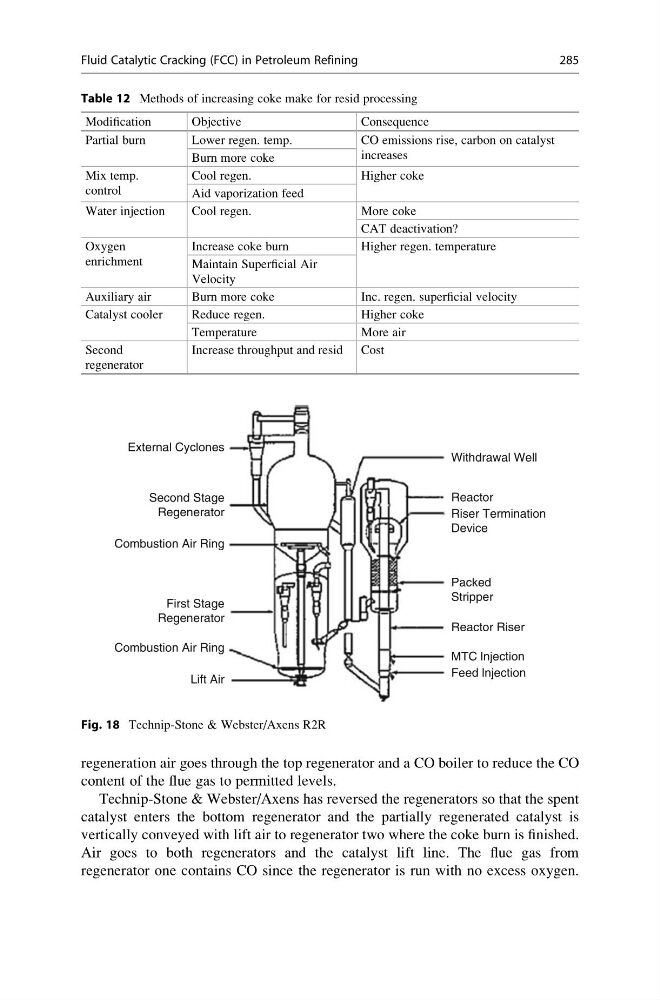
Technip-Stone & Webster/Axens has reversed the regenerators so that the spent
catalyst enters the bottom regenerator and the partially regenerated catalyst is
vertically conveyed with lift air to regenerator two where the coke burn is finished.
Air goes to both regenerators and the catalyst lift line. The flue gas from
regenerator one contains CO since the regenerator is run with no excess oxygen.
Table 12 Methods of increasing coke make for resid processing
Modification
Objective
Consequence
Partial burn
Lower regen. temp.
CO emissions rise, carbon on catalyst
increases
Burn more coke
Mix temp.
control
Cool regen.
Higher coke
Aid vaporization feed
Water injection
Cool regen.
More coke
CAT deactivation?
Oxygen
enrichment
Increase coke burn
Higher regen. temperature
Maintain Superficial Air
Velocity
Auxiliary air
Burn more coke
Inc. regen. superficial velocity
Catalyst cooler
Reduce regen.
Higher coke
Temperature
More air
Second
regenerator
Increase throughput and resid Cost
External Cyclones
Second Stage
Regenerator
Combustion Air Ring
First Stage
Regenerator
Combustion Air Ring
Lift Air
Withdrawal Well
Reactor
Riser Termination
Device
Packed
Stripper
Reactor Riser
MTC lnjection
Feed lnjection
Fig. 18 Technip-Stone & Webster/Axens R2R
Fluid Catalytic Cracking (FCC) in Petroleum Refining
285
content of the flue gas to permitted levels.
Technip-Stone & Webster/Axens has reversed the regenerators so that the spent
catalyst enters the bottom regenerator and the partially regenerated catalyst is
vertically conveyed with lift air to regenerator two where the coke burn is finished.
Air goes to both regenerators and the catalyst lift line. The flue gas from
regenerator one contains CO since the regenerator is run with no excess oxygen.
Table 12 Methods of increasing coke make for resid processing
Modification
Objective
Consequence
Partial burn
Lower regen. temp.
CO emissions rise, carbon on catalyst
increases
Burn more coke
Mix temp.
control
Cool regen.
Higher coke
Aid vaporization feed
Water injection
Cool regen.
More coke
CAT deactivation?
Oxygen
enrichment
Increase coke burn
Higher regen. temperature
Maintain Superficial Air
Velocity
Auxiliary air
Burn more coke
Inc. regen. superficial velocity
Catalyst cooler
Reduce regen.
Higher coke
Temperature
More air
Second
regenerator
Increase throughput and resid Cost
External Cyclones
Second Stage
Regenerator
Combustion Air Ring
First Stage
Regenerator
Combustion Air Ring
Lift Air
Withdrawal Well
Reactor
Riser Termination
Device
Packed
Stripper
Reactor Riser
MTC lnjection
Feed lnjection
Fig. 18 Technip-Stone & Webster/Axens R2R
Fluid Catalytic Cracking (FCC) in Petroleum Refining
285