

catalyst inventory are illustrated in Table 10 for a 50,000 B/D unit that circulates
between 30 and 40 t/min of catalyst.
Shorter contact times and smaller catalyst inventories limit operable regeneration conditions and need higher internal catalyst recycle rates for increased throughput or coke burn. Since a catalyst is frequently added on a pound per barrel basis,
each of these units would use about 5 t/day of fresh catalyst. Equation 5 relates the
catalyst activity to S, the daily fractional replacement rate or age of the catalyst:
A ¼
A O S
K D þ S
:
(5)
This equation implies that the smaller inventory would give the highest equilibrium
or unit activity. However, K is also a function of the contacting between the spent
1200
1250
Regeneration Temp. °F
Catalyst Residence Time, Seconds
1300
Plug Flow
Bubbling
Bed
1350
1150
10
30
50
70
100
300
500
700
1000
Carbon 0.85
Constant Pressure & XS Oxygen
0.05 wt%
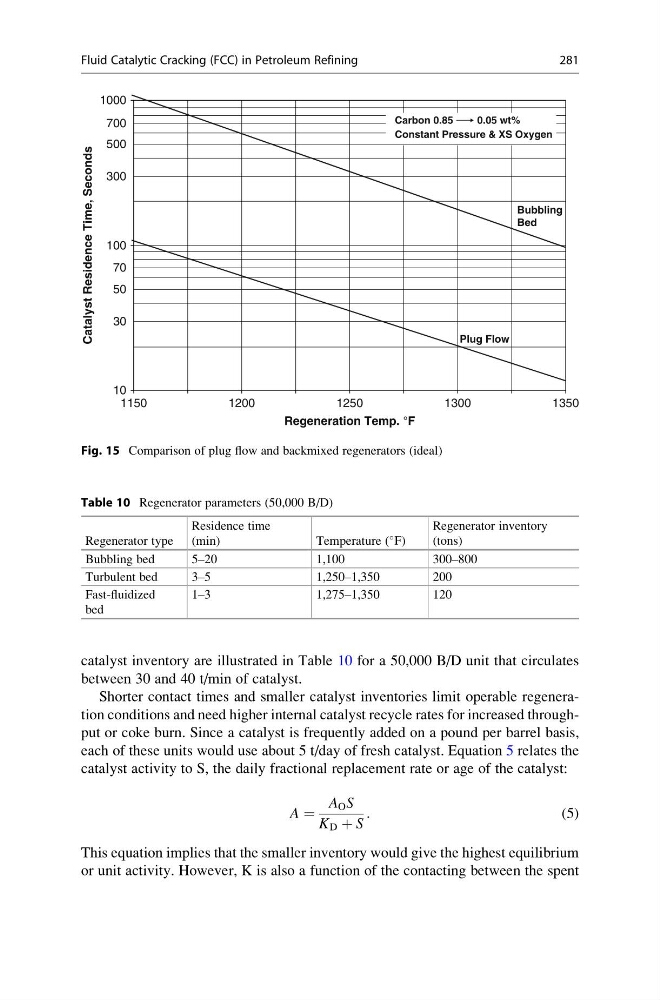
Fig. 15 Comparison of plug flow and backmixed regenerators (ideal)
Table 10 Regenerator parameters (50,000 B/D)
Regenerator type
Residence time
(min)
Temperature (
F)
Regenerator inventory
(tons)
Bubbling bed
5–20
1,100
300–800
Turbulent bed
3–5
1,250–1,350
200
Fast-fluidized
bed
1–3
1,275–1,350
120
Fluid Catalytic Cracking (FCC) in Petroleum Refining
281
between 30 and 40 t/min of catalyst.
Shorter contact times and smaller catalyst inventories limit operable regeneration conditions and need higher internal catalyst recycle rates for increased throughput or coke burn. Since a catalyst is frequently added on a pound per barrel basis,
each of these units would use about 5 t/day of fresh catalyst. Equation 5 relates the
catalyst activity to S, the daily fractional replacement rate or age of the catalyst:
A ¼
A O S
K D þ S
:
(5)
This equation implies that the smaller inventory would give the highest equilibrium
or unit activity. However, K is also a function of the contacting between the spent
1200
1250
Regeneration Temp. °F
Catalyst Residence Time, Seconds
1300
Plug Flow
Bubbling
Bed
1350
1150
10
30
50
70
100
300
500
700
1000
Carbon 0.85
Constant Pressure & XS Oxygen
0.05 wt%
Fig. 15 Comparison of plug flow and backmixed regenerators (ideal)
Table 10 Regenerator parameters (50,000 B/D)
Regenerator type
Residence time
(min)
Temperature (
F)
Regenerator inventory
(tons)
Bubbling bed
5–20
1,100
300–800
Turbulent bed
3–5
1,250–1,350
200
Fast-fluidized
bed
1–3
1,275–1,350
120
Fluid Catalytic Cracking (FCC) in Petroleum Refining
281