

Before describing in detail the determination of pseudo components and their
application in the prediction of the properties of crude oil fractions, it is necessary to
define some of the terms used in the crude oil analysis. These are as follows:
Bubble Point
Bubble point is the temperature and pressure at which a hydrocarbon begins to boil.
An example of bubble point calculation for a stream is provided here as an example.
The bubble point can also be calculated using process simulation software
(HYSYS, Pro/II, or other programs) with selection of appropriate thermodynamic/equilibrium systems. Understanding the manual calculation approach is
useful in interpreting and evaluating the computer calculation results.
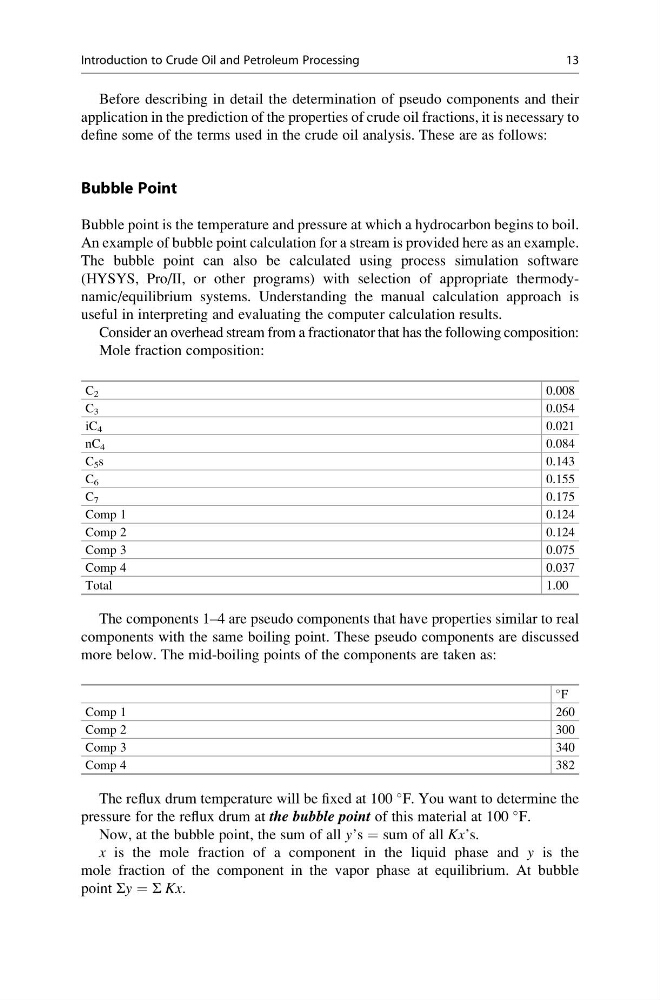
Consider an overhead stream from a fractionator that has the following composition:
Mole fraction composition:
C 2
0.008
C 3
0.054
iC 4
0.021
nC 4
0.084
C 5 s
0.143
C 6
0.155
C 7
0.175
Comp 1
0.124
Comp 2
0.124
Comp 3
0.075
Comp 4
0.037
Total
1.00
The components 1–4 are pseudo components that have properties similar to real
components with the same boiling point. These pseudo components are discussed
more below. The mid-boiling points of the components are taken as:
F
Comp 1
260
Comp 2
300
Comp 3
340
Comp 4
382
The reflux drum temperature will be fixed at 100
F. You want to determine the
pressure for the reflux drum at the bubble point of this material at 100
F.
Now, at the bubble point, the sum of all y’s = sum of all Kx’s.
x is the mole fraction of a component in the liquid phase and y is the
mole fraction of the component in the vapor phase at equilibrium. At bubble
point Σy = Σ Kx.
Introduction to Crude Oil and Petroleum Processing
13
application in the prediction of the properties of crude oil fractions, it is necessary to
define some of the terms used in the crude oil analysis. These are as follows:
Bubble Point
Bubble point is the temperature and pressure at which a hydrocarbon begins to boil.
An example of bubble point calculation for a stream is provided here as an example.
The bubble point can also be calculated using process simulation software
(HYSYS, Pro/II, or other programs) with selection of appropriate thermodynamic/equilibrium systems. Understanding the manual calculation approach is
useful in interpreting and evaluating the computer calculation results.
Consider an overhead stream from a fractionator that has the following composition:
Mole fraction composition:
C 2
0.008
C 3
0.054
iC 4
0.021
nC 4
0.084
C 5 s
0.143
C 6
0.155
C 7
0.175
Comp 1
0.124
Comp 2
0.124
Comp 3
0.075
Comp 4
0.037
Total
1.00
The components 1–4 are pseudo components that have properties similar to real
components with the same boiling point. These pseudo components are discussed
more below. The mid-boiling points of the components are taken as:
F
Comp 1
260
Comp 2
300
Comp 3
340
Comp 4
382
The reflux drum temperature will be fixed at 100
F. You want to determine the
pressure for the reflux drum at the bubble point of this material at 100
F.
Now, at the bubble point, the sum of all y’s = sum of all Kx’s.
x is the mole fraction of a component in the liquid phase and y is the
mole fraction of the component in the vapor phase at equilibrium. At bubble
point Σy = Σ Kx.
Introduction to Crude Oil and Petroleum Processing
13