

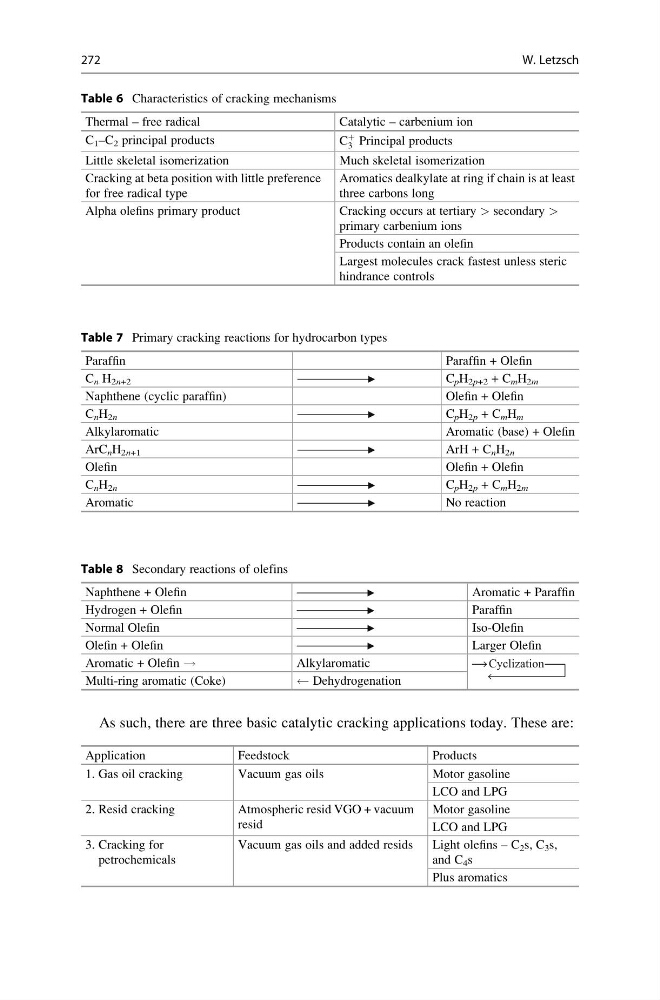
As such, there are three basic catalytic cracking applications today. These are:
Application
Feedstock
Products
1. Gas oil cracking
Vacuum gas oils
Motor gasoline
LCO and LPG
2. Resid cracking
Atmospheric resid VGO + vacuum
resid
Motor gasoline
LCO and LPG
3. Cracking for
petrochemicals
Vacuum gas oils and added resids
Light olefins – C 2 s, C 3 s,
and C 4 s
Plus aromatics
Table 6 Characteristics of cracking mechanisms
Thermal – free radical
Catalytic – carbenium ion
C 1 –C 2 principal products
C
þ
3 Principal products
Little skeletal isomerization
Much skeletal isomerization
Cracking at beta position with little preference
for free radical type
Aromatics dealkylate at ring if chain is at least
three carbons long
Alpha olefins primary product
Cracking occurs at tertiary > secondary >
primary carbenium ions
Products contain an olefin
Largest molecules crack fastest unless steric
hindrance controls
Table 7 Primary cracking reactions for hydrocarbon types
Paraffin
Paraffin + Olefin
C n H 2n+2
C p H 2p+2 + C m H 2m
Naphthene (cyclic paraffin)
Olefin + Olefin
C n H 2n
C p H 2p + C m H m
Alkylaromatic
Aromatic (base) + Olefin
ArC n H 2n+1
ArH + C n H 2n
Olefin
Olefin + Olefin
C n H 2n
C p H 2p + C m H 2m
Aromatic
No reaction
Table 8 Secondary reactions of olefins
Naphthene + Olefin
Aromatic + Paraffin
Hydrogen + Olefin
Paraffin
Normal Olefin
Iso-Olefin
Olefin + Olefin
Larger Olefin
Aromatic + Olefin !
Alkylaromatic
Cyclization
Multi-ring aromatic (Coke)
Dehydrogenation
272
W. Letzsch
Application
Feedstock
Products
1. Gas oil cracking
Vacuum gas oils
Motor gasoline
LCO and LPG
2. Resid cracking
Atmospheric resid VGO + vacuum
resid
Motor gasoline
LCO and LPG
3. Cracking for
petrochemicals
Vacuum gas oils and added resids
Light olefins – C 2 s, C 3 s,
and C 4 s
Plus aromatics
Table 6 Characteristics of cracking mechanisms
Thermal – free radical
Catalytic – carbenium ion
C 1 –C 2 principal products
C
þ
3 Principal products
Little skeletal isomerization
Much skeletal isomerization
Cracking at beta position with little preference
for free radical type
Aromatics dealkylate at ring if chain is at least
three carbons long
Alpha olefins primary product
Cracking occurs at tertiary > secondary >
primary carbenium ions
Products contain an olefin
Largest molecules crack fastest unless steric
hindrance controls
Table 7 Primary cracking reactions for hydrocarbon types
Paraffin
Paraffin + Olefin
C n H 2n+2
C p H 2p+2 + C m H 2m
Naphthene (cyclic paraffin)
Olefin + Olefin
C n H 2n
C p H 2p + C m H m
Alkylaromatic
Aromatic (base) + Olefin
ArC n H 2n+1
ArH + C n H 2n
Olefin
Olefin + Olefin
C n H 2n
C p H 2p + C m H 2m
Aromatic
No reaction
Table 8 Secondary reactions of olefins
Naphthene + Olefin
Aromatic + Paraffin
Hydrogen + Olefin
Paraffin
Normal Olefin
Iso-Olefin
Olefin + Olefin
Larger Olefin
Aromatic + Olefin !
Alkylaromatic
Cyclization
Multi-ring aromatic (Coke)
Dehydrogenation
272
W. Letzsch