

There have been many advances in the fluid catalytic cracking process. The high
capacities of a cracking unit (typically a third of the crude oil a fuel refinery runs goes
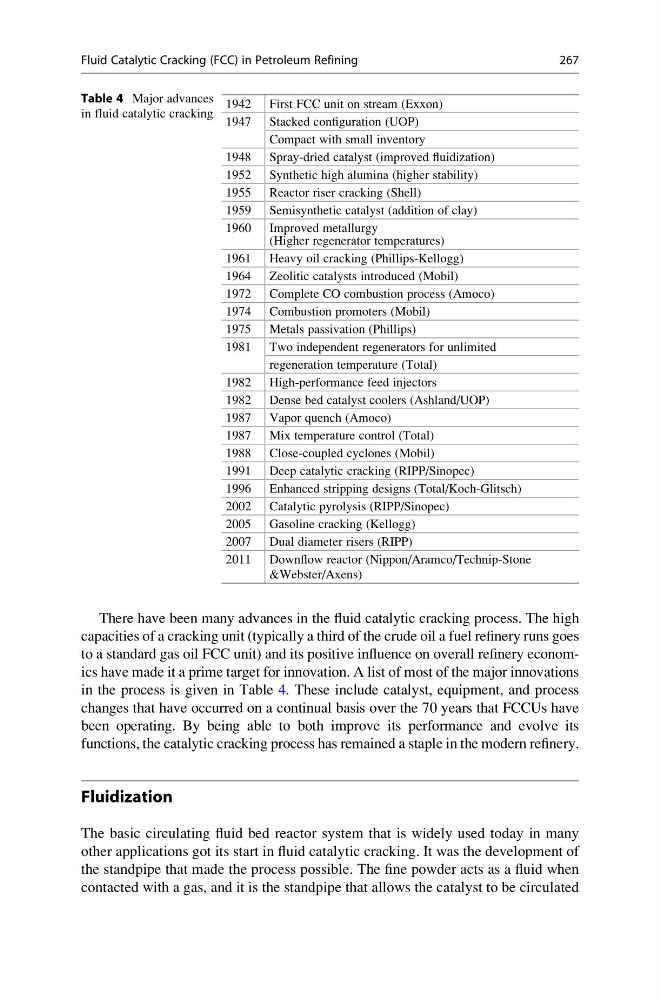
to a standard gas oil FCC unit) and its positive influence on overall refinery economics have made it a prime target for innovation. A list of most of the major innovations
in the process is given in Table 4. These include catalyst, equipment, and process
changes that have occurred on a continual basis over the 70 years that FCCUs have
been operating. By being able to both improve its performance and evolve its
functions, the catalytic cracking process has remained a staple in the modern refinery.
Fluidization
The basic circulating fluid bed reactor system that is widely used today in many
other applications got its start in fluid catalytic cracking. It was the development of
the standpipe that made the process possible. The fine powder acts as a fluid when
contacted with a gas, and it is the standpipe that allows the catalyst to be circulated
Table 4 Major advances
in fluid catalytic cracking
1942 First FCC unit on stream (Exxon)
1947 Stacked configuration (UOP)
Compact with small inventory
1948 Spray-dried catalyst (improved fluidization)
1952 Synthetic high alumina (higher stability)
1955 Reactor riser cracking (Shell)
1959 Semisynthetic catalyst (addition of clay)
1960 Improved metallurgy
(Higher regenerator temperatures)
1961 Heavy oil cracking (Phillips-Kellogg)
1964 Zeolitic catalysts introduced (Mobil)
1972 Complete CO combustion process (Amoco)
1974 Combustion promoters (Mobil)
1975 Metals passivation (Phillips)
1981 Two independent regenerators for unlimited
regeneration temperature (Total)
1982 High-performance feed injectors
1982 Dense bed catalyst coolers (Ashland/UOP)
1987 Vapor quench (Amoco)
1987 Mix temperature control (Total)
1988 Close-coupled cyclones (Mobil)
1991 Deep catalytic cracking (RIPP/Sinopec)
1996 Enhanced stripping designs (Total/Koch-Glitsch)
2002 Catalytic pyrolysis (RIPP/Sinopec)
2005 Gasoline cracking (Kellogg)
2007 Dual diameter risers (RIPP)
2011 Downflow reactor (Nippon/Aramco/Technip-Stone
&Webster/Axens)
Fluid Catalytic Cracking (FCC) in Petroleum Refining
267
capacities of a cracking unit (typically a third of the crude oil a fuel refinery runs goes
to a standard gas oil FCC unit) and its positive influence on overall refinery economics have made it a prime target for innovation. A list of most of the major innovations
in the process is given in Table 4. These include catalyst, equipment, and process
changes that have occurred on a continual basis over the 70 years that FCCUs have
been operating. By being able to both improve its performance and evolve its
functions, the catalytic cracking process has remained a staple in the modern refinery.
Fluidization
The basic circulating fluid bed reactor system that is widely used today in many
other applications got its start in fluid catalytic cracking. It was the development of
the standpipe that made the process possible. The fine powder acts as a fluid when
contacted with a gas, and it is the standpipe that allows the catalyst to be circulated
Table 4 Major advances
in fluid catalytic cracking
1942 First FCC unit on stream (Exxon)
1947 Stacked configuration (UOP)
Compact with small inventory
1948 Spray-dried catalyst (improved fluidization)
1952 Synthetic high alumina (higher stability)
1955 Reactor riser cracking (Shell)
1959 Semisynthetic catalyst (addition of clay)
1960 Improved metallurgy
(Higher regenerator temperatures)
1961 Heavy oil cracking (Phillips-Kellogg)
1964 Zeolitic catalysts introduced (Mobil)
1972 Complete CO combustion process (Amoco)
1974 Combustion promoters (Mobil)
1975 Metals passivation (Phillips)
1981 Two independent regenerators for unlimited
regeneration temperature (Total)
1982 High-performance feed injectors
1982 Dense bed catalyst coolers (Ashland/UOP)
1987 Vapor quench (Amoco)
1987 Mix temperature control (Total)
1988 Close-coupled cyclones (Mobil)
1991 Deep catalytic cracking (RIPP/Sinopec)
1996 Enhanced stripping designs (Total/Koch-Glitsch)
2002 Catalytic pyrolysis (RIPP/Sinopec)
2005 Gasoline cracking (Kellogg)
2007 Dual diameter risers (RIPP)
2011 Downflow reactor (Nippon/Aramco/Technip-Stone
&Webster/Axens)
Fluid Catalytic Cracking (FCC) in Petroleum Refining
267