

Flash Points
The flash point of an oil is the temperature at which the vapor above the oil will
momentarily flash or explode. This temperature is determined by laboratory testing
using an apparatus consisting of a closed cup containing the oil, heating and stirring
equipment, and a special adjustable flame. The type of apparatus used for middle
distillate and fuel oils is called the Pensky-Martens (PM), while the apparatus used
in the case of kerosene and lighter distillates is called the Abel. References to these
tests are given later in this handbook, and full details of the test methods and
procedures are given in ASTM Standards Part 7, Petroleum Products and Lubricants. There are many empirical methods for determining flash points from the
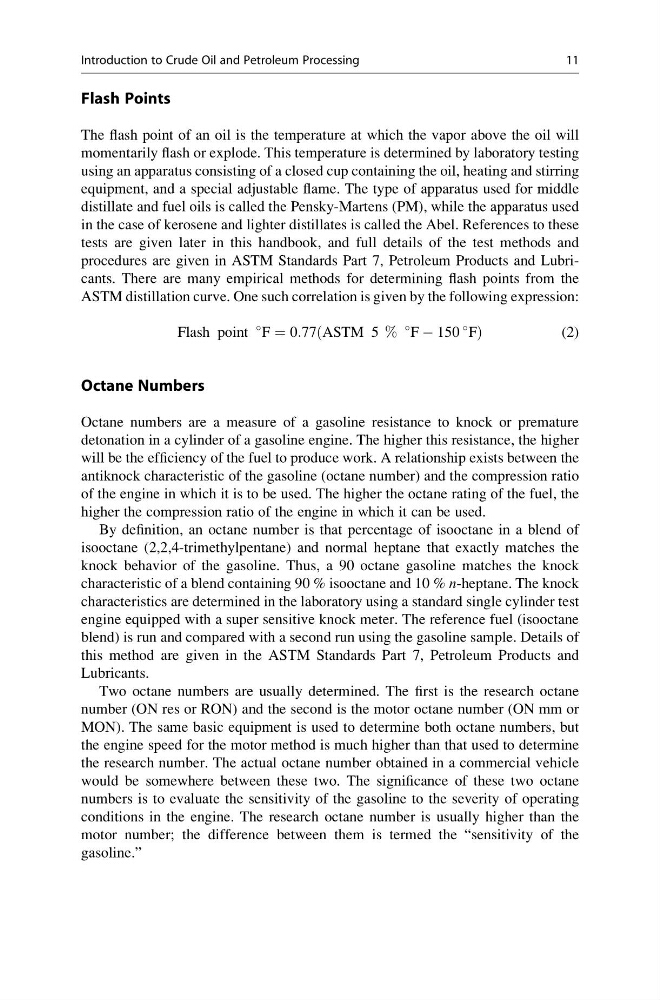
ASTM distillation curve. One such correlation is given by the following expression:
Flash point
F ¼ 0:77 ASTM 5 %
F À 150
F
ð
Þ
(2)
Octane Numbers
Octane numbers are a measure of a gasoline resistance to knock or premature
detonation in a cylinder of a gasoline engine. The higher this resistance, the higher
will be the efficiency of the fuel to produce work. A relationship exists between the
antiknock characteristic of the gasoline (octane number) and the compression ratio
of the engine in which it is to be used. The higher the octane rating of the fuel, the
higher the compression ratio of the engine in which it can be used.
By definition, an octane number is that percentage of isooctane in a blend of
isooctane (2,2,4-trimethylpentane) and normal heptane that exactly matches the
knock behavior of the gasoline. Thus, a 90 octane gasoline matches the knock
characteristic of a blend containing 90 % isooctane and 10 % n-heptane. The knock
characteristics are determined in the laboratory using a standard single cylinder test
engine equipped with a super sensitive knock meter. The reference fuel (isooctane
blend) is run and compared with a second run using the gasoline sample. Details of
this method are given in the ASTM Standards Part 7, Petroleum Products and
Lubricants.
Two octane numbers are usually determined. The first is the research octane
number (ON res or RON) and the second is the motor octane number (ON mm or
MON). The same basic equipment is used to determine both octane numbers, but
the engine speed for the motor method is much higher than that used to determine
the research number. The actual octane number obtained in a commercial vehicle
would be somewhere between these two. The significance of these two octane
numbers is to evaluate the sensitivity of the gasoline to the severity of operating
conditions in the engine. The research octane number is usually higher than the
motor number; the difference between them is termed the “sensitivity of the
gasoline.”
Introduction to Crude Oil and Petroleum Processing
11
The flash point of an oil is the temperature at which the vapor above the oil will
momentarily flash or explode. This temperature is determined by laboratory testing
using an apparatus consisting of a closed cup containing the oil, heating and stirring
equipment, and a special adjustable flame. The type of apparatus used for middle
distillate and fuel oils is called the Pensky-Martens (PM), while the apparatus used
in the case of kerosene and lighter distillates is called the Abel. References to these
tests are given later in this handbook, and full details of the test methods and
procedures are given in ASTM Standards Part 7, Petroleum Products and Lubricants. There are many empirical methods for determining flash points from the
ASTM distillation curve. One such correlation is given by the following expression:
Flash point
F ¼ 0:77 ASTM 5 %
F À 150
F
ð
Þ
(2)
Octane Numbers
Octane numbers are a measure of a gasoline resistance to knock or premature
detonation in a cylinder of a gasoline engine. The higher this resistance, the higher
will be the efficiency of the fuel to produce work. A relationship exists between the
antiknock characteristic of the gasoline (octane number) and the compression ratio
of the engine in which it is to be used. The higher the octane rating of the fuel, the
higher the compression ratio of the engine in which it can be used.
By definition, an octane number is that percentage of isooctane in a blend of
isooctane (2,2,4-trimethylpentane) and normal heptane that exactly matches the
knock behavior of the gasoline. Thus, a 90 octane gasoline matches the knock
characteristic of a blend containing 90 % isooctane and 10 % n-heptane. The knock
characteristics are determined in the laboratory using a standard single cylinder test
engine equipped with a super sensitive knock meter. The reference fuel (isooctane
blend) is run and compared with a second run using the gasoline sample. Details of
this method are given in the ASTM Standards Part 7, Petroleum Products and
Lubricants.
Two octane numbers are usually determined. The first is the research octane
number (ON res or RON) and the second is the motor octane number (ON mm or
MON). The same basic equipment is used to determine both octane numbers, but
the engine speed for the motor method is much higher than that used to determine
the research number. The actual octane number obtained in a commercial vehicle
would be somewhere between these two. The significance of these two octane
numbers is to evaluate the sensitivity of the gasoline to the severity of operating
conditions in the engine. The research octane number is usually higher than the
motor number; the difference between them is termed the “sensitivity of the
gasoline.”
Introduction to Crude Oil and Petroleum Processing
11