

use the assay data in preparing the process design of petroleum plants they are
bidding on or, having been awarded the project, they are now building.
In order to utilize the crude oil assay, it is necessary to understand the data it
provides and the significance of some of the laboratory tests that are used in its
compilation. Some of these are summarized below and are further described and
discussed in other chapters of the handbook.
The True Boiling Point Curve
This is a plot of the boiling points of almost pure components, contained
in the crude oil or fractions of the crude oil. In earlier times this curve was
produced in the laboratory using complex batch distillation apparatus of a hundred or more equilibrium stages and a very high reflux ratio. Nowadays, this curve
is produced by mass spectrometry techniques much quicker and more accurately
than by batch distillation. A typical true boiling point curve (TBP) is shown in
Fig. 10.
The ASTM Distillation Curve
While the TBP curve is not produced, on a routine basis the ASTM distillation
curves are. Rarely, however, is an ASTM curve conducted on the whole crude.
This type of distillation curve is used on a routine basis for plant and product
quality control. This test is carried out on crude oil fractions using a simple
apparatus designed to boil the test liquid and to condense the vapors as they are
produced. Vapor temperatures are noted as the distillation proceeds and are
plotted against the distillate recovered. Because only one equilibrium stage is
used and no reflux is returned, the separation of components is poor. Thus, the
initial boiling point (IBP) for ASTM is higher than the corresponding TBP point
and the final boiling point (FBP) of the ASTM is lower than that for the TBP
curve. There is a correlation between the ASTM and the TBP curve, and this is
dealt with later in this chapter.
API Gravity
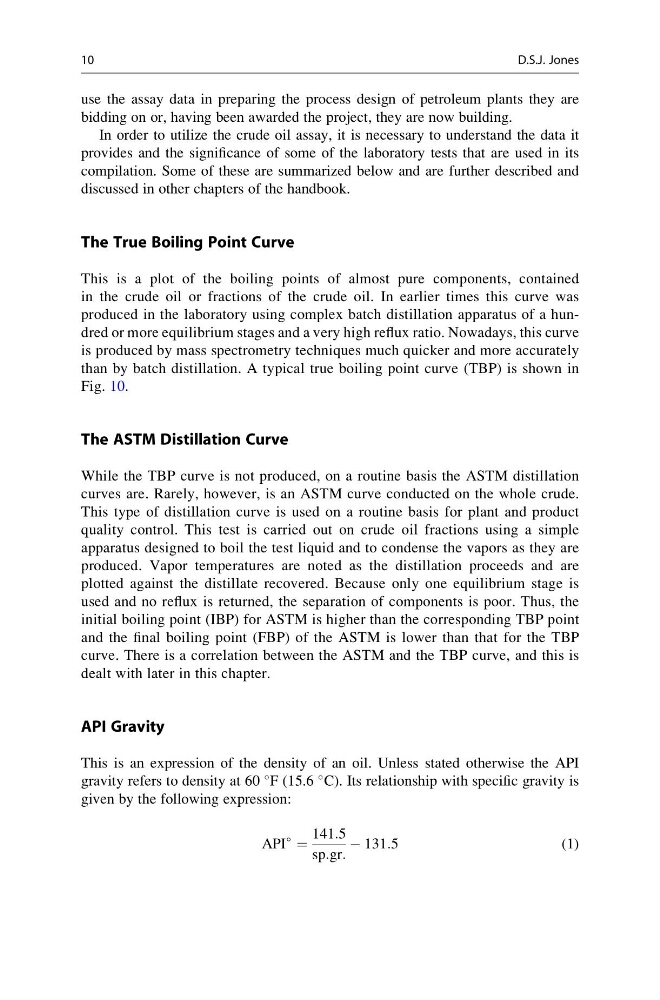
This is an expression of the density of an oil. Unless stated otherwise the API
gravity refers to density at 60
F (15.6
C). Its relationship with specific gravity is
given by the following expression:
API
∘
¼
141:5
sp:gr:
À 131:5
(1)
10
D.S.J. Jones
bidding on or, having been awarded the project, they are now building.
In order to utilize the crude oil assay, it is necessary to understand the data it
provides and the significance of some of the laboratory tests that are used in its
compilation. Some of these are summarized below and are further described and
discussed in other chapters of the handbook.
The True Boiling Point Curve
This is a plot of the boiling points of almost pure components, contained
in the crude oil or fractions of the crude oil. In earlier times this curve was
produced in the laboratory using complex batch distillation apparatus of a hundred or more equilibrium stages and a very high reflux ratio. Nowadays, this curve
is produced by mass spectrometry techniques much quicker and more accurately
than by batch distillation. A typical true boiling point curve (TBP) is shown in
Fig. 10.
The ASTM Distillation Curve
While the TBP curve is not produced, on a routine basis the ASTM distillation
curves are. Rarely, however, is an ASTM curve conducted on the whole crude.
This type of distillation curve is used on a routine basis for plant and product
quality control. This test is carried out on crude oil fractions using a simple
apparatus designed to boil the test liquid and to condense the vapors as they are
produced. Vapor temperatures are noted as the distillation proceeds and are
plotted against the distillate recovered. Because only one equilibrium stage is
used and no reflux is returned, the separation of components is poor. Thus, the
initial boiling point (IBP) for ASTM is higher than the corresponding TBP point
and the final boiling point (FBP) of the ASTM is lower than that for the TBP
curve. There is a correlation between the ASTM and the TBP curve, and this is
dealt with later in this chapter.
API Gravity
This is an expression of the density of an oil. Unless stated otherwise the API
gravity refers to density at 60
F (15.6
C). Its relationship with specific gravity is
given by the following expression:
API
∘
¼
141:5
sp:gr:
À 131:5
(1)
10
D.S.J. Jones