

the maximum number of active sites for dehydrogenation is available. Platinum
cluster size dimensions are on the order of angstroms or 10
À10 m. The interaction of
the platinum with the alumina surface is such that the platinum clusters are
relatively immobile and do not agglomerate during reforming reactions. However,
there is Pt agglomeration during regeneration and the Pt must be redispersed.
The cost of the Pt to a refiner can be significant, with Pt prices increasing
fourfold from about US$400 per troy ounce in the 1990s to US$1,600 per troy
ounce (US$ 51,440/kg) in the 2010s. At 2014 market prices for Pt and catalyst, the
value of the Pt content is approximately four times as much as the base catalyst cost
to a refiner.
Sulfidation of the platinum is sometimes used to partially poison the platinum or
reduce its activity; this has the beneficial effect of reducing a major portion of the
hydrogenolysis or metal-catalyzed cracking reactions. Liquid product yields are
improved, and the light gas production, particularly methane, is reduced.
Alumina Support
The alumina support can be in the eta (η) or gamma (γ) phase, but gamma is most
often utilized in reforming catalysts. Chloride is added during the catalyst finishing
step to promote acidity. It is also added to the process during regeneration to
maintain the level, typically with a compound such as perchloroethylene (PERC).
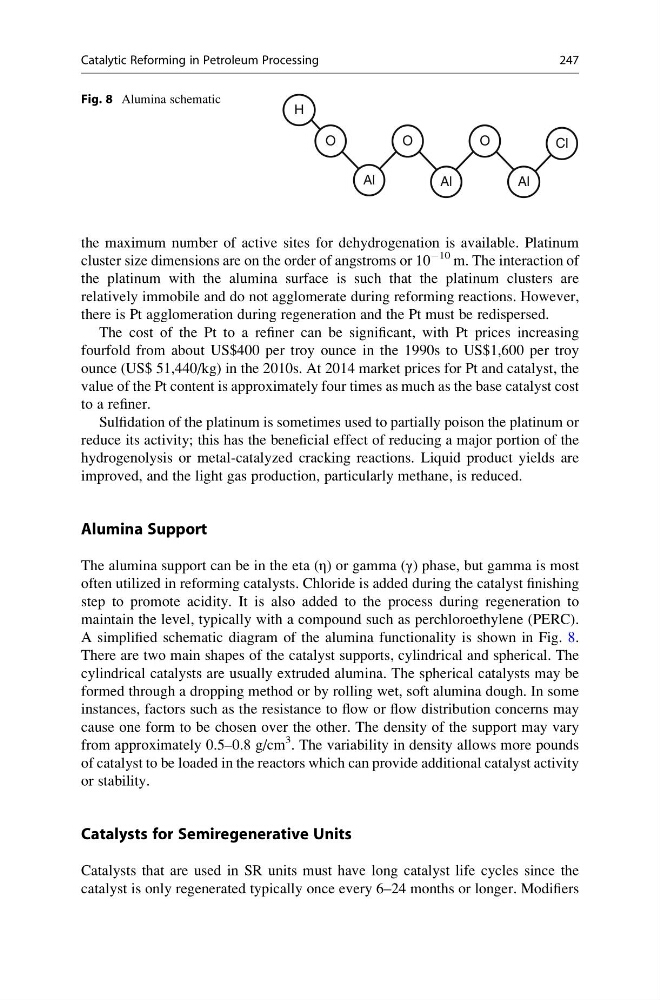
A simplified schematic diagram of the alumina functionality is shown in Fig. 8.
There are two main shapes of the catalyst supports, cylindrical and spherical. The
cylindrical catalysts are usually extruded alumina. The spherical catalysts may be
formed through a dropping method or by rolling wet, soft alumina dough. In some
instances, factors such as the resistance to flow or flow distribution concerns may
cause one form to be chosen over the other. The density of the support may vary
from approximately 0.5–0.8 g/cm
3 . The variability in density allows more pounds
of catalyst to be loaded in the reactors which can provide additional catalyst activity
or stability.
Catalysts for Semiregenerative Units
Catalysts that are used in SR units must have long catalyst life cycles since the
catalyst is only regenerated typically once every 6–24 months or longer. Modifiers
Al
Al
Al
O
O
O
Cl
H
Fig. 8 Alumina schematic
Catalytic Reforming in Petroleum Processing
247
cluster size dimensions are on the order of angstroms or 10
À10 m. The interaction of
the platinum with the alumina surface is such that the platinum clusters are
relatively immobile and do not agglomerate during reforming reactions. However,
there is Pt agglomeration during regeneration and the Pt must be redispersed.
The cost of the Pt to a refiner can be significant, with Pt prices increasing
fourfold from about US$400 per troy ounce in the 1990s to US$1,600 per troy
ounce (US$ 51,440/kg) in the 2010s. At 2014 market prices for Pt and catalyst, the
value of the Pt content is approximately four times as much as the base catalyst cost
to a refiner.
Sulfidation of the platinum is sometimes used to partially poison the platinum or
reduce its activity; this has the beneficial effect of reducing a major portion of the
hydrogenolysis or metal-catalyzed cracking reactions. Liquid product yields are
improved, and the light gas production, particularly methane, is reduced.
Alumina Support
The alumina support can be in the eta (η) or gamma (γ) phase, but gamma is most
often utilized in reforming catalysts. Chloride is added during the catalyst finishing
step to promote acidity. It is also added to the process during regeneration to
maintain the level, typically with a compound such as perchloroethylene (PERC).
A simplified schematic diagram of the alumina functionality is shown in Fig. 8.
There are two main shapes of the catalyst supports, cylindrical and spherical. The
cylindrical catalysts are usually extruded alumina. The spherical catalysts may be
formed through a dropping method or by rolling wet, soft alumina dough. In some
instances, factors such as the resistance to flow or flow distribution concerns may
cause one form to be chosen over the other. The density of the support may vary
from approximately 0.5–0.8 g/cm
3 . The variability in density allows more pounds
of catalyst to be loaded in the reactors which can provide additional catalyst activity
or stability.
Catalysts for Semiregenerative Units
Catalysts that are used in SR units must have long catalyst life cycles since the
catalyst is only regenerated typically once every 6–24 months or longer. Modifiers
Al
Al
Al
O
O
O
Cl
H
Fig. 8 Alumina schematic
Catalytic Reforming in Petroleum Processing
247