

reactions are sufficiently fast that actual concentrations are near equilibrium.
The observed reaction rate for dehydrocyclization is reduced by the low concentrations of the olefin intermediates that exist at equilibrium. Hydrogen partial
pressure significantly affects olefin equilibrium concentrations and has a significant
impact on aromatization and dehydrocyclization of paraffins. Lowering hydrogen
partial pressures results in an increase in the rate of aromatization, a decrease in the
rate of hydrocracking, and an increase in the rate of coke formation.
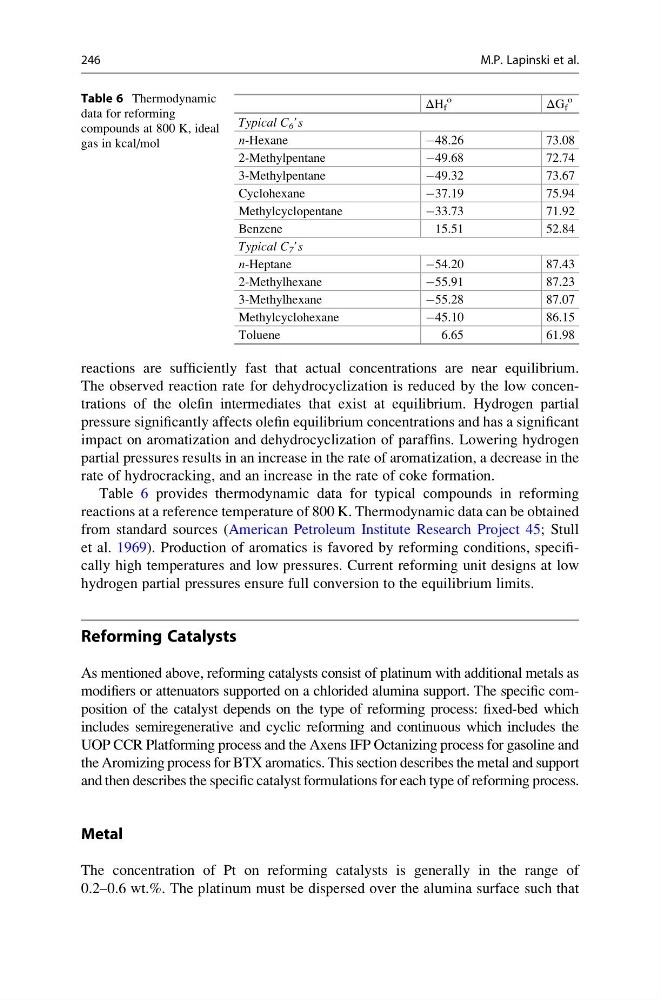
Table 6 provides thermodynamic data for typical compounds in reforming
reactions at a reference temperature of 800 K. Thermodynamic data can be obtained
from standard sources (American Petroleum Institute Research Project 45; Stull
et al. 1969). Production of aromatics is favored by reforming conditions, specifically high temperatures and low pressures. Current reforming unit designs at low
hydrogen partial pressures ensure full conversion to the equilibrium limits.
Reforming Catalysts
As mentioned above, reforming catalysts consist of platinum with additional metals as
modifiers or attenuators supported on a chlorided alumina support. The specific composition of the catalyst depends on the type of reforming process: fixed-bed which
includes semiregenerative and cyclic reforming and continuous which includes the
UOP CCR Platforming process and the Axens IFP Octanizing process for gasoline and
the Aromizing process for BTX aromatics. This section describes the metal and support
and then describes the specific catalyst formulations for each type of reforming process.
Metal
The concentration of Pt on reforming catalysts is generally in the range of
0.2–0.6 wt.%. The platinum must be dispersed over the alumina surface such that
Table 6 Thermodynamic
data for reforming
compounds at 800 K, ideal
gas in kcal/mol
ΔH f
o
ΔG f
o
Typical C 6 ’s
n-Hexane
À48.26
73.08
2-Methylpentane
À49.68
72.74
3-Methylpentane
À49.32
73.67
Cyclohexane
À37.19
75.94
Methylcyclopentane
À33.73
71.92
Benzene
15.51
52.84
Typical C 7 ’s
n-Heptane
À54.20
87.43
2-Methylhexane
À55.91
87.23
3-Methylhexane
À55.28
87.07
Methylcyclohexane
À45.10
86.15
Toluene
6.65
61.98
246
M.P. Lapinski et al.
The observed reaction rate for dehydrocyclization is reduced by the low concentrations of the olefin intermediates that exist at equilibrium. Hydrogen partial
pressure significantly affects olefin equilibrium concentrations and has a significant
impact on aromatization and dehydrocyclization of paraffins. Lowering hydrogen
partial pressures results in an increase in the rate of aromatization, a decrease in the
rate of hydrocracking, and an increase in the rate of coke formation.
Table 6 provides thermodynamic data for typical compounds in reforming
reactions at a reference temperature of 800 K. Thermodynamic data can be obtained
from standard sources (American Petroleum Institute Research Project 45; Stull
et al. 1969). Production of aromatics is favored by reforming conditions, specifically high temperatures and low pressures. Current reforming unit designs at low
hydrogen partial pressures ensure full conversion to the equilibrium limits.
Reforming Catalysts
As mentioned above, reforming catalysts consist of platinum with additional metals as
modifiers or attenuators supported on a chlorided alumina support. The specific composition of the catalyst depends on the type of reforming process: fixed-bed which
includes semiregenerative and cyclic reforming and continuous which includes the
UOP CCR Platforming process and the Axens IFP Octanizing process for gasoline and
the Aromizing process for BTX aromatics. This section describes the metal and support
and then describes the specific catalyst formulations for each type of reforming process.
Metal
The concentration of Pt on reforming catalysts is generally in the range of
0.2–0.6 wt.%. The platinum must be dispersed over the alumina surface such that
Table 6 Thermodynamic
data for reforming
compounds at 800 K, ideal
gas in kcal/mol
ΔH f
o
ΔG f
o
Typical C 6 ’s
n-Hexane
À48.26
73.08
2-Methylpentane
À49.68
72.74
3-Methylpentane
À49.32
73.67
Cyclohexane
À37.19
75.94
Methylcyclopentane
À33.73
71.92
Benzene
15.51
52.84
Typical C 7 ’s
n-Heptane
À54.20
87.43
2-Methylhexane
À55.91
87.23
3-Methylhexane
À55.28
87.07
Methylcyclohexane
À45.10
86.15
Toluene
6.65
61.98
246
M.P. Lapinski et al.