

Aromatics
Approximately one-third of reforming capacity is used for the production of
aromatics. Many reformers are an integral part of an aromatic complex, producing
an aromatic-rich feed to other process units to make benzene, toluene, and xylenes,
particularly para-xylene.
Benzene is primarily used in the production of ethylbenzene, cumene, and
cyclohexane. Plastics and polymers are produced from styrene, which is made
from ethylbenzene. Resins and adhesives are produced from phenol, which is
made from cumene. Nylon is produced from cyclohexane. The majority of
reformers produce mixed aromatics which are subsequently converted and/or
purified to benzene. There are a few catalytic reforming units such as UOP RZ
Platforming process that are dedicated to on-purpose benzene production with very
high selectivity to benzene. Toluene is a common solvent used in paints, lacquers,
rubber, ink, adhesives, silicone sealants, polyurethane foam, and TNT.
Para-xylene is the primary C 8 aromatic of interest, since it is used to make
polyesters. The polyester chain generally begins with p-xylene and ends with a
form of polyethylene terephthalate or more commonly PET. p-Xylene is converted
to purified terephthalic acid (PTA), and a melt polymerization process is used to
make polyester. Approximately two-thirds of PET is used for production of polyester fibers in filament and staple forms, with the former used to make textiles and
apparels. One-third is used for production of resins used for PET bottles, packaging,
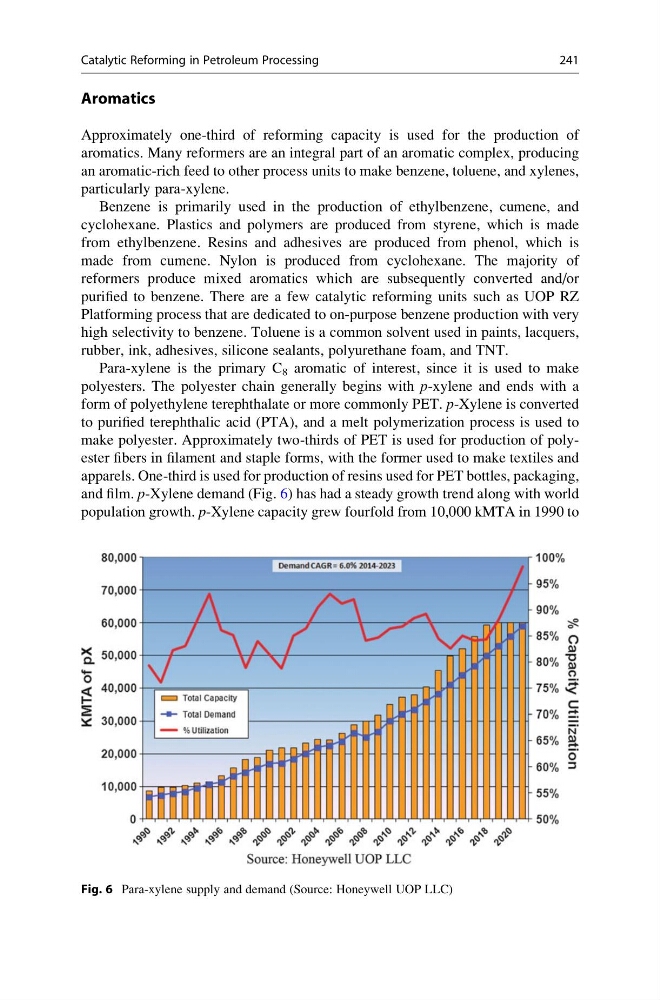
and film. p-Xylene demand (Fig. 6) has had a steady growth trend along with world
population growth. p-Xylene capacity grew fourfold from 10,000 kMTA in 1990 to
Fig. 6 Para-xylene supply and demand (Source: Honeywell UOP LLC)
Catalytic Reforming in Petroleum Processing
241
Approximately one-third of reforming capacity is used for the production of
aromatics. Many reformers are an integral part of an aromatic complex, producing
an aromatic-rich feed to other process units to make benzene, toluene, and xylenes,
particularly para-xylene.
Benzene is primarily used in the production of ethylbenzene, cumene, and
cyclohexane. Plastics and polymers are produced from styrene, which is made
from ethylbenzene. Resins and adhesives are produced from phenol, which is
made from cumene. Nylon is produced from cyclohexane. The majority of
reformers produce mixed aromatics which are subsequently converted and/or
purified to benzene. There are a few catalytic reforming units such as UOP RZ
Platforming process that are dedicated to on-purpose benzene production with very
high selectivity to benzene. Toluene is a common solvent used in paints, lacquers,
rubber, ink, adhesives, silicone sealants, polyurethane foam, and TNT.
Para-xylene is the primary C 8 aromatic of interest, since it is used to make
polyesters. The polyester chain generally begins with p-xylene and ends with a
form of polyethylene terephthalate or more commonly PET. p-Xylene is converted
to purified terephthalic acid (PTA), and a melt polymerization process is used to
make polyester. Approximately two-thirds of PET is used for production of polyester fibers in filament and staple forms, with the former used to make textiles and
apparels. One-third is used for production of resins used for PET bottles, packaging,
and film. p-Xylene demand (Fig. 6) has had a steady growth trend along with world
population growth. p-Xylene capacity grew fourfold from 10,000 kMTA in 1990 to
Fig. 6 Para-xylene supply and demand (Source: Honeywell UOP LLC)
Catalytic Reforming in Petroleum Processing
241