

is needed in order to facilitate starting of an internal combustion engine, particularly
in cold climates. However, too high of an RVP results in undesirable hydrocarbon
emissions into the atmosphere. Other properties are endpoint and color
(Marshall and Owen 1995). High-endpoint reformates, for example, may not
combust well in an internal combustion engine and lead to formation of carbonaceous or gummy hydrocarbon deposits.
Market Segmentation
The reforming market can be separated into two distinct segments: motor fuels and
aromatics. Some reformers operate in both motor fuels and aromatic modes, largely
achieved by changing the operating temperature. The mode of operation is dependent upon the processor’s downstream configuration and product demand.
Motor Fuels
The gasolines available to the consumer consist of a mixture of gasoline fractions
from many refinery sources, including: straight run naphtha, isomerate, alkylate,
reformate, polymer, and FCC fractions. Gasoline also contains additives such as
ethanol, used to lower emissions via oxygenate addition, boost octane, and consume
a biofuel source, typically from corn and sugar cane.
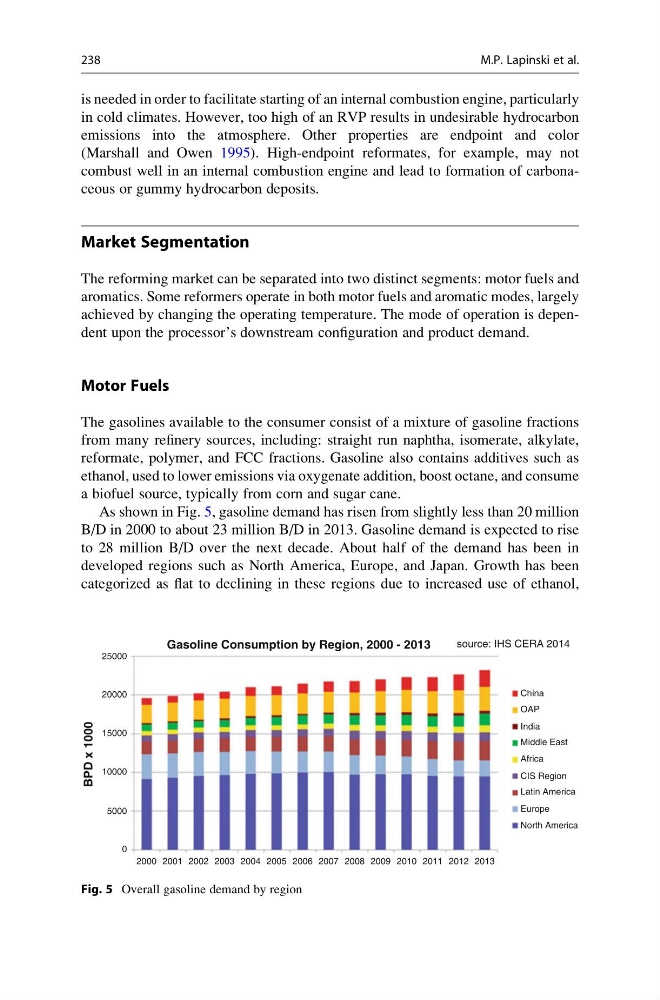
As shown in Fig. 5, gasoline demand has risen from slightly less than 20 million
B/D in 2000 to about 23 million B/D in 2013. Gasoline demand is expected to rise
to 28 million B/D over the next decade. About half of the demand has been in
developed regions such as North America, Europe, and Japan. Growth has been
categorized as flat to declining in these regions due to increased use of ethanol,
25000
Gasoline Consumption by Region, 2000 - 2013
20000
15000
10000
5000
2000 2001 2002 2003 2004 2005 2006 2007 2008 2009 2010 2011 2012 2013
China
OAP
India
Middle East
Africa
CIS Region
Latin America
Europe
North America
0
BPD x 1000
source: IHS CERA 2014
Fig. 5 Overall gasoline demand by region
238
M.P. Lapinski et al.
in cold climates. However, too high of an RVP results in undesirable hydrocarbon
emissions into the atmosphere. Other properties are endpoint and color
(Marshall and Owen 1995). High-endpoint reformates, for example, may not
combust well in an internal combustion engine and lead to formation of carbonaceous or gummy hydrocarbon deposits.
Market Segmentation
The reforming market can be separated into two distinct segments: motor fuels and
aromatics. Some reformers operate in both motor fuels and aromatic modes, largely
achieved by changing the operating temperature. The mode of operation is dependent upon the processor’s downstream configuration and product demand.
Motor Fuels
The gasolines available to the consumer consist of a mixture of gasoline fractions
from many refinery sources, including: straight run naphtha, isomerate, alkylate,
reformate, polymer, and FCC fractions. Gasoline also contains additives such as
ethanol, used to lower emissions via oxygenate addition, boost octane, and consume
a biofuel source, typically from corn and sugar cane.
As shown in Fig. 5, gasoline demand has risen from slightly less than 20 million
B/D in 2000 to about 23 million B/D in 2013. Gasoline demand is expected to rise
to 28 million B/D over the next decade. About half of the demand has been in
developed regions such as North America, Europe, and Japan. Growth has been
categorized as flat to declining in these regions due to increased use of ethanol,
25000
Gasoline Consumption by Region, 2000 - 2013
20000
15000
10000
5000
2000 2001 2002 2003 2004 2005 2006 2007 2008 2009 2010 2011 2012 2013
China
OAP
India
Middle East
Africa
CIS Region
Latin America
Europe
North America
0
BPD x 1000
source: IHS CERA 2014
Fig. 5 Overall gasoline demand by region
238
M.P. Lapinski et al.