

D2699) or at high engine speeds (motor octane number, or MON, as measured by
ASTM D2700). In the USA, the octane values posted on gasoline pumps are the
arithmetic average of the MON and the RON. The acronym RONC, research octane
number clear, is used to denote that there are no additives, such as tetra-ethyl lead
(TEL) or methyl-tertiary-butyl-ether (MTBE), included to increase the octane
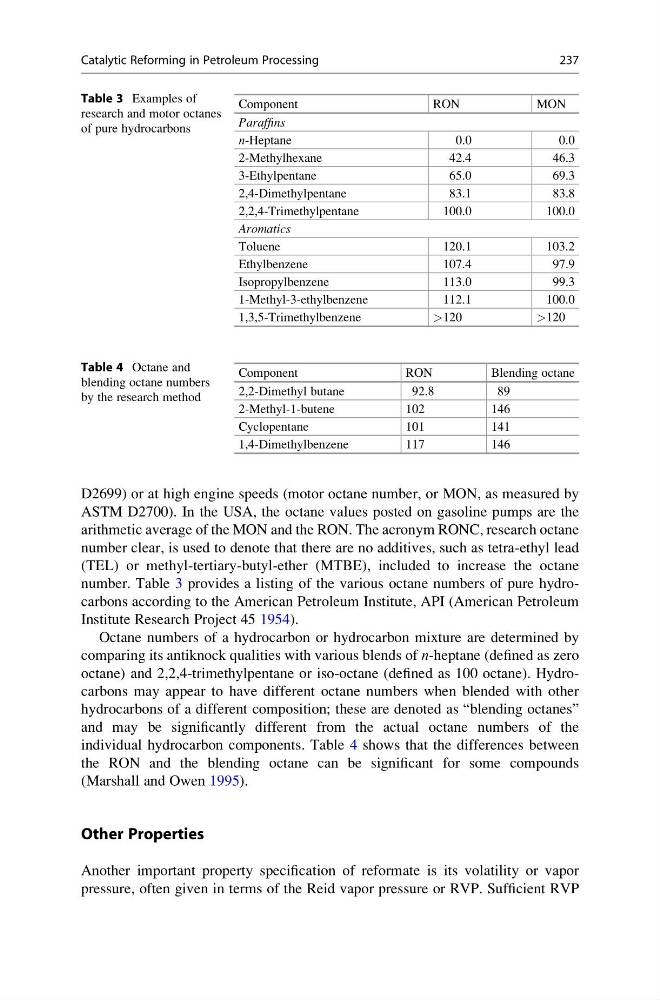
number. Table 3 provides a listing of the various octane numbers of pure hydrocarbons according to the American Petroleum Institute, API (American Petroleum
Institute Research Project 45 1954).
Octane numbers of a hydrocarbon or hydrocarbon mixture are determined by
comparing its antiknock qualities with various blends of n-heptane (defined as zero
octane) and 2,2,4-trimethylpentane or iso-octane (defined as 100 octane). Hydrocarbons may appear to have different octane numbers when blended with other
hydrocarbons of a different composition; these are denoted as “blending octanes”
and may be significantly different from the actual octane numbers of the
individual hydrocarbon components. Table 4 shows that the differences between
the RON and the blending octane can be significant for some compounds
(Marshall and Owen 1995).
Other Properties
Another important property specification of reformate is its volatility or vapor
pressure, often given in terms of the Reid vapor pressure or RVP. Sufficient RVP
Table 3 Examples of
research and motor octanes
of pure hydrocarbons
Component
RON
MON
Paraffins
n-Heptane
0.0
0.0
2-Methylhexane
42.4
46.3
3-Ethylpentane
65.0
69.3
2,4-Dimethylpentane
83.1
83.8
2,2,4-Trimethylpentane
100.0
100.0
Aromatics
Toluene
120.1
103.2
Ethylbenzene
107.4
97.9
Isopropylbenzene
113.0
99.3
1-Methyl-3-ethylbenzene
112.1
100.0
1,3,5-Trimethylbenzene
>120
>120
Table 4 Octane and
blending octane numbers
by the research method
Component
RON
Blending octane
2,2-Dimethyl butane
92.8
89
2-Methyl-1-butene
102
146
Cyclopentane
101
141
1,4-Dimethylbenzene
117
146
Catalytic Reforming in Petroleum Processing
237
ASTM D2700). In the USA, the octane values posted on gasoline pumps are the
arithmetic average of the MON and the RON. The acronym RONC, research octane
number clear, is used to denote that there are no additives, such as tetra-ethyl lead
(TEL) or methyl-tertiary-butyl-ether (MTBE), included to increase the octane
number. Table 3 provides a listing of the various octane numbers of pure hydrocarbons according to the American Petroleum Institute, API (American Petroleum
Institute Research Project 45 1954).
Octane numbers of a hydrocarbon or hydrocarbon mixture are determined by
comparing its antiknock qualities with various blends of n-heptane (defined as zero
octane) and 2,2,4-trimethylpentane or iso-octane (defined as 100 octane). Hydrocarbons may appear to have different octane numbers when blended with other
hydrocarbons of a different composition; these are denoted as “blending octanes”
and may be significantly different from the actual octane numbers of the
individual hydrocarbon components. Table 4 shows that the differences between
the RON and the blending octane can be significant for some compounds
(Marshall and Owen 1995).
Other Properties
Another important property specification of reformate is its volatility or vapor
pressure, often given in terms of the Reid vapor pressure or RVP. Sufficient RVP
Table 3 Examples of
research and motor octanes
of pure hydrocarbons
Component
RON
MON
Paraffins
n-Heptane
0.0
0.0
2-Methylhexane
42.4
46.3
3-Ethylpentane
65.0
69.3
2,4-Dimethylpentane
83.1
83.8
2,2,4-Trimethylpentane
100.0
100.0
Aromatics
Toluene
120.1
103.2
Ethylbenzene
107.4
97.9
Isopropylbenzene
113.0
99.3
1-Methyl-3-ethylbenzene
112.1
100.0
1,3,5-Trimethylbenzene
>120
>120
Table 4 Octane and
blending octane numbers
by the research method
Component
RON
Blending octane
2,2-Dimethyl butane
92.8
89
2-Methyl-1-butene
102
146
Cyclopentane
101
141
1,4-Dimethylbenzene
117
146
Catalytic Reforming in Petroleum Processing
237