

oxygen compounds. Removing these requires breaking of a carbon-sulfur, a carbonnitrogen, or a carbon-oxygen bond and formation of hydrogen sulfide, ammonia, or
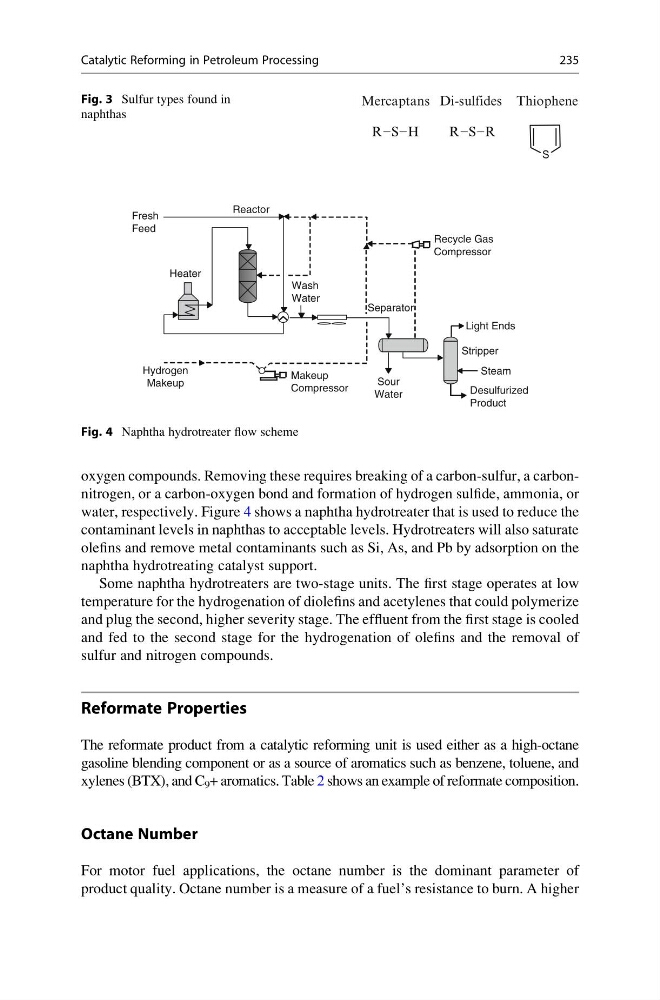
water, respectively. Figure 4 shows a naphtha hydrotreater that is used to reduce the
contaminant levels in naphthas to acceptable levels. Hydrotreaters will also saturate
olefins and remove metal contaminants such as Si, As, and Pb by adsorption on the
naphtha hydrotreating catalyst support.
Some naphtha hydrotreaters are two-stage units. The first stage operates at low
temperature for the hydrogenation of diolefins and acetylenes that could polymerize
and plug the second, higher severity stage. The effluent from the first stage is cooled
and fed to the second stage for the hydrogenation of olefins and the removal of
sulfur and nitrogen compounds.
Reformate Properties
The reformate product from a catalytic reforming unit is used either as a high-octane
gasoline blending component or as a source of aromatics such as benzene, toluene, and
xylenes (BTX), and C 9 + aromatics. Table 2 shows an example of reformate composition.
Octane Number
For motor fuel applications, the octane number is the dominant parameter of
product quality. Octane number is a measure of a fuel’s resistance to burn. A higher
Heater
Reactor
Separator
Stripper
Fresh
Feed
Recycle Gas
Compressor
Light Ends
Desulfurized
Product
Hydrogen
Makeup
Makeup
Compressor
Sour
Water
Wash
Water
Steam
Fig. 4 Naphtha hydrotreater flow scheme
Mercaptans Di-sulfides Thiophene
R−S−H
R−S−R
S
Fig. 3 Sulfur types found in
naphthas
Catalytic Reforming in Petroleum Processing
235
water, respectively. Figure 4 shows a naphtha hydrotreater that is used to reduce the
contaminant levels in naphthas to acceptable levels. Hydrotreaters will also saturate
olefins and remove metal contaminants such as Si, As, and Pb by adsorption on the
naphtha hydrotreating catalyst support.
Some naphtha hydrotreaters are two-stage units. The first stage operates at low
temperature for the hydrogenation of diolefins and acetylenes that could polymerize
and plug the second, higher severity stage. The effluent from the first stage is cooled
and fed to the second stage for the hydrogenation of olefins and the removal of
sulfur and nitrogen compounds.
Reformate Properties
The reformate product from a catalytic reforming unit is used either as a high-octane
gasoline blending component or as a source of aromatics such as benzene, toluene, and
xylenes (BTX), and C 9 + aromatics. Table 2 shows an example of reformate composition.
Octane Number
For motor fuel applications, the octane number is the dominant parameter of
product quality. Octane number is a measure of a fuel’s resistance to burn. A higher
Heater
Reactor
Separator
Stripper
Fresh
Feed
Recycle Gas
Compressor
Light Ends
Desulfurized
Product
Hydrogen
Makeup
Makeup
Compressor
Sour
Water
Wash
Water
Steam
Fig. 4 Naphtha hydrotreater flow scheme
Mercaptans Di-sulfides Thiophene
R−S−H
R−S−R
S
Fig. 3 Sulfur types found in
naphthas
Catalytic Reforming in Petroleum Processing
235