

Naphtha Feed Pretreatment
In order to prevent contamination and deactivation of a reforming catalyst, most
naphtha feeds must be hydrotreated to remove several types of contaminants.
Common poisons for reforming catalysts include sulfur (Fig. 3), nitrogen, and
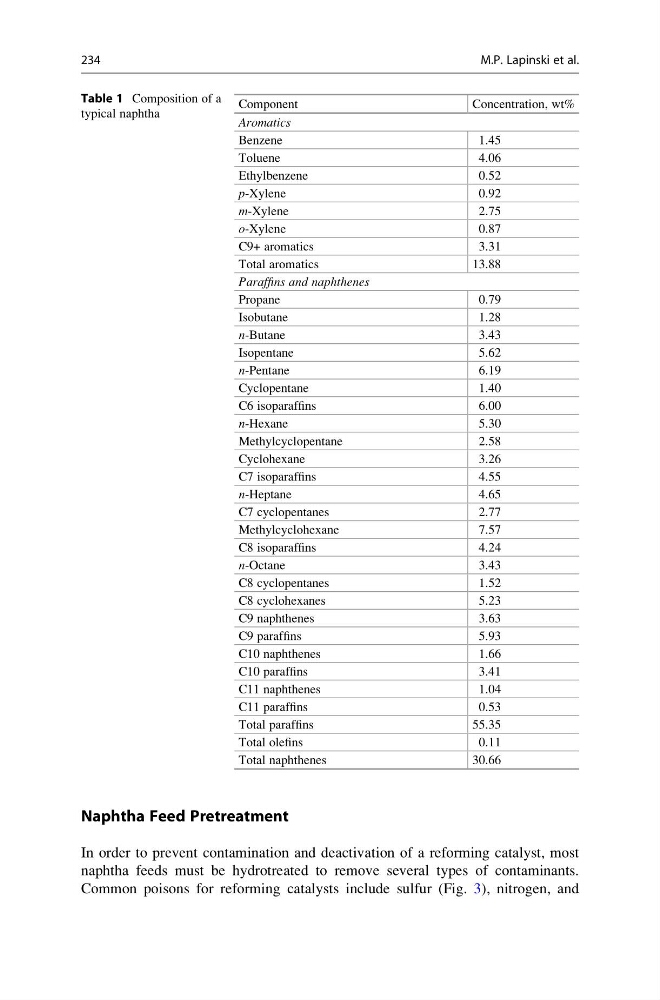
Table 1 Composition of a
typical naphtha
Component
Concentration, wt%
Aromatics
Benzene
1.45
Toluene
4.06
Ethylbenzene
0.52
p-Xylene
0.92
m-Xylene
2.75
o-Xylene
0.87
C9+ aromatics
3.31
Total aromatics
13.88
Paraffins and naphthenes
Propane
0.79
Isobutane
1.28
n-Butane
3.43
Isopentane
5.62
n-Pentane
6.19
Cyclopentane
1.40
C6 isoparaffins
6.00
n-Hexane
5.30
Methylcyclopentane
2.58
Cyclohexane
3.26
C7 isoparaffins
4.55
n-Heptane
4.65
C7 cyclopentanes
2.77
Methylcyclohexane
7.57
C8 isoparaffins
4.24
n-Octane
3.43
C8 cyclopentanes
1.52
C8 cyclohexanes
5.23
C9 naphthenes
3.63
C9 paraffins
5.93
C10 naphthenes
1.66
C10 paraffins
3.41
C11 naphthenes
1.04
C11 paraffins
0.53
Total paraffins
55.35
Total olefins
0.11
Total naphthenes
30.66
234
M.P. Lapinski et al.
In order to prevent contamination and deactivation of a reforming catalyst, most
naphtha feeds must be hydrotreated to remove several types of contaminants.
Common poisons for reforming catalysts include sulfur (Fig. 3), nitrogen, and
Table 1 Composition of a
typical naphtha
Component
Concentration, wt%
Aromatics
Benzene
1.45
Toluene
4.06
Ethylbenzene
0.52
p-Xylene
0.92
m-Xylene
2.75
o-Xylene
0.87
C9+ aromatics
3.31
Total aromatics
13.88
Paraffins and naphthenes
Propane
0.79
Isobutane
1.28
n-Butane
3.43
Isopentane
5.62
n-Pentane
6.19
Cyclopentane
1.40
C6 isoparaffins
6.00
n-Hexane
5.30
Methylcyclopentane
2.58
Cyclohexane
3.26
C7 isoparaffins
4.55
n-Heptane
4.65
C7 cyclopentanes
2.77
Methylcyclohexane
7.57
C8 isoparaffins
4.24
n-Octane
3.43
C8 cyclopentanes
1.52
C8 cyclohexanes
5.23
C9 naphthenes
3.63
C9 paraffins
5.93
C10 naphthenes
1.66
C10 paraffins
3.41
C11 naphthenes
1.04
C11 paraffins
0.53
Total paraffins
55.35
Total olefins
0.11
Total naphthenes
30.66
234
M.P. Lapinski et al.