

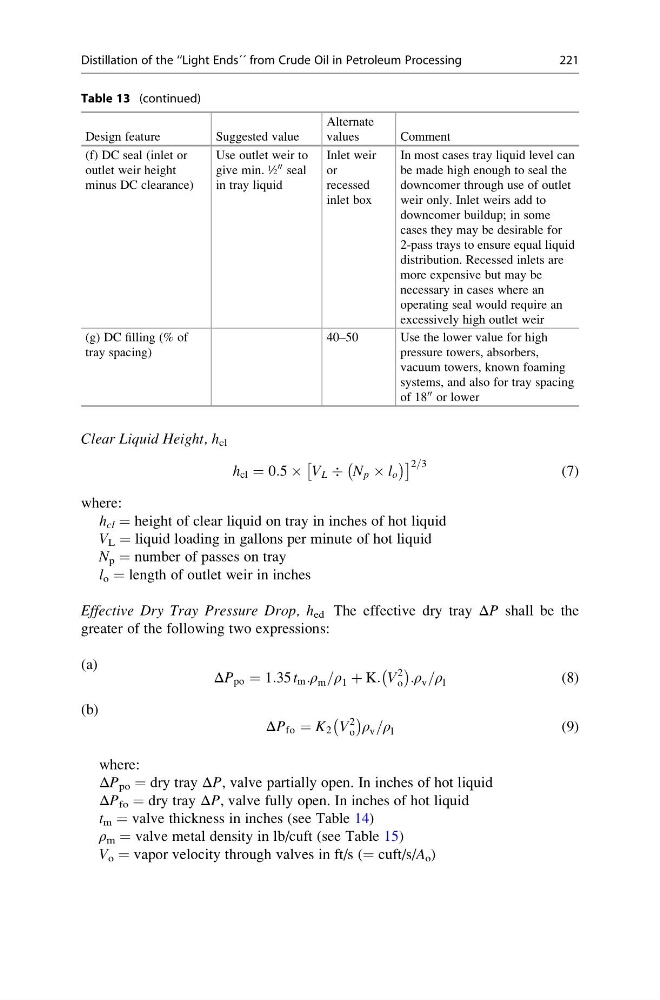
Clear Liquid Height, h cl
h cl ¼ 0:5  V L Ä N p  l o
À
Á
Â
à 2=3
(7)
where:
h cl = height of clear liquid on tray in inches of hot liquid
V L = liquid loading in gallons per minute of hot liquid
N p = number of passes on tray
l o = length of outlet weir in inches
Effective Dry Tray Pressure Drop, h ed The effective dry tray ΔP shall be the
greater of the following two expressions:
(a)
ΔP po ¼ 1:35 t m :ρ m =ρ 1 þ K: V
2
o
À Á :ρ v =ρ l
(8)
(b)
ΔP fo ¼ K 2 V
2
o
À Á
ρ v =ρ l
(9)
where:
ΔP po = dry tray ΔP, valve partially open. In inches of hot liquid
ΔP fo = dry tray ΔP, valve fully open. In inches of hot liquid
t m = valve thickness in inches (see Table 14)
ρ m = valve metal density in lb/cuft (see Table 15)
V o = vapor velocity through valves in ft/s (= cuft/s/A o )
Table 13 (continued)
Design feature
Suggested value
Alternate
values
Comment
(f) DC seal (inlet or
outlet weir height
minus DC clearance)
Use outlet weir to
give min. ½
00 seal
in tray liquid
Inlet weir
or
recessed
inlet box
In most cases tray liquid level can
be made high enough to seal the
downcomer through use of outlet
weir only. Inlet weirs add to
downcomer buildup; in some
cases they may be desirable for
2-pass trays to ensure equal liquid
distribution. Recessed inlets are
more expensive but may be
necessary in cases where an
operating seal would require an
excessively high outlet weir
(g) DC filling (% of
tray spacing)
40–50
Use the lower value for high
pressure towers, absorbers,
vacuum towers, known foaming
systems, and also for tray spacing
of 18
00 or lower
Distillation of the ‘‘Light Ends´´ from Crude Oil in Petroleum Processing
221
h cl ¼ 0:5  V L Ä N p  l o
À
Á
Â
à 2=3
(7)
where:
h cl = height of clear liquid on tray in inches of hot liquid
V L = liquid loading in gallons per minute of hot liquid
N p = number of passes on tray
l o = length of outlet weir in inches
Effective Dry Tray Pressure Drop, h ed The effective dry tray ΔP shall be the
greater of the following two expressions:
(a)
ΔP po ¼ 1:35 t m :ρ m =ρ 1 þ K: V
2
o
À Á :ρ v =ρ l
(8)
(b)
ΔP fo ¼ K 2 V
2
o
À Á
ρ v =ρ l
(9)
where:
ΔP po = dry tray ΔP, valve partially open. In inches of hot liquid
ΔP fo = dry tray ΔP, valve fully open. In inches of hot liquid
t m = valve thickness in inches (see Table 14)
ρ m = valve metal density in lb/cuft (see Table 15)
V o = vapor velocity through valves in ft/s (= cuft/s/A o )
Table 13 (continued)
Design feature
Suggested value
Alternate
values
Comment
(f) DC seal (inlet or
outlet weir height
minus DC clearance)
Use outlet weir to
give min. ½
00 seal
in tray liquid
Inlet weir
or
recessed
inlet box
In most cases tray liquid level can
be made high enough to seal the
downcomer through use of outlet
weir only. Inlet weirs add to
downcomer buildup; in some
cases they may be desirable for
2-pass trays to ensure equal liquid
distribution. Recessed inlets are
more expensive but may be
necessary in cases where an
operating seal would require an
excessively high outlet weir
(g) DC filling (% of
tray spacing)
40–50
Use the lower value for high
pressure towers, absorbers,
vacuum towers, known foaming
systems, and also for tray spacing
of 18
00 or lower
Distillation of the ‘‘Light Ends´´ from Crude Oil in Petroleum Processing
221