

Condenser and Reboiler Duties
Both the condenser and reboiler duties are the result of the light ends tower heat
balance that meets the degree of separation required in the products. It may be said
that the condenser duty and operation determine the amount of wash liquid flow in
the tower to meet the degree of rectification required for the lighter product. The
reboiler in turn generates the vapor flow in the tower to satisfy the degree of
stripping required for the particular separation and the quality of the heavy product.
At a constant feed temperature and pressure, changes to either the condenser duty or
the reboiler duty will affect the duty of the other. In other words the tower must
always be in heat balance.
Calculating the Condenser Duty
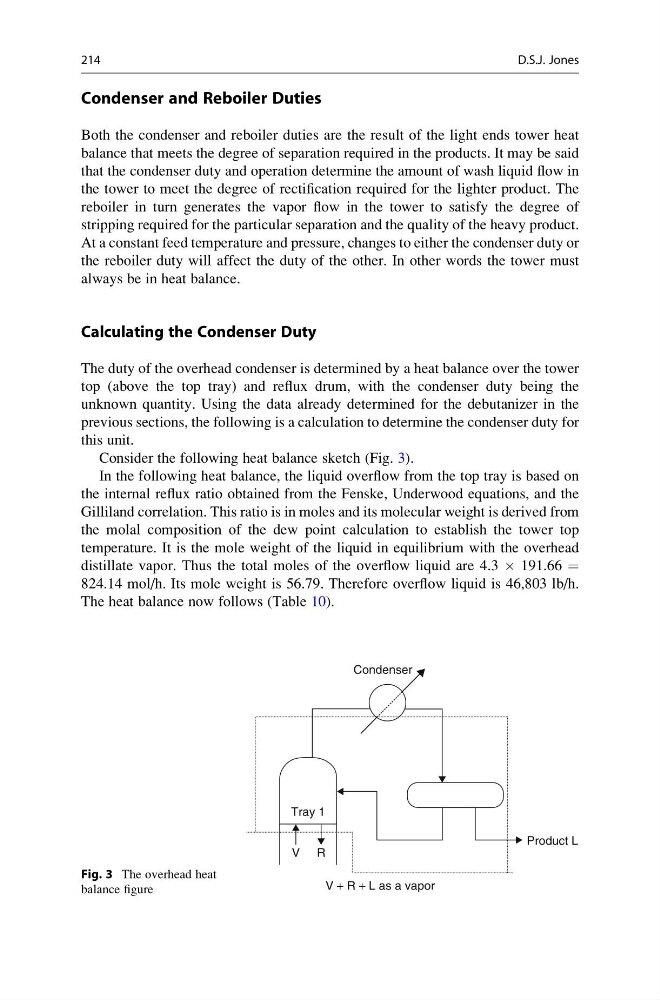
The duty of the overhead condenser is determined by a heat balance over the tower
top (above the top tray) and reflux drum, with the condenser duty being the
unknown quantity. Using the data already determined for the debutanizer in the
previous sections, the following is a calculation to determine the condenser duty for
this unit.
Consider the following heat balance sketch (Fig. 3).
In the following heat balance, the liquid overflow from the top tray is based on
the internal reflux ratio obtained from the Fenske, Underwood equations, and the
Gilliland correlation. This ratio is in moles and its molecular weight is derived from
the molal composition of the dew point calculation to establish the tower top
temperature. It is the mole weight of the liquid in equilibrium with the overhead
distillate vapor. Thus the total moles of the overflow liquid are 4.3 Â 191.66 =
824.14 mol/h. Its mole weight is 56.79. Therefore overflow liquid is 46,803 lb/h.
The heat balance now follows (Table 10).
Condenser
Tray 1
V R
V + R + L as a vapor
Product L
Fig. 3 The overhead heat
balance figure
214
D.S.J. Jones
Both the condenser and reboiler duties are the result of the light ends tower heat
balance that meets the degree of separation required in the products. It may be said
that the condenser duty and operation determine the amount of wash liquid flow in
the tower to meet the degree of rectification required for the lighter product. The
reboiler in turn generates the vapor flow in the tower to satisfy the degree of
stripping required for the particular separation and the quality of the heavy product.
At a constant feed temperature and pressure, changes to either the condenser duty or
the reboiler duty will affect the duty of the other. In other words the tower must
always be in heat balance.
Calculating the Condenser Duty
The duty of the overhead condenser is determined by a heat balance over the tower
top (above the top tray) and reflux drum, with the condenser duty being the
unknown quantity. Using the data already determined for the debutanizer in the
previous sections, the following is a calculation to determine the condenser duty for
this unit.
Consider the following heat balance sketch (Fig. 3).
In the following heat balance, the liquid overflow from the top tray is based on
the internal reflux ratio obtained from the Fenske, Underwood equations, and the
Gilliland correlation. This ratio is in moles and its molecular weight is derived from
the molal composition of the dew point calculation to establish the tower top
temperature. It is the mole weight of the liquid in equilibrium with the overhead
distillate vapor. Thus the total moles of the overflow liquid are 4.3 Â 191.66 =
824.14 mol/h. Its mole weight is 56.79. Therefore overflow liquid is 46,803 lb/h.
The heat balance now follows (Table 10).
Condenser
Tray 1
V R
V + R + L as a vapor
Product L
Fig. 3 The overhead heat
balance figure
214
D.S.J. Jones