

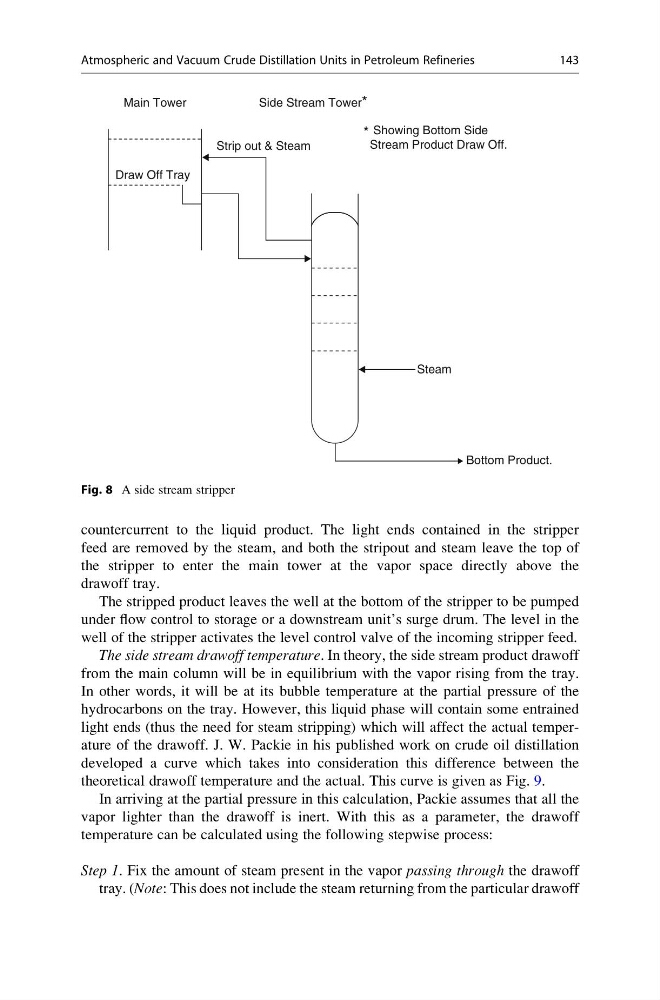
countercurrent to the liquid product. The light ends contained in the stripper
feed are removed by the steam, and both the stripout and steam leave the top of
the stripper to enter the main tower at the vapor space directly above the
drawoff tray.
The stripped product leaves the well at the bottom of the stripper to be pumped
under flow control to storage or a downstream unit’s surge drum. The level in the
well of the stripper activates the level control valve of the incoming stripper feed.
The side stream drawoff temperature. In theory, the side stream product drawoff
from the main column will be in equilibrium with the vapor rising from the tray.
In other words, it will be at its bubble temperature at the partial pressure of the
hydrocarbons on the tray. However, this liquid phase will contain some entrained
light ends (thus the need for steam stripping) which will affect the actual temperature of the drawoff. J. W. Packie in his published work on crude oil distillation
developed a curve which takes into consideration this difference between the
theoretical drawoff temperature and the actual. This curve is given as Fig. 9.
In arriving at the partial pressure in this calculation, Packie assumes that all the
vapor lighter than the drawoff is inert. With this as a parameter, the drawoff
temperature can be calculated using the following stepwise process:
Step 1. Fix the amount of steam present in the vapor passing through the drawoff
tray. (Note: This does not include the steam returning from the particular drawoff
Bottom Product.
Steam
Main Tower
Side Stream Tower*
Strip out & Steam
Draw Off Tray
* Showing Bottom Side
Stream Product Draw Off.
Fig. 8 A side stream stripper
Atmospheric and Vacuum Crude Distillation Units in Petroleum Refineries
143
feed are removed by the steam, and both the stripout and steam leave the top of
the stripper to enter the main tower at the vapor space directly above the
drawoff tray.
The stripped product leaves the well at the bottom of the stripper to be pumped
under flow control to storage or a downstream unit’s surge drum. The level in the
well of the stripper activates the level control valve of the incoming stripper feed.
The side stream drawoff temperature. In theory, the side stream product drawoff
from the main column will be in equilibrium with the vapor rising from the tray.
In other words, it will be at its bubble temperature at the partial pressure of the
hydrocarbons on the tray. However, this liquid phase will contain some entrained
light ends (thus the need for steam stripping) which will affect the actual temperature of the drawoff. J. W. Packie in his published work on crude oil distillation
developed a curve which takes into consideration this difference between the
theoretical drawoff temperature and the actual. This curve is given as Fig. 9.
In arriving at the partial pressure in this calculation, Packie assumes that all the
vapor lighter than the drawoff is inert. With this as a parameter, the drawoff
temperature can be calculated using the following stepwise process:
Step 1. Fix the amount of steam present in the vapor passing through the drawoff
tray. (Note: This does not include the steam returning from the particular drawoff
Bottom Product.
Steam
Main Tower
Side Stream Tower*
Strip out & Steam
Draw Off Tray
* Showing Bottom Side
Stream Product Draw Off.
Fig. 8 A side stream stripper
Atmospheric and Vacuum Crude Distillation Units in Petroleum Refineries
143