

capacity revamp calls for such a configuration. In these circumstances, a light cut is
flashed off and fractionated in a “primary” tower. The bottoms from this tower are
then heated and vaporized to enter the flash zone of a “secondary” tower where it is
fractionated to meet the conventional overhead and side distillate products.
This section of this chapter will deal only with the single atmospheric crude
distillation process however.
The Tower Flash Zone
As described earlier the crude oil feed is heated to the required temperature for
separating its distillate products from the unvaporized portion (i.e., the residue) by
heat exchange with products being cooled or condensed and finally by a fired heater.
This heated crude enters a section of the atmospheric fractionating tower at a point
below the fractionating trays. This section of the tower is called the flash zone.
The temperature and pressure conditions in this zone are such as to allow the correct
amount of vapor to be flashed from the heated crude to provide the quantities of the
distillate product streams and the internal reflux to control their quality.
These flash zone conditions of temperature and pressure are determined taking
into consideration the shape of the crude oil’s equilibrium flash vaporization (EFV)
curve, the pressure (usually the partial pressure in the case of the atmospheric
tower) existing in this section of the tower, and the temperature on the EFV
corresponding to the volume % cut of the total vapor to be flashed.
Setting the Flash Zone Partial Pressure
Because steam is used to strip the residue leaving the tower free of light ends, this steam
enters the flash zone from the top stripping tray. The steam influences the pressure
condition at which the hydrocarbon vapors separate from the residue. This pressure
condition is the partial pressure exerted by the steam. It is calculated as follows:
Partial pressure of HC vapor ¼
moles HC vapor
moles HC vapor þ moles steam
 Total pressure
(1)
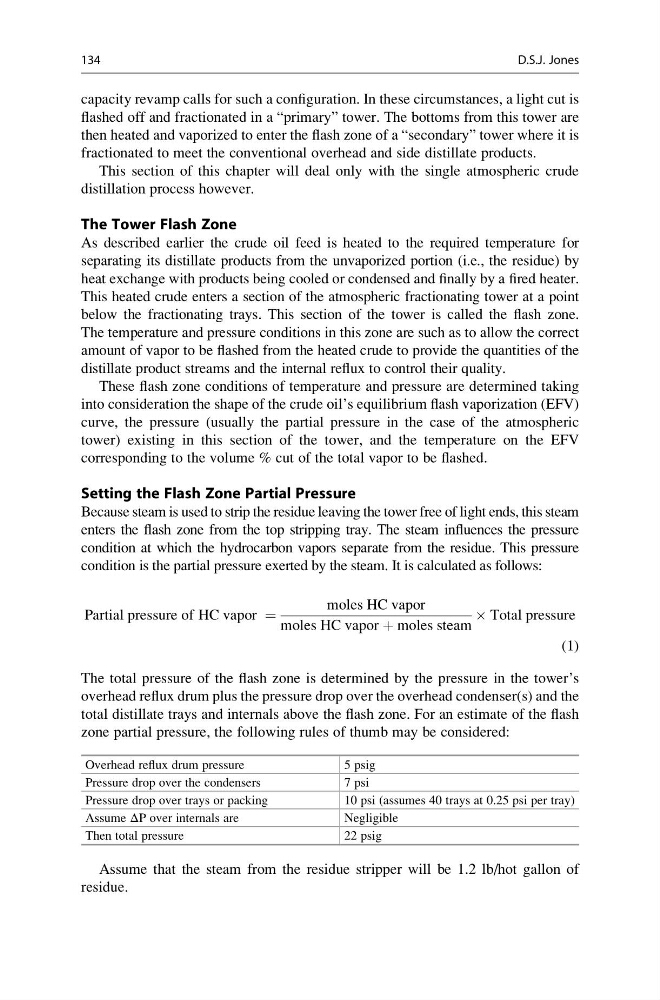
The total pressure of the flash zone is determined by the pressure in the tower’s
overhead reflux drum plus the pressure drop over the overhead condenser(s) and the
total distillate trays and internals above the flash zone. For an estimate of the flash
zone partial pressure, the following rules of thumb may be considered:
Overhead reflux drum pressure
5 psig
Pressure drop over the condensers
7 psi
Pressure drop over trays or packing
10 psi (assumes 40 trays at 0.25 psi per tray)
Assume ΔP over internals are
Negligible
Then total pressure
22 psig
Assume that the steam from the residue stripper will be 1.2 lb/hot gallon of
residue.
134
D.S.J. Jones
flashed off and fractionated in a “primary” tower. The bottoms from this tower are
then heated and vaporized to enter the flash zone of a “secondary” tower where it is
fractionated to meet the conventional overhead and side distillate products.
This section of this chapter will deal only with the single atmospheric crude
distillation process however.
The Tower Flash Zone
As described earlier the crude oil feed is heated to the required temperature for
separating its distillate products from the unvaporized portion (i.e., the residue) by
heat exchange with products being cooled or condensed and finally by a fired heater.
This heated crude enters a section of the atmospheric fractionating tower at a point
below the fractionating trays. This section of the tower is called the flash zone.
The temperature and pressure conditions in this zone are such as to allow the correct
amount of vapor to be flashed from the heated crude to provide the quantities of the
distillate product streams and the internal reflux to control their quality.
These flash zone conditions of temperature and pressure are determined taking
into consideration the shape of the crude oil’s equilibrium flash vaporization (EFV)
curve, the pressure (usually the partial pressure in the case of the atmospheric
tower) existing in this section of the tower, and the temperature on the EFV
corresponding to the volume % cut of the total vapor to be flashed.
Setting the Flash Zone Partial Pressure
Because steam is used to strip the residue leaving the tower free of light ends, this steam
enters the flash zone from the top stripping tray. The steam influences the pressure
condition at which the hydrocarbon vapors separate from the residue. This pressure
condition is the partial pressure exerted by the steam. It is calculated as follows:
Partial pressure of HC vapor ¼
moles HC vapor
moles HC vapor þ moles steam
 Total pressure
(1)
The total pressure of the flash zone is determined by the pressure in the tower’s
overhead reflux drum plus the pressure drop over the overhead condenser(s) and the
total distillate trays and internals above the flash zone. For an estimate of the flash
zone partial pressure, the following rules of thumb may be considered:
Overhead reflux drum pressure
5 psig
Pressure drop over the condensers
7 psi
Pressure drop over trays or packing
10 psi (assumes 40 trays at 0.25 psi per tray)
Assume ΔP over internals are
Negligible
Then total pressure
22 psig
Assume that the steam from the residue stripper will be 1.2 lb/hot gallon of
residue.
134
D.S.J. Jones