

4.2 Shift and Broadening of the Alkali Atom Hyperfine Lines
in an Atmosphere of the Inert Gas
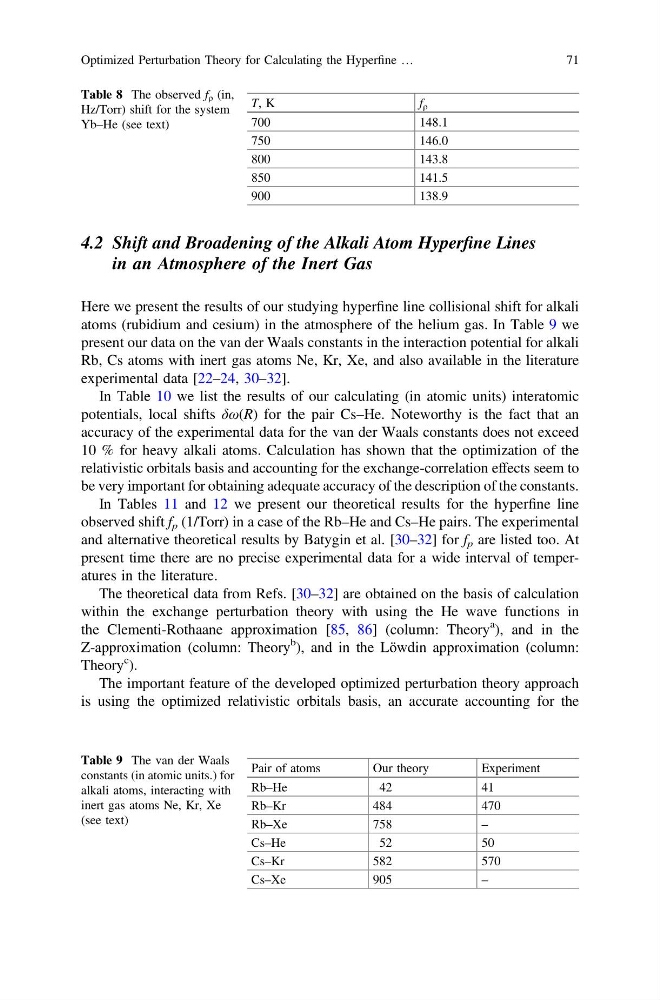
Here we present the results of our studying hyperfine line collisional shift for alkali
atoms (rubidium and cesium) in the atmosphere of the helium gas. In Table 9 we
present our data on the van der Waals constants in the interaction potential for alkali
Rb, Cs atoms with inert gas atoms Ne, Kr, Xe, and also available in the literature
experimental data [22–24, 30–32].
In Table 10 we list the results of our calculating (in atomic units) interatomic
potentials, local shifts δω(R) for the pair Cs–He. Noteworthy is the fact that an
accuracy of the experimental data for the van der Waals constants does not exceed
10 % for heavy alkali atoms. Calculation has shown that the optimization of the
relativistic orbitals basis and accounting for the exchange-correlation effects seem to
be very important for obtaining adequate accuracy of the description of the constants.
In Tables 11 and 12 we present our theoretical results for the hyperfine line
observed shift f p (1/Torr) in a case of the Rb–He and Cs–He pairs. The experimental
and alternative theoretical results by Batygin et al. [30–32] for f p are listed too. At
present time there are no precise experimental data for a wide interval of temperatures in the literature.
The theoretical data from Refs. [30–32] are obtained on the basis of calculation
within the exchange perturbation theory with using the He wave functions in
the Clementi-Rothaane approximation [85, 86] (column: Theory
a ), and in the
Z-approximation (column: Theory
b ), and in the Löwdin approximation (column:
Theory
c ).
The important feature of the developed optimized perturbation theory approach
is using the optimized relativistic orbitals basis, an accurate accounting for the
Table 8 The observed f ρ (in,
Hz/Torr) shift for the system
Yb–He (see text)
T, K
f ρ
700
148.1
750
146.0
800
143.8
850
141.5
900
138.9
Table 9 The van der Waals
constants (in atomic units.) for
alkali atoms, interacting with
inert gas atoms Ne, Kr, Xe
(see text)
Pair of atoms
Our theory
Experiment
Rb–He
42
41
Rb–Kr
484
470
Rb–Xe
758
–
Cs–He
52
50
Cs–Kr
582
570
Cs–Xe
905
–
Optimized Perturbation Theory for Calculating the Hyperfine …
71
in an Atmosphere of the Inert Gas
Here we present the results of our studying hyperfine line collisional shift for alkali
atoms (rubidium and cesium) in the atmosphere of the helium gas. In Table 9 we
present our data on the van der Waals constants in the interaction potential for alkali
Rb, Cs atoms with inert gas atoms Ne, Kr, Xe, and also available in the literature
experimental data [22–24, 30–32].
In Table 10 we list the results of our calculating (in atomic units) interatomic
potentials, local shifts δω(R) for the pair Cs–He. Noteworthy is the fact that an
accuracy of the experimental data for the van der Waals constants does not exceed
10 % for heavy alkali atoms. Calculation has shown that the optimization of the
relativistic orbitals basis and accounting for the exchange-correlation effects seem to
be very important for obtaining adequate accuracy of the description of the constants.
In Tables 11 and 12 we present our theoretical results for the hyperfine line
observed shift f p (1/Torr) in a case of the Rb–He and Cs–He pairs. The experimental
and alternative theoretical results by Batygin et al. [30–32] for f p are listed too. At
present time there are no precise experimental data for a wide interval of temperatures in the literature.
The theoretical data from Refs. [30–32] are obtained on the basis of calculation
within the exchange perturbation theory with using the He wave functions in
the Clementi-Rothaane approximation [85, 86] (column: Theory
a ), and in the
Z-approximation (column: Theory
b ), and in the Löwdin approximation (column:
Theory
c ).
The important feature of the developed optimized perturbation theory approach
is using the optimized relativistic orbitals basis, an accurate accounting for the
Table 8 The observed f ρ (in,
Hz/Torr) shift for the system
Yb–He (see text)
T, K
f ρ
700
148.1
750
146.0
800
143.8
850
141.5
900
138.9
Table 9 The van der Waals
constants (in atomic units.) for
alkali atoms, interacting with
inert gas atoms Ne, Kr, Xe
(see text)
Pair of atoms
Our theory
Experiment
Rb–He
42
41
Rb–Kr
484
470
Rb–Xe
758
–
Cs–He
52
50
Cs–Kr
582
570
Cs–Xe
905
–
Optimized Perturbation Theory for Calculating the Hyperfine …
71