

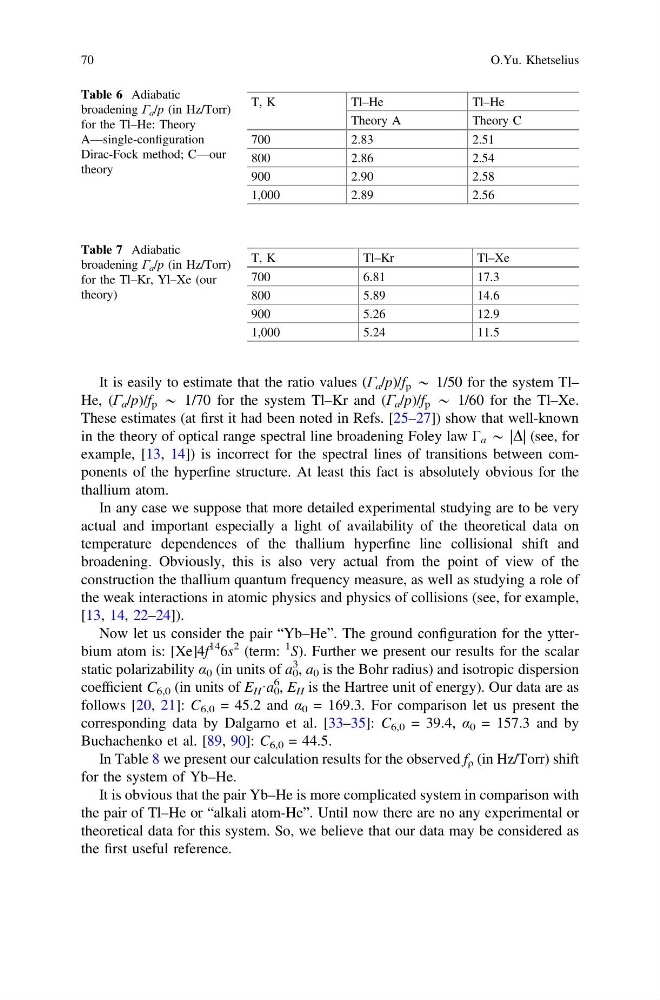
It is easily to estimate that the ratio values (Г a /p)/f p * 1/50 for the system Tl–
He, (Г a /p)/f p * 1/70 for the system Tl–Kr and (Г a /p)/f p * 1/60 for the Tl–Xe.
These estimates (at first it had been noted in Refs. [25–27]) show that well-known
in the theory of optical range spectral line broadening Foley law Г a * |D| (see, for
example, [13, 14]) is incorrect for the spectral lines of transitions between components of the hyperfine structure. At least this fact is absolutely obvious for the
thallium atom.
In any case we suppose that more detailed experimental studying are to be very
actual and important especially a light of availability of the theoretical data on
temperature dependences of the thallium hyperfine line collisional shift and
broadening. Obviously, this is also very actual from the point of view of the
construction the thallium quantum frequency measure, as well as studying a role of
the weak interactions in atomic physics and physics of collisions (see, for example,
[13, 14, 22–24]).
Now let us consider the pair “Yb–He”. The ground configuration for the ytterbium atom is: [Xe]4f
14 6s
2 (term:
1 S). Further we present our results for the scalar
static polarizability α 0 (in units of a 0
3 , a 0 is the Bohr radius) and isotropic dispersion
coefficient C 6,0 (in units of E H ·a 0
6 , E H is the Hartree unit of energy). Our data are as
follows [20, 21]: C 6,0 = 45.2 and α 0 = 169.3. For comparison let us present the
corresponding data by Dalgarno et al. [33–35]: C 6,0 = 39.4, α 0 = 157.3 and by
Buchachenko et al. [89, 90]: C 6,0 = 44.5.
In Table 8 we present our calculation results for the observed f ρ (in Hz/Torr) shift
for the system of Yb–He.
It is obvious that the pair Yb–He is more complicated system in comparison with
the pair of Tl–He or “alkali atom-He”. Until now there are no any experimental or
theoretical data for this system. So, we believe that our data may be considered as
the first useful reference.
Table 6 Adiabatic
broadening Г a /p (in Hz/Torr)
for the Tl–He: Theory
A—single-configuration
Dirac-Fock method; C—our
theory
T, K
Tl–He
Tl–He
Theory A
Theory C
700
2.83
2.51
800
2.86
2.54
900
2.90
2.58
1,000
2.89
2.56
Table 7 Adiabatic
broadening Г a /p (in Hz/Torr)
for the Tl–Kr, Yl–Xe (our
theory)
T, K
Tl–Kr
Tl–Xe
700
6.81
17.3
800
5.89
14.6
900
5.26
12.9
1,000
5.24
11.5
70
O.Yu. Khetselius
He, (Г a /p)/f p * 1/70 for the system Tl–Kr and (Г a /p)/f p * 1/60 for the Tl–Xe.
These estimates (at first it had been noted in Refs. [25–27]) show that well-known
in the theory of optical range spectral line broadening Foley law Г a * |D| (see, for
example, [13, 14]) is incorrect for the spectral lines of transitions between components of the hyperfine structure. At least this fact is absolutely obvious for the
thallium atom.
In any case we suppose that more detailed experimental studying are to be very
actual and important especially a light of availability of the theoretical data on
temperature dependences of the thallium hyperfine line collisional shift and
broadening. Obviously, this is also very actual from the point of view of the
construction the thallium quantum frequency measure, as well as studying a role of
the weak interactions in atomic physics and physics of collisions (see, for example,
[13, 14, 22–24]).
Now let us consider the pair “Yb–He”. The ground configuration for the ytterbium atom is: [Xe]4f
14 6s
2 (term:
1 S). Further we present our results for the scalar
static polarizability α 0 (in units of a 0
3 , a 0 is the Bohr radius) and isotropic dispersion
coefficient C 6,0 (in units of E H ·a 0
6 , E H is the Hartree unit of energy). Our data are as
follows [20, 21]: C 6,0 = 45.2 and α 0 = 169.3. For comparison let us present the
corresponding data by Dalgarno et al. [33–35]: C 6,0 = 39.4, α 0 = 157.3 and by
Buchachenko et al. [89, 90]: C 6,0 = 44.5.
In Table 8 we present our calculation results for the observed f ρ (in Hz/Torr) shift
for the system of Yb–He.
It is obvious that the pair Yb–He is more complicated system in comparison with
the pair of Tl–He or “alkali atom-He”. Until now there are no any experimental or
theoretical data for this system. So, we believe that our data may be considered as
the first useful reference.
Table 6 Adiabatic
broadening Г a /p (in Hz/Torr)
for the Tl–He: Theory
A—single-configuration
Dirac-Fock method; C—our
theory
T, K
Tl–He
Tl–He
Theory A
Theory C
700
2.83
2.51
800
2.86
2.54
900
2.90
2.58
1,000
2.89
2.56
Table 7 Adiabatic
broadening Г a /p (in Hz/Torr)
for the Tl–Kr, Yl–Xe (our
theory)
T, K
Tl–Kr
Tl–Xe
700
6.81
17.3
800
5.89
14.6
900
5.26
12.9
1,000
5.24
11.5
70
O.Yu. Khetselius