

5 Conclusions
We have performed TDDFT calculations on a range of silver tetrahedral nanoparticle sizes using time domain and frequency domain methods. The optical
response of the silver tetrahedral nanoparticles can be characterized as having a
dominant intraband transition around 3 eV, with the smallest clusters being blue
shifted relative to the larger clusters. The three codes we considered all give similar
results for optical spectra and state densities when the functionals, basis sets and
pseudopotentials are chosen to be as similar as possible. This is an encouraging
result, as it means that we can use the different methods somewhat interchangeably.
Using RT-TDDFT we have also determined that both GGA and LDA exchangecorrelation functionals give similar optical response. It is important to use an
appropriate basis set that includes 11 valence electrons for each silver atom and
accurately describes the D orbitals. Using NWChem and ADF, both FD-TDDFT
methods, we found that a smaller basis set is sufficient for determining linear
response properties and the poles of the response function.
The electronic transitions can be described as a linear combination of single
particle transitions from occupied atomic orbitals to unoccupied atomic orbitals. It
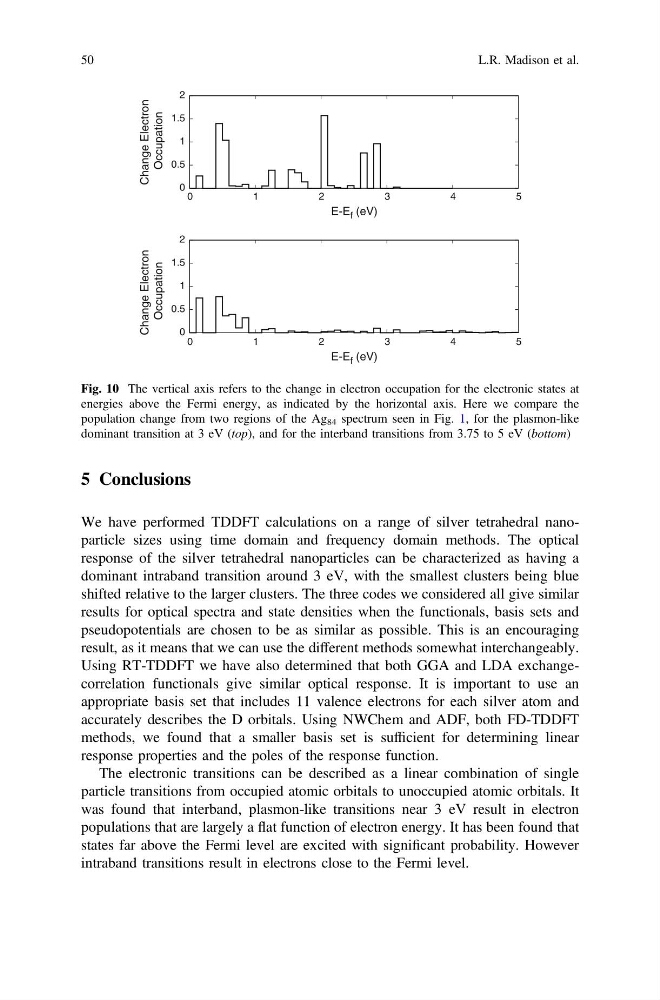
was found that interband, plasmon-like transitions near 3 eV result in electron
populations that are largely a flat function of electron energy. It has been found that
states far above the Fermi level are excited with significant probability. However
intraband transitions result in electrons close to the Fermi level.
0
0.5
1
1.5
2
0
1
2
3
4
5
Change Electron
Occupation
E-E f (eV)
0
0.5
1
1.5
2
0
1
2
3
4
5
Change Electron
Occupation
E-E f (eV)
Fig. 10 The vertical axis refers to the change in electron occupation for the electronic states at
energies above the Fermi energy, as indicated by the horizontal axis. Here we compare the
population change from two regions of the Ag 84 spectrum seen in Fig. 1, for the plasmon-like
dominant transition at 3 eV (top), and for the interband transitions from 3.75 to 5 eV (bottom)
50
L.R. Madison et al.
We have performed TDDFT calculations on a range of silver tetrahedral nanoparticle sizes using time domain and frequency domain methods. The optical
response of the silver tetrahedral nanoparticles can be characterized as having a
dominant intraband transition around 3 eV, with the smallest clusters being blue
shifted relative to the larger clusters. The three codes we considered all give similar
results for optical spectra and state densities when the functionals, basis sets and
pseudopotentials are chosen to be as similar as possible. This is an encouraging
result, as it means that we can use the different methods somewhat interchangeably.
Using RT-TDDFT we have also determined that both GGA and LDA exchangecorrelation functionals give similar optical response. It is important to use an
appropriate basis set that includes 11 valence electrons for each silver atom and
accurately describes the D orbitals. Using NWChem and ADF, both FD-TDDFT
methods, we found that a smaller basis set is sufficient for determining linear
response properties and the poles of the response function.
The electronic transitions can be described as a linear combination of single
particle transitions from occupied atomic orbitals to unoccupied atomic orbitals. It
was found that interband, plasmon-like transitions near 3 eV result in electron
populations that are largely a flat function of electron energy. It has been found that
states far above the Fermi level are excited with significant probability. However
intraband transitions result in electrons close to the Fermi level.
0
0.5
1
1.5
2
0
1
2
3
4
5
Change Electron
Occupation
E-E f (eV)
0
0.5
1
1.5
2
0
1
2
3
4
5
Change Electron
Occupation
E-E f (eV)
Fig. 10 The vertical axis refers to the change in electron occupation for the electronic states at
energies above the Fermi energy, as indicated by the horizontal axis. Here we compare the
population change from two regions of the Ag 84 spectrum seen in Fig. 1, for the plasmon-like
dominant transition at 3 eV (top), and for the interband transitions from 3.75 to 5 eV (bottom)
50
L.R. Madison et al.