

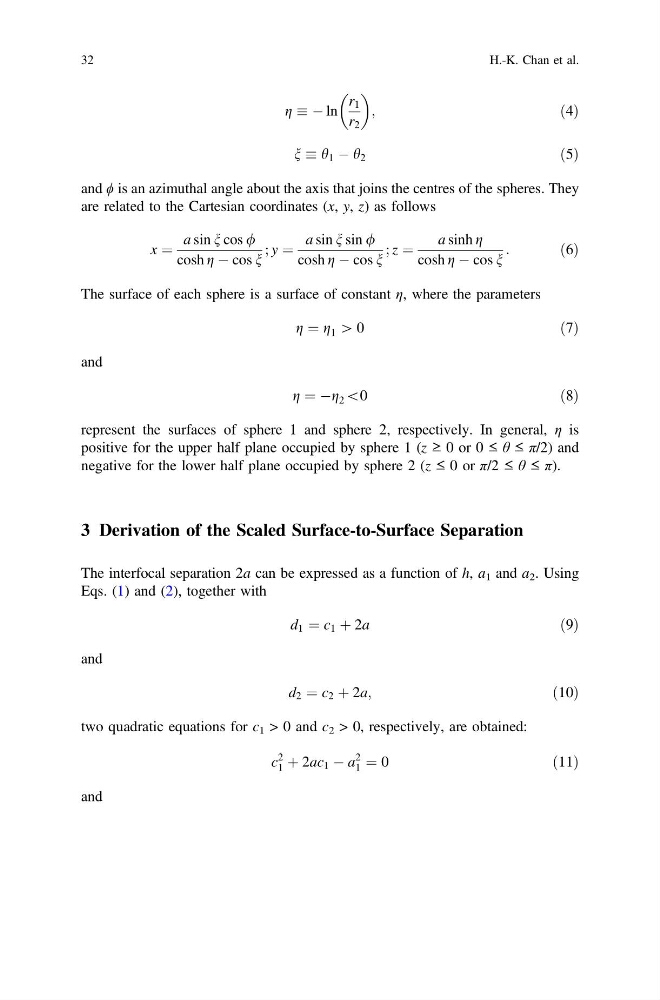
g À ln
r 1
r 2
;
ð4Þ
n h 1 À h 2
ð5Þ
and ϕ is an azimuthal angle about the axis that joins the centres of the spheres. They
are related to the Cartesian coordinates (x, y, z) as follows
x ¼
a sin n cos /
cosh g À cos n
; y ¼
a sin n sin /
cosh g À cos n
; z ¼
a sinh g
cosh g À cos n
:
ð6Þ
The surface of each sphere is a surface of constant η, where the parameters
g ¼ g 1 [ 0
ð7Þ
and
g ¼ Àg 2 \0
ð8Þ
represent the surfaces of sphere 1 and sphere 2, respectively. In general, η is
positive for the upper half plane occupied by sphere 1 (z ≥ 0 or 0 ≤ θ ≤ π/2) and
negative for the lower half plane occupied by sphere 2 (z ≤ 0 or π/2 ≤ θ ≤ π).
3 Derivation of the Scaled Surface-to-Surface Separation
The interfocal separation 2a can be expressed as a function of h, a 1 and a 2 . Using
Eqs. (1) and (2), together with
d 1 ¼ c 1 þ 2a
ð9Þ
and
d 2 ¼ c 2 þ 2a;
ð10Þ
two quadratic equations for c 1 > 0 and c 2 > 0, respectively, are obtained:
c
2
1 þ 2ac 1 À a
2
1 ¼ 0
ð11Þ
and
32
H.-K. Chan et al.
r 1
r 2
;
ð4Þ
n h 1 À h 2
ð5Þ
and ϕ is an azimuthal angle about the axis that joins the centres of the spheres. They
are related to the Cartesian coordinates (x, y, z) as follows
x ¼
a sin n cos /
cosh g À cos n
; y ¼
a sin n sin /
cosh g À cos n
; z ¼
a sinh g
cosh g À cos n
:
ð6Þ
The surface of each sphere is a surface of constant η, where the parameters
g ¼ g 1 [ 0
ð7Þ
and
g ¼ Àg 2 \0
ð8Þ
represent the surfaces of sphere 1 and sphere 2, respectively. In general, η is
positive for the upper half plane occupied by sphere 1 (z ≥ 0 or 0 ≤ θ ≤ π/2) and
negative for the lower half plane occupied by sphere 2 (z ≤ 0 or π/2 ≤ θ ≤ π).
3 Derivation of the Scaled Surface-to-Surface Separation
The interfocal separation 2a can be expressed as a function of h, a 1 and a 2 . Using
Eqs. (1) and (2), together with
d 1 ¼ c 1 þ 2a
ð9Þ
and
d 2 ¼ c 2 þ 2a;
ð10Þ
two quadratic equations for c 1 > 0 and c 2 > 0, respectively, are obtained:
c
2
1 þ 2ac 1 À a
2
1 ¼ 0
ð11Þ
and
32
H.-K. Chan et al.