

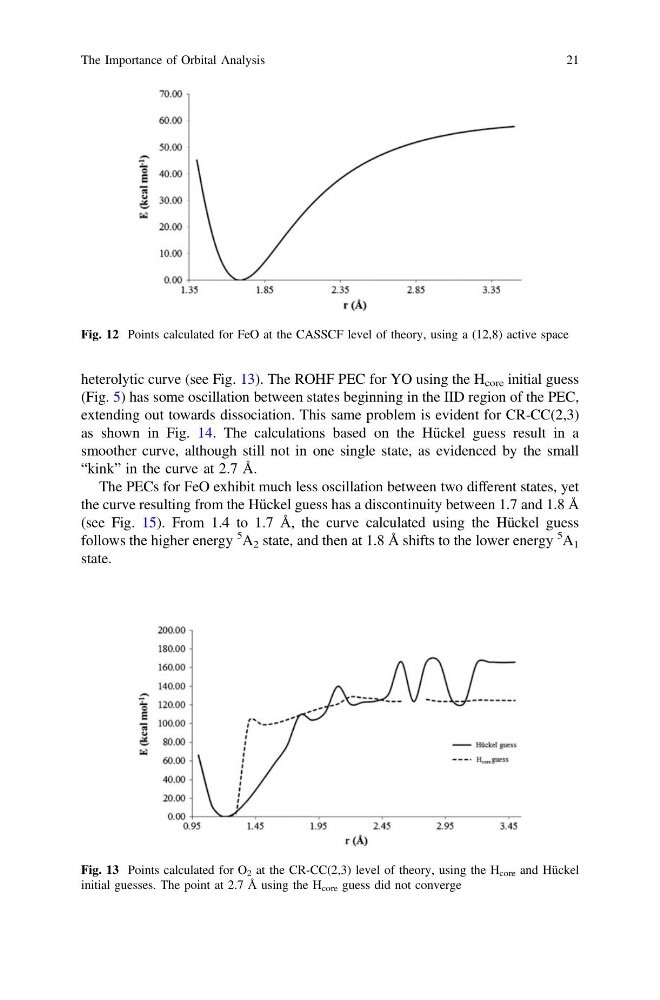
heterolytic curve (see Fig. 13). The ROHF PEC for YO using the H core initial guess
(Fig. 5) has some oscillation between states beginning in the IID region of the PEC,
extending out towards dissociation. This same problem is evident for CR-CC(2,3)
as shown in Fig. 14. The calculations based on the Hückel guess result in a
smoother curve, although still not in one single state, as evidenced by the small
“kink” in the curve at 2.7 Å.
The PECs for FeO exhibit much less oscillation between two different states, yet
the curve resulting from the Hückel guess has a discontinuity between 1.7 and 1.8 Å
(see Fig. 15). From 1.4 to 1.7 Å, the curve calculated using the Hückel guess
follows the higher energy
5 A 2 state, and then at 1.8 Å shifts to the lower energy
5
A 1
state.
Fig. 12 Points calculated for FeO at the CASSCF level of theory, using a (12,8) active space
Fig. 13 Points calculated for O 2 at the CR-CC(2,3) level of theory, using the H core and Hückel
initial guesses. The point at 2.7 Å using the H core guess did not converge
The Importance of Orbital Analysis
21
(Fig. 5) has some oscillation between states beginning in the IID region of the PEC,
extending out towards dissociation. This same problem is evident for CR-CC(2,3)
as shown in Fig. 14. The calculations based on the Hückel guess result in a
smoother curve, although still not in one single state, as evidenced by the small
“kink” in the curve at 2.7 Å.
The PECs for FeO exhibit much less oscillation between two different states, yet
the curve resulting from the Hückel guess has a discontinuity between 1.7 and 1.8 Å
(see Fig. 15). From 1.4 to 1.7 Å, the curve calculated using the Hückel guess
follows the higher energy
5 A 2 state, and then at 1.8 Å shifts to the lower energy
5
A 1
state.
Fig. 12 Points calculated for FeO at the CASSCF level of theory, using a (12,8) active space
Fig. 13 Points calculated for O 2 at the CR-CC(2,3) level of theory, using the H core and Hückel
initial guesses. The point at 2.7 Å using the H core guess did not converge
The Importance of Orbital Analysis
21