

Fe
2+ O
2− , then Fe exists in the
5 D state with a valence configuration of 4s
0 3d
6 .
Thus, it may be possible to cut the 4s orbital out of the active space if it is shown to
have negligible occupation at all internuclear distances, i.e. Fe is Fe(II) at all
internuclear distances. This would allow for a reduced active space of (12,8). The
smooth potential energy curve with this active space is shown in Fig. 12.
3.3.2 CR-CC(2,3) Results
If the ROHF wave function providing the reference for correlated calculations is not
correct, then the correlated calculations may be incorrect as well. The exception to
this would be full CI calculations, or coupled cluster or many-body perturbation
theory calculations that converge to full CI in the full expansion. These results are
independent of the reference wave function, yet a good reference will speed up
convergence. This is demonstrated by the PECs for O 2 , YO, and FeO (see Figs. 13,
14 and 15). The PECs for O 2 show the same oscillating behavior between the
homolytic and heterolytic dissociation states, yet the H core guess produces only the
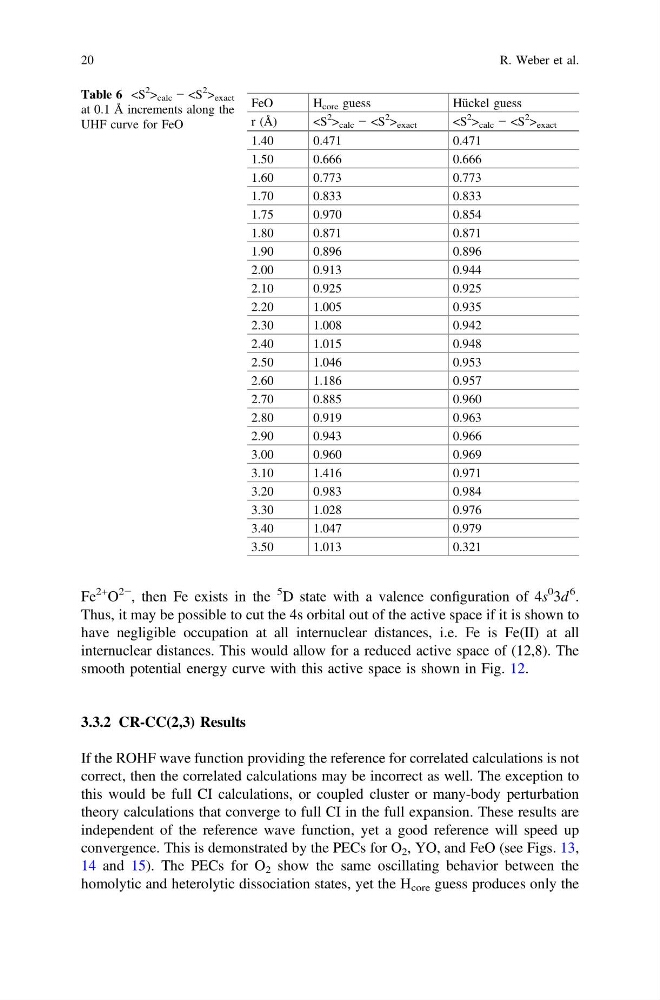
Table 6
> calc −
> exact
at 0.1 Å increments along the
UHF curve for FeO
FeO
H core guess
Hückel guess
r (Å)
< S
2
> calc −
> exact
> calc −
> exact
1.40
0.471
0.471
1.50
0.666
0.666
1.60
0.773
0.773
1.70
0.833
0.833
1.75
0.970
0.854
1.80
0.871
0.871
1.90
0.896
0.896
2.00
0.913
0.944
2.10
0.925
0.925
2.20
1.005
0.935
2.30
1.008
0.942
2.40
1.015
0.948
2.50
1.046
0.953
2.60
1.186
0.957
2.70
0.885
0.960
2.80
0.919
0.963
2.90
0.943
0.966
3.00
0.960
0.969
3.10
1.416
0.971
3.20
0.983
0.984
3.30
1.028
0.976
3.40
1.047
0.979
3.50
1.013
0.321
20
R. Weber et al.
2+ O
2− , then Fe exists in the
5 D state with a valence configuration of 4s
0 3d
6 .
Thus, it may be possible to cut the 4s orbital out of the active space if it is shown to
have negligible occupation at all internuclear distances, i.e. Fe is Fe(II) at all
internuclear distances. This would allow for a reduced active space of (12,8). The
smooth potential energy curve with this active space is shown in Fig. 12.
3.3.2 CR-CC(2,3) Results
If the ROHF wave function providing the reference for correlated calculations is not
correct, then the correlated calculations may be incorrect as well. The exception to
this would be full CI calculations, or coupled cluster or many-body perturbation
theory calculations that converge to full CI in the full expansion. These results are
independent of the reference wave function, yet a good reference will speed up
convergence. This is demonstrated by the PECs for O 2 , YO, and FeO (see Figs. 13,
14 and 15). The PECs for O 2 show the same oscillating behavior between the
homolytic and heterolytic dissociation states, yet the H core guess produces only the
Table 6
> calc −
> exact
at 0.1 Å increments along the
UHF curve for FeO
FeO
H core guess
Hückel guess
r (Å)
< S
2
> calc −
> exact
> calc −
> exact
1.40
0.471
0.471
1.50
0.666
0.666
1.60
0.773
0.773
1.70
0.833
0.833
1.75
0.970
0.854
1.80
0.871
0.871
1.90
0.896
0.896
2.00
0.913
0.944
2.10
0.925
0.925
2.20
1.005
0.935
2.30
1.008
0.942
2.40
1.015
0.948
2.50
1.046
0.953
2.60
1.186
0.957
2.70
0.885
0.960
2.80
0.919
0.963
2.90
0.943
0.966
3.00
0.960
0.969
3.10
1.416
0.971
3.20
0.983
0.984
3.30
1.028
0.976
3.40
1.047
0.979
3.50
1.013
0.321
20
R. Weber et al.