

3.3 Transition Metal Diatomics
The transition metal diatomics in the test set are ScO, FeO, TiO, YO, and ZrO. The
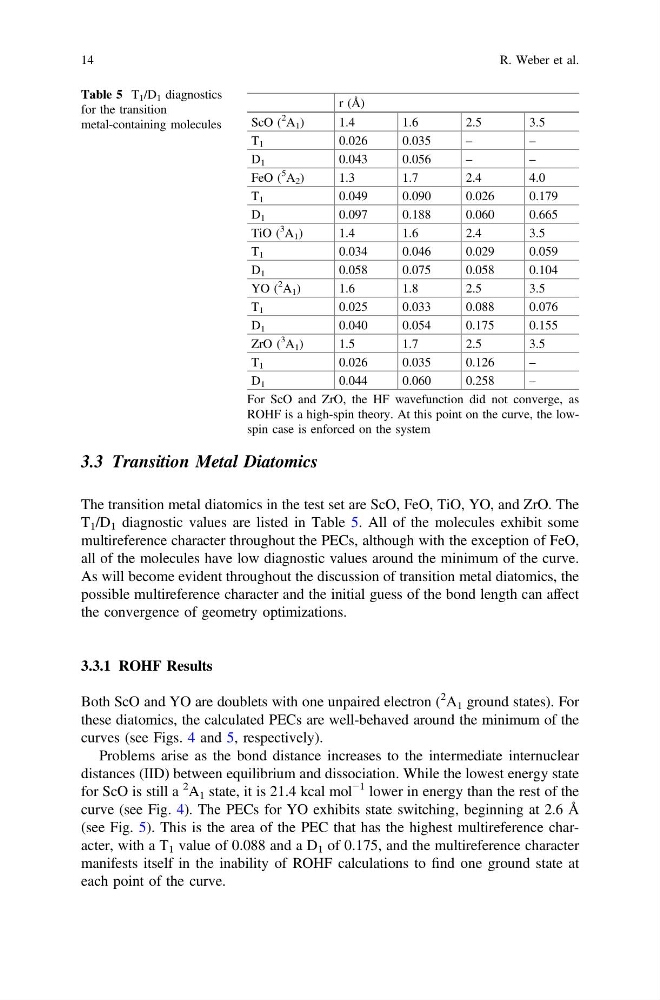
T 1 /D 1 diagnostic values are listed in Table 5. All of the molecules exhibit some
multireference character throughout the PECs, although with the exception of FeO,
all of the molecules have low diagnostic values around the minimum of the curve.
As will become evident throughout the discussion of transition metal diatomics, the
possible multireference character and the initial guess of the bond length can affect
the convergence of geometry optimizations.
3.3.1 ROHF Results
Both ScO and YO are doublets with one unpaired electron (
2 A 1 ground states). For
these diatomics, the calculated PECs are well-behaved around the minimum of the
curves (see Figs. 4 and 5, respectively).
Problems arise as the bond distance increases to the intermediate internuclear
distances (IID) between equilibrium and dissociation. While the lowest energy state
for ScO is still a
2 A 1 state, it is 21.4 kcal mol
−1 lower in energy than the rest of the
curve (see Fig. 4). The PECs for YO exhibits state switching, beginning at 2.6 Å
(see Fig. 5). This is the area of the PEC that has the highest multireference character, with a T 1 value of 0.088 and a D 1 of 0.175, and the multireference character
manifests itself in the inability of ROHF calculations to find one ground state at
each point of the curve.
Table 5 T 1 /D 1 diagnostics
for the transition
metal-containing molecules
r (Å)
ScO (
2
A 1 )
1.4
1.6
2.5
3.5
T 1
0.026
0.035
–
–
D 1
0.043
0.056
–
–
FeO (
5
A 2 )
1.3
1.7
2.4
4.0
T 1
0.049
0.090
0.026
0.179
D 1
0.097
0.188
0.060
0.665
TiO (
3
A 1 )
1.4
1.6
2.4
3.5
T 1
0.034
0.046
0.029
0.059
D 1
0.058
0.075
0.058
0.104
YO (
2
A 1 )
1.6
1.8
2.5
3.5
T 1
0.025
0.033
0.088
0.076
D 1
0.040
0.054
0.175
0.155
ZrO (
3
A 1 )
1.5
1.7
2.5
3.5
T 1
0.026
0.035
0.126
–
D 1
0.044
0.060
0.258
–
For ScO and ZrO, the HF wavefunction did not converge, as
ROHF is a high-spin theory. At this point on the curve, the lowspin case is enforced on the system
14
R. Weber et al.
The transition metal diatomics in the test set are ScO, FeO, TiO, YO, and ZrO. The
T 1 /D 1 diagnostic values are listed in Table 5. All of the molecules exhibit some
multireference character throughout the PECs, although with the exception of FeO,
all of the molecules have low diagnostic values around the minimum of the curve.
As will become evident throughout the discussion of transition metal diatomics, the
possible multireference character and the initial guess of the bond length can affect
the convergence of geometry optimizations.
3.3.1 ROHF Results
Both ScO and YO are doublets with one unpaired electron (
2 A 1 ground states). For
these diatomics, the calculated PECs are well-behaved around the minimum of the
curves (see Figs. 4 and 5, respectively).
Problems arise as the bond distance increases to the intermediate internuclear
distances (IID) between equilibrium and dissociation. While the lowest energy state
for ScO is still a
2 A 1 state, it is 21.4 kcal mol
−1 lower in energy than the rest of the
curve (see Fig. 4). The PECs for YO exhibits state switching, beginning at 2.6 Å
(see Fig. 5). This is the area of the PEC that has the highest multireference character, with a T 1 value of 0.088 and a D 1 of 0.175, and the multireference character
manifests itself in the inability of ROHF calculations to find one ground state at
each point of the curve.
Table 5 T 1 /D 1 diagnostics
for the transition
metal-containing molecules
r (Å)
ScO (
2
A 1 )
1.4
1.6
2.5
3.5
T 1
0.026
0.035
–
–
D 1
0.043
0.056
–
–
FeO (
5
A 2 )
1.3
1.7
2.4
4.0
T 1
0.049
0.090
0.026
0.179
D 1
0.097
0.188
0.060
0.665
TiO (
3
A 1 )
1.4
1.6
2.4
3.5
T 1
0.034
0.046
0.029
0.059
D 1
0.058
0.075
0.058
0.104
YO (
2
A 1 )
1.6
1.8
2.5
3.5
T 1
0.025
0.033
0.088
0.076
D 1
0.040
0.054
0.175
0.155
ZrO (
3
A 1 )
1.5
1.7
2.5
3.5
T 1
0.026
0.035
0.126
–
D 1
0.044
0.060
0.258
–
For ScO and ZrO, the HF wavefunction did not converge, as
ROHF is a high-spin theory. At this point on the curve, the lowspin case is enforced on the system
14
R. Weber et al.