

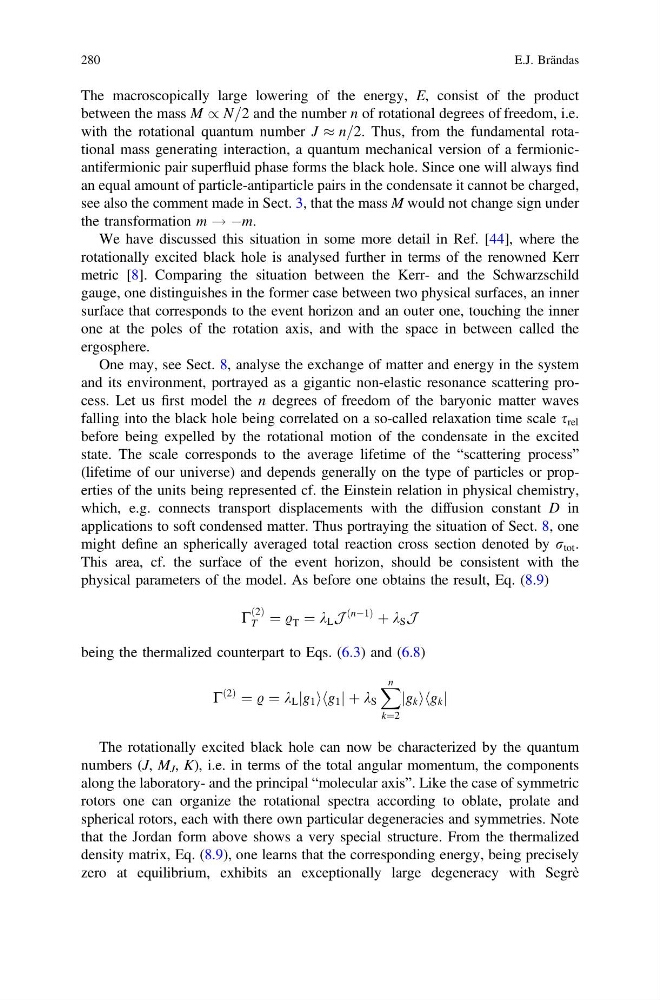
The macroscopically large lowering of the energy, E, consist of the product
between the mass M / N=2 and the number n of rotational degrees of freedom, i.e.
with the rotational quantum number J % n=2. Thus, from the fundamental rotational mass generating interaction, a quantum mechanical version of a fermionicantifermionic pair superfluid phase forms the black hole. Since one will always find
an equal amount of particle-antiparticle pairs in the condensate it cannot be charged,
see also the comment made in Sect. 3, that the mass M would not change sign under
the transformation m ! Àm.
We have discussed this situation in some more detail in Ref. [44], where the
rotationally excited black hole is analysed further in terms of the renowned Kerr
metric [8]. Comparing the situation between the Kerr- and the Schwarzschild
gauge, one distinguishes in the former case between two physical surfaces, an inner
surface that corresponds to the event horizon and an outer one, touching the inner
one at the poles of the rotation axis, and with the space in between called the
ergosphere.
One may, see Sect. 8, analyse the exchange of matter and energy in the system
and its environment, portrayed as a gigantic non-elastic resonance scattering process. Let us first model the n degrees of freedom of the baryonic matter waves
falling into the black hole being correlated on a so-called relaxation time scale s rel
before being expelled by the rotational motion of the condensate in the excited
state. The scale corresponds to the average lifetime of the “scattering process”
(lifetime of our universe) and depends generally on the type of particles or properties of the units being represented cf. the Einstein relation in physical chemistry,
which, e.g. connects transport displacements with the diffusion constant D in
applications to soft condensed matter. Thus portraying the situation of Sect. 8, one
might define an spherically averaged total reaction cross section denoted by r tot .
This area, cf. the surface of the event horizon, should be consistent with the
physical parameters of the model. As before one obtains the result, Eq. (8.9)
C
ð2Þ
T ¼ . T ¼ k L J
ðnÀ1Þ
þ k S J
being the thermalized counterpart to Eqs. (6.3) and (6.8)
C
ð2Þ
¼ . ¼ k L g 1
j i g 1
h j þ k S
X n
k¼2
g k
j i g k
h j
The rotationally excited black hole can now be characterized by the quantum
numbers (J, M J , K), i.e. in terms of the total angular momentum, the components
along the laboratory- and the principal “molecular axis”. Like the case of symmetric
rotors one can organize the rotational spectra according to oblate, prolate and
spherical rotors, each with there own particular degeneracies and symmetries. Note
that the Jordan form above shows a very special structure. From the thermalized
density matrix, Eq. (8.9), one learns that the corresponding energy, being precisely
zero at equilibrium, exhibits an exceptionally large degeneracy with Segrè
280
E.J. Brändas
between the mass M / N=2 and the number n of rotational degrees of freedom, i.e.
with the rotational quantum number J % n=2. Thus, from the fundamental rotational mass generating interaction, a quantum mechanical version of a fermionicantifermionic pair superfluid phase forms the black hole. Since one will always find
an equal amount of particle-antiparticle pairs in the condensate it cannot be charged,
see also the comment made in Sect. 3, that the mass M would not change sign under
the transformation m ! Àm.
We have discussed this situation in some more detail in Ref. [44], where the
rotationally excited black hole is analysed further in terms of the renowned Kerr
metric [8]. Comparing the situation between the Kerr- and the Schwarzschild
gauge, one distinguishes in the former case between two physical surfaces, an inner
surface that corresponds to the event horizon and an outer one, touching the inner
one at the poles of the rotation axis, and with the space in between called the
ergosphere.
One may, see Sect. 8, analyse the exchange of matter and energy in the system
and its environment, portrayed as a gigantic non-elastic resonance scattering process. Let us first model the n degrees of freedom of the baryonic matter waves
falling into the black hole being correlated on a so-called relaxation time scale s rel
before being expelled by the rotational motion of the condensate in the excited
state. The scale corresponds to the average lifetime of the “scattering process”
(lifetime of our universe) and depends generally on the type of particles or properties of the units being represented cf. the Einstein relation in physical chemistry,
which, e.g. connects transport displacements with the diffusion constant D in
applications to soft condensed matter. Thus portraying the situation of Sect. 8, one
might define an spherically averaged total reaction cross section denoted by r tot .
This area, cf. the surface of the event horizon, should be consistent with the
physical parameters of the model. As before one obtains the result, Eq. (8.9)
C
ð2Þ
T ¼ . T ¼ k L J
ðnÀ1Þ
þ k S J
being the thermalized counterpart to Eqs. (6.3) and (6.8)
C
ð2Þ
¼ . ¼ k L g 1
j i g 1
h j þ k S
X n
k¼2
g k
j i g k
h j
The rotationally excited black hole can now be characterized by the quantum
numbers (J, M J , K), i.e. in terms of the total angular momentum, the components
along the laboratory- and the principal “molecular axis”. Like the case of symmetric
rotors one can organize the rotational spectra according to oblate, prolate and
spherical rotors, each with there own particular degeneracies and symmetries. Note
that the Jordan form above shows a very special structure. From the thermalized
density matrix, Eq. (8.9), one learns that the corresponding energy, being precisely
zero at equilibrium, exhibits an exceptionally large degeneracy with Segrè
280
E.J. Brändas