

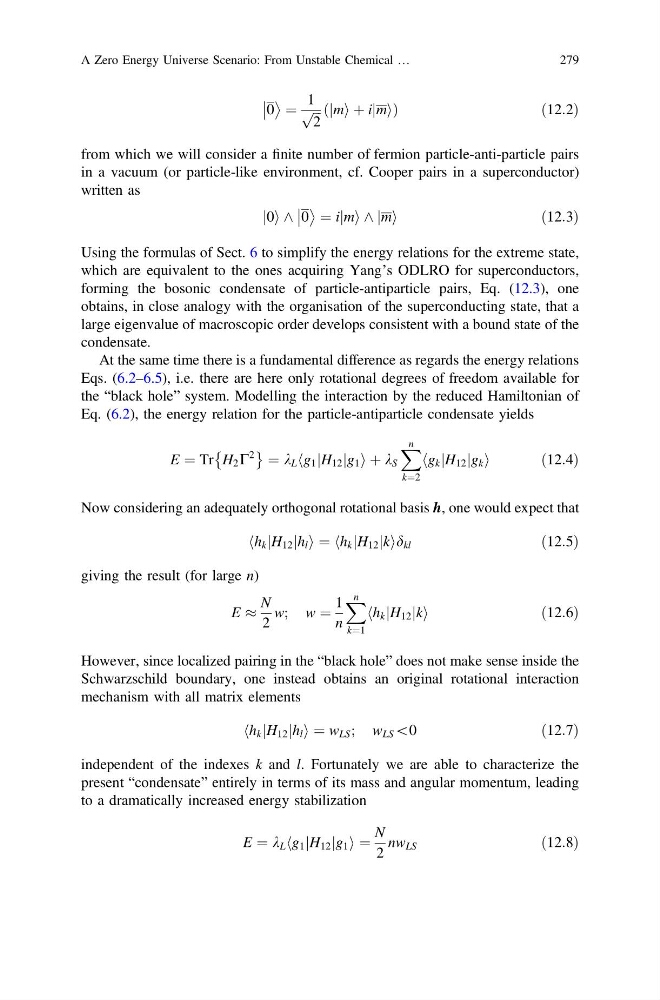
0
¼
1
ffiffi ffi
2
p ð m
j i þ i m
j iÞ
ð12:2Þ
from which we will consider a finite number of fermion particle-anti-particle pairs
in a vacuum (or particle-like environment, cf. Cooper pairs in a superconductor)
written as
0
j i ^ 0
¼ i m
j i ^ m
j i
ð12:3Þ
Using the formulas of Sect. 6 to simplify the energy relations for the extreme state,
which are equivalent to the ones acquiring Yang’s ODLRO for superconductors,
forming the bosonic condensate of particle-antiparticle pairs, Eq. (12.3), one
obtains, in close analogy with the organisation of the superconducting state, that a
large eigenvalue of macroscopic order develops consistent with a bound state of the
condensate.
At the same time there is a fundamental difference as regards the energy relations
Eqs. (6.2–6.5), i.e. there are here only rotational degrees of freedom available for
the “black hole” system. Modelling the interaction by the reduced Hamiltonian of
Eq. (6.2), the energy relation for the particle-antiparticle condensate yields
E ¼ Tr H 2 C
2
È
É ¼ k L g 1
h jH 12 g 1
j i þ k S
X n
k¼2
g k
h jH 12 g k
j i
ð12:4Þ
Now considering an adequately orthogonal rotational basis h, one would expect that
h k
h jH 12 h l
j i ¼ h k
h jH 12 k
j id kl
ð12:5Þ
giving the result (for large n)
E %
N
2
w; w ¼
1
n
X n
k¼1
h k
h jH 12 k
j i
ð12:6Þ
However, since localized pairing in the “black hole” does not make sense inside the
Schwarzschild boundary, one instead obtains an original rotational interaction
mechanism with all matrix elements
h k
h jH 12 h l
j i ¼ w LS ; w LS \0
ð12:7Þ
independent of the indexes k and l. Fortunately we are able to characterize the
present “condensate” entirely in terms of its mass and angular momentum, leading
to a dramatically increased energy stabilization
E ¼ k L g 1
h jH 12 g 1
j i ¼
N
2
nw LS
ð12:8Þ
A Zero Energy Universe Scenario: From Unstable Chemical …
279
¼
1
ffiffi ffi
2
p ð m
j i þ i m
j iÞ
ð12:2Þ
from which we will consider a finite number of fermion particle-anti-particle pairs
in a vacuum (or particle-like environment, cf. Cooper pairs in a superconductor)
written as
0
j i ^ 0
¼ i m
j i ^ m
j i
ð12:3Þ
Using the formulas of Sect. 6 to simplify the energy relations for the extreme state,
which are equivalent to the ones acquiring Yang’s ODLRO for superconductors,
forming the bosonic condensate of particle-antiparticle pairs, Eq. (12.3), one
obtains, in close analogy with the organisation of the superconducting state, that a
large eigenvalue of macroscopic order develops consistent with a bound state of the
condensate.
At the same time there is a fundamental difference as regards the energy relations
Eqs. (6.2–6.5), i.e. there are here only rotational degrees of freedom available for
the “black hole” system. Modelling the interaction by the reduced Hamiltonian of
Eq. (6.2), the energy relation for the particle-antiparticle condensate yields
E ¼ Tr H 2 C
2
È
É ¼ k L g 1
h jH 12 g 1
j i þ k S
X n
k¼2
g k
h jH 12 g k
j i
ð12:4Þ
Now considering an adequately orthogonal rotational basis h, one would expect that
h k
h jH 12 h l
j i ¼ h k
h jH 12 k
j id kl
ð12:5Þ
giving the result (for large n)
E %
N
2
w; w ¼
1
n
X n
k¼1
h k
h jH 12 k
j i
ð12:6Þ
However, since localized pairing in the “black hole” does not make sense inside the
Schwarzschild boundary, one instead obtains an original rotational interaction
mechanism with all matrix elements
h k
h jH 12 h l
j i ¼ w LS ; w LS \0
ð12:7Þ
independent of the indexes k and l. Fortunately we are able to characterize the
present “condensate” entirely in terms of its mass and angular momentum, leading
to a dramatically increased energy stabilization
E ¼ k L g 1
h jH 12 g 1
j i ¼
N
2
nw LS
ð12:8Þ
A Zero Energy Universe Scenario: From Unstable Chemical …
279