

12
6
6
4
4
4
3
3
3
3
12
2
2
2
2
2
2
12
3
3
3
3
4
4
4
6
6
12
ð11:1Þ
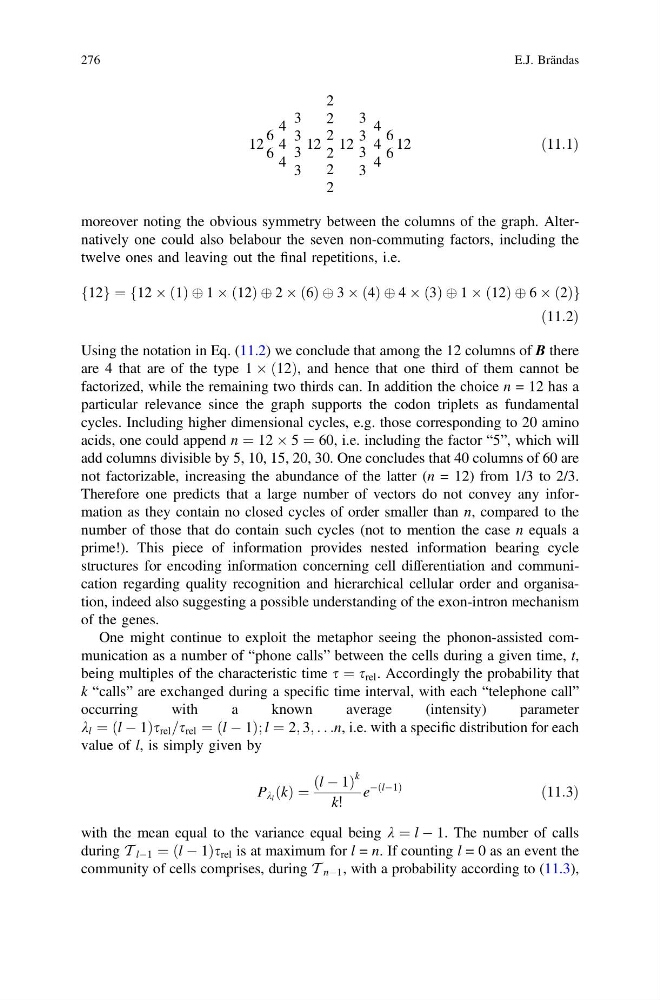
moreover noting the obvious symmetry between the columns of the graph. Alternatively one could also belabour the seven non-commuting factors, including the
twelve ones and leaving out the final repetitions, i.e.
12
f g ¼ 12 Â 1
ð Þ È 1 Â 12
ð Þ È 2 Â 6
ð Þ È 3 Â 4
ð Þ È 4 Â 3
ð Þ È 1 Â 12
ð Þ È 6 Â 2
ð Þ
f
g
ð11:2Þ
Using the notation in Eq. (11.2) we conclude that among the 12 columns of B there
are 4 that are of the type 1 Â ð12Þ, and hence that one third of them cannot be
factorized, while the remaining two thirds can. In addition the choice n = 12 has a
particular relevance since the graph supports the codon triplets as fundamental
cycles. Including higher dimensional cycles, e.g. those corresponding to 20 amino
acids, one could append n ¼ 12 Â 5 ¼ 60, i.e. including the factor “5”, which will
add columns divisible by 5, 10, 15, 20, 30. One concludes that 40 columns of 60 are
not factorizable, increasing the abundance of the latter (n = 12) from 1/3 to 2/3.
Therefore one predicts that a large number of vectors do not convey any information as they contain no closed cycles of order smaller than n, compared to the
number of those that do contain such cycles (not to mention the case n equals a
prime!). This piece of information provides nested information bearing cycle
structures for encoding information concerning cell differentiation and communication regarding quality recognition and hierarchical cellular order and organisation, indeed also suggesting a possible understanding of the exon-intron mechanism
of the genes.
One might continue to exploit the metaphor seeing the phonon-assisted communication as a number of “phone calls” between the cells during a given time, t,
being multiples of the characteristic time s ¼ s rel . Accordingly the probability that
k “calls” are exchanged during a specific time interval, with each “telephone call”
occurring
with
a
known
average
(intensity)
parameter
k l ¼ l À 1
ð
Þs rel =s rel ¼ l À 1
ð
Þ; l ¼ 2; 3; . . .n, i.e. with a specific distribution for each
value of l, is simply given by
P k l k
ð Þ ¼
l À 1
ð
Þ
k
k!
e
À lÀ1
ð
Þ
ð11:3Þ
with the mean equal to the variance equal being k ¼ l À 1. The number of calls
during T lÀ1 ¼ ðl À 1Þs rel is at maximum for l = n. If counting l = 0 as an event the
community of cells comprises, during T nÀ1 , with a probability according to (11.3),
276
E.J. Brändas
6
6
4
4
4
3
3
3
3
12
2
2
2
2
2
2
12
3
3
3
3
4
4
4
6
6
12
ð11:1Þ
moreover noting the obvious symmetry between the columns of the graph. Alternatively one could also belabour the seven non-commuting factors, including the
twelve ones and leaving out the final repetitions, i.e.
12
f g ¼ 12 Â 1
ð Þ È 1 Â 12
ð Þ È 2 Â 6
ð Þ È 3 Â 4
ð Þ È 4 Â 3
ð Þ È 1 Â 12
ð Þ È 6 Â 2
ð Þ
f
g
ð11:2Þ
Using the notation in Eq. (11.2) we conclude that among the 12 columns of B there
are 4 that are of the type 1 Â ð12Þ, and hence that one third of them cannot be
factorized, while the remaining two thirds can. In addition the choice n = 12 has a
particular relevance since the graph supports the codon triplets as fundamental
cycles. Including higher dimensional cycles, e.g. those corresponding to 20 amino
acids, one could append n ¼ 12 Â 5 ¼ 60, i.e. including the factor “5”, which will
add columns divisible by 5, 10, 15, 20, 30. One concludes that 40 columns of 60 are
not factorizable, increasing the abundance of the latter (n = 12) from 1/3 to 2/3.
Therefore one predicts that a large number of vectors do not convey any information as they contain no closed cycles of order smaller than n, compared to the
number of those that do contain such cycles (not to mention the case n equals a
prime!). This piece of information provides nested information bearing cycle
structures for encoding information concerning cell differentiation and communication regarding quality recognition and hierarchical cellular order and organisation, indeed also suggesting a possible understanding of the exon-intron mechanism
of the genes.
One might continue to exploit the metaphor seeing the phonon-assisted communication as a number of “phone calls” between the cells during a given time, t,
being multiples of the characteristic time s ¼ s rel . Accordingly the probability that
k “calls” are exchanged during a specific time interval, with each “telephone call”
occurring
with
a
known
average
(intensity)
parameter
k l ¼ l À 1
ð
Þs rel =s rel ¼ l À 1
ð
Þ; l ¼ 2; 3; . . .n, i.e. with a specific distribution for each
value of l, is simply given by
P k l k
ð Þ ¼
l À 1
ð
Þ
k
k!
e
À lÀ1
ð
Þ
ð11:3Þ
with the mean equal to the variance equal being k ¼ l À 1. The number of calls
during T lÀ1 ¼ ðl À 1Þs rel is at maximum for l = n. If counting l = 0 as an event the
community of cells comprises, during T nÀ1 , with a probability according to (11.3),
276
E.J. Brändas