

particular entry in the string the choice between two pairs, AT (AG in RNA) and
GT. Note also that this version prompts information capacities in bits, but because
of the reduced density matrix formalism the formulation exhibits quantum
mechanical linearity (linear in an n-dimensional space) in contrast to the full
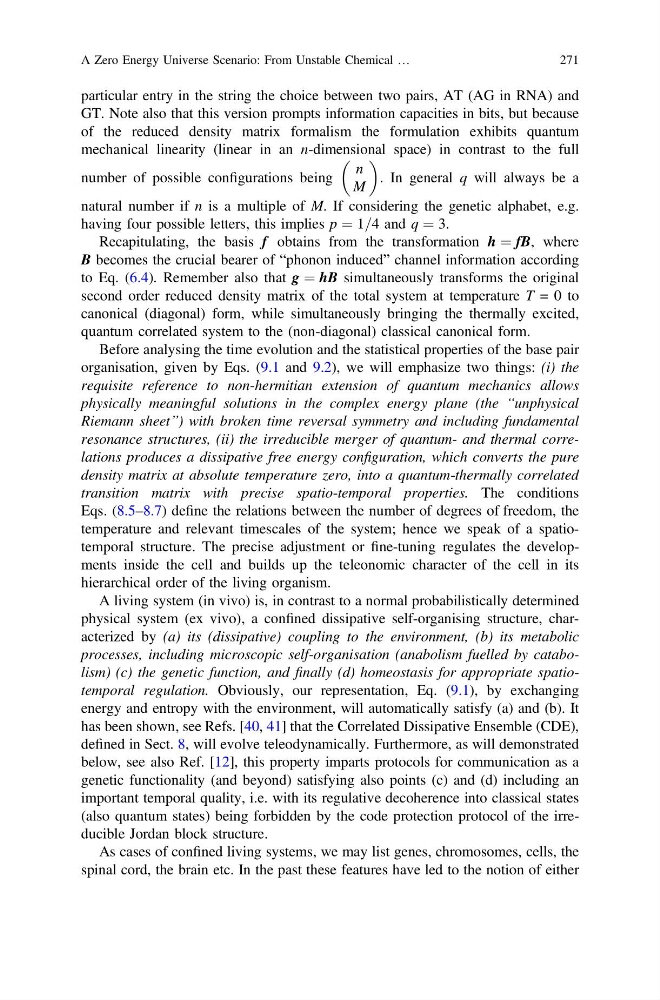
number of possible configurations being
n
M
. In general q will always be a
natural number if n is a multiple of M. If considering the genetic alphabet, e.g.
having four possible letters, this implies p ¼ 1=4 and q ¼ 3.
Recapitulating, the basis f obtains from the transformation h ¼ fB, where
B becomes the crucial bearer of “phonon induced” channel information according
to Eq. (6.4). Remember also that g ¼ hB simultaneously transforms the original
second order reduced density matrix of the total system at temperature T = 0 to
canonical (diagonal) form, while simultaneously bringing the thermally excited,
quantum correlated system to the (non-diagonal) classical canonical form.
Before analysing the time evolution and the statistical properties of the base pair
organisation, given by Eqs. (9.1 and 9.2), we will emphasize two things: (i) the
requisite reference to non-hermitian extension of quantum mechanics allows
physically meaningful solutions in the complex energy plane (the “unphysical
Riemann sheet”) with broken time reversal symmetry and including fundamental
resonance structures, (ii) the irreducible merger of quantum- and thermal correlations produces a dissipative free energy configuration, which converts the pure
density matrix at absolute temperature zero, into a quantum-thermally correlated
transition matrix with precise spatio-temporal properties. The conditions
Eqs. (8.5–8.7) define the relations between the number of degrees of freedom, the
temperature and relevant timescales of the system; hence we speak of a spatiotemporal structure. The precise adjustment or fine-tuning regulates the developments inside the cell and builds up the teleonomic character of the cell in its
hierarchical order of the living organism.
A living system (in vivo) is, in contrast to a normal probabilistically determined
physical system (ex vivo), a confined dissipative self-organising structure, characterized by (a) its (dissipative) coupling to the environment, (b) its metabolic
processes, including microscopic self-organisation (anabolism fuelled by catabolism) (c) the genetic function, and finally (d) homeostasis for appropriate spatiotemporal regulation. Obviously, our representation, Eq. (9.1), by exchanging
energy and entropy with the environment, will automatically satisfy (a) and (b). It
has been shown, see Refs. [40, 41] that the Correlated Dissipative Ensemble (CDE),
defined in Sect. 8, will evolve teleodynamically. Furthermore, as will demonstrated
below, see also Ref. [12], this property imparts protocols for communication as a
genetic functionality (and beyond) satisfying also points (c) and (d) including an
important temporal quality, i.e. with its regulative decoherence into classical states
(also quantum states) being forbidden by the code protection protocol of the irreducible Jordan block structure.
As cases of confined living systems, we may list genes, chromosomes, cells, the
spinal cord, the brain etc. In the past these features have led to the notion of either
A Zero Energy Universe Scenario: From Unstable Chemical …
271
GT. Note also that this version prompts information capacities in bits, but because
of the reduced density matrix formalism the formulation exhibits quantum
mechanical linearity (linear in an n-dimensional space) in contrast to the full
number of possible configurations being
n
M
. In general q will always be a
natural number if n is a multiple of M. If considering the genetic alphabet, e.g.
having four possible letters, this implies p ¼ 1=4 and q ¼ 3.
Recapitulating, the basis f obtains from the transformation h ¼ fB, where
B becomes the crucial bearer of “phonon induced” channel information according
to Eq. (6.4). Remember also that g ¼ hB simultaneously transforms the original
second order reduced density matrix of the total system at temperature T = 0 to
canonical (diagonal) form, while simultaneously bringing the thermally excited,
quantum correlated system to the (non-diagonal) classical canonical form.
Before analysing the time evolution and the statistical properties of the base pair
organisation, given by Eqs. (9.1 and 9.2), we will emphasize two things: (i) the
requisite reference to non-hermitian extension of quantum mechanics allows
physically meaningful solutions in the complex energy plane (the “unphysical
Riemann sheet”) with broken time reversal symmetry and including fundamental
resonance structures, (ii) the irreducible merger of quantum- and thermal correlations produces a dissipative free energy configuration, which converts the pure
density matrix at absolute temperature zero, into a quantum-thermally correlated
transition matrix with precise spatio-temporal properties. The conditions
Eqs. (8.5–8.7) define the relations between the number of degrees of freedom, the
temperature and relevant timescales of the system; hence we speak of a spatiotemporal structure. The precise adjustment or fine-tuning regulates the developments inside the cell and builds up the teleonomic character of the cell in its
hierarchical order of the living organism.
A living system (in vivo) is, in contrast to a normal probabilistically determined
physical system (ex vivo), a confined dissipative self-organising structure, characterized by (a) its (dissipative) coupling to the environment, (b) its metabolic
processes, including microscopic self-organisation (anabolism fuelled by catabolism) (c) the genetic function, and finally (d) homeostasis for appropriate spatiotemporal regulation. Obviously, our representation, Eq. (9.1), by exchanging
energy and entropy with the environment, will automatically satisfy (a) and (b). It
has been shown, see Refs. [40, 41] that the Correlated Dissipative Ensemble (CDE),
defined in Sect. 8, will evolve teleodynamically. Furthermore, as will demonstrated
below, see also Ref. [12], this property imparts protocols for communication as a
genetic functionality (and beyond) satisfying also points (c) and (d) including an
important temporal quality, i.e. with its regulative decoherence into classical states
(also quantum states) being forbidden by the code protection protocol of the irreducible Jordan block structure.
As cases of confined living systems, we may list genes, chromosomes, cells, the
spinal cord, the brain etc. In the past these features have led to the notion of either
A Zero Energy Universe Scenario: From Unstable Chemical …
271