

9 The CDE as a Spatio-Temporal Mnemonic
Configuration, STEM
Returning to the general issue portrayed in the introduction, we will use the Correlated Dissipative Ensemble, CDE, to examine complex enough examples
8 from
the biological field. As a background for this undertaking we remind the reader of
the important work of the leading evolutionary biologist of the twentieth century,
Ernst Mayr. In particular we revisit his concept of so-called biological teleonomic
processes, i.e. those influenced upon by an evolved program, cf. the genetic code,
Mayr [37, 38]. To do so we will reconnect with our main result of the previous
sections, i.e. the correlated free energy configuration, Eqs. (8.8–8.10).
In passing we note that the present result leads to a mathematical generalization
of the self-referential argument given in Sect. 4. While the translation of Gödel’s
paradox into a Jordan matrix of dimension two (the Segrè characteristic equals 2),
the dissipative structure of Eq. (8.9) contains an n-dimensional Jordan block, i.e.
with the Segrè characteristic equal to n. Although the situations between the two
scenarios are vastly different, we will demonstrate that such an analogy imparts
fundamental consequences for the (teleo-)dynamics of the dissipative system, cf.
the analogy between Gödel’s self-referential argument, translated to unconventional
algebraic form, and its identical gravitational formulation in terms of conjugate
physical observables.
For instance, in our portrayal of a complex enough biological system, the preferred basis h may represent important sites in the cell, reflecting the mirrorstructure between the light fermion-carriers and the nuclear dynamics, the latter
referring to the molecular double-proton tunnelling motion, see e.g. Löwdin [39] for
a simple illustrative account, of the various base pairs, adenine-thymine, AT, and
guanine-cytosine GT (and uracil instead of thymine in RNA).
In order to continue the build-up of a biological organisation, in terms of the
dissipative units just defined, we will characterize the cell C
i , as derived from the
molecular motion associated with the M base pairs, rewriting Eqs. (8.8–8.10) and
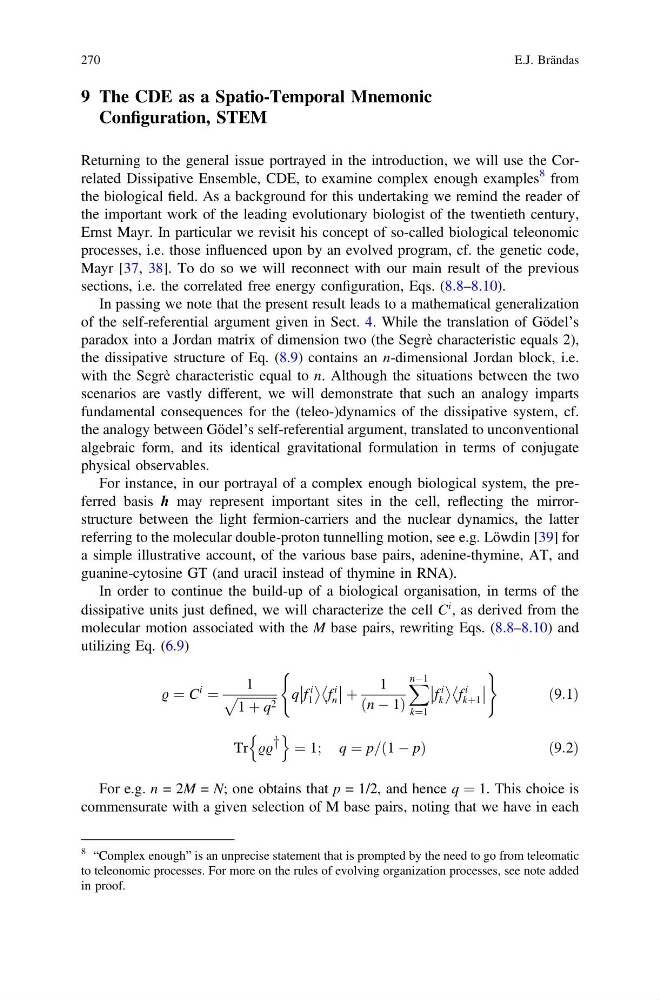
utilizing Eq. (6.9)
. ¼ C
i
¼
1
ffiffiffiffiffiffiffiffiffiffiffiffiffi
1 þ q 2
p
q f
i
1
f
i
n
þ
1
ðn À 1Þ
X nÀ1
k¼1
f
i
k
f
i
kþ1
(
)
ð9:1Þ
Tr .. y
n o
¼ 1; q ¼ p=ð1 À pÞ
ð 9:2Þ
For e.g. n = 2M = N; one obtains that p = 1/2, and hence q ¼ 1. This choice is
commensurate with a given selection of M base pairs, noting that we have in each
8 “Complex enough” is an unprecise statement that is prompted by the need to go from teleomatic
to teleonomic processes. For more on the rules of evolving organization processes, see note added
in proof.
270
E.J. Brändas
Configuration, STEM
Returning to the general issue portrayed in the introduction, we will use the Correlated Dissipative Ensemble, CDE, to examine complex enough examples
8 from
the biological field. As a background for this undertaking we remind the reader of
the important work of the leading evolutionary biologist of the twentieth century,
Ernst Mayr. In particular we revisit his concept of so-called biological teleonomic
processes, i.e. those influenced upon by an evolved program, cf. the genetic code,
Mayr [37, 38]. To do so we will reconnect with our main result of the previous
sections, i.e. the correlated free energy configuration, Eqs. (8.8–8.10).
In passing we note that the present result leads to a mathematical generalization
of the self-referential argument given in Sect. 4. While the translation of Gödel’s
paradox into a Jordan matrix of dimension two (the Segrè characteristic equals 2),
the dissipative structure of Eq. (8.9) contains an n-dimensional Jordan block, i.e.
with the Segrè characteristic equal to n. Although the situations between the two
scenarios are vastly different, we will demonstrate that such an analogy imparts
fundamental consequences for the (teleo-)dynamics of the dissipative system, cf.
the analogy between Gödel’s self-referential argument, translated to unconventional
algebraic form, and its identical gravitational formulation in terms of conjugate
physical observables.
For instance, in our portrayal of a complex enough biological system, the preferred basis h may represent important sites in the cell, reflecting the mirrorstructure between the light fermion-carriers and the nuclear dynamics, the latter
referring to the molecular double-proton tunnelling motion, see e.g. Löwdin [39] for
a simple illustrative account, of the various base pairs, adenine-thymine, AT, and
guanine-cytosine GT (and uracil instead of thymine in RNA).
In order to continue the build-up of a biological organisation, in terms of the
dissipative units just defined, we will characterize the cell C
i , as derived from the
molecular motion associated with the M base pairs, rewriting Eqs. (8.8–8.10) and
utilizing Eq. (6.9)
. ¼ C
i
¼
1
ffiffiffiffiffiffiffiffiffiffiffiffiffi
1 þ q 2
p
q f
i
1
f
i
n
þ
1
ðn À 1Þ
X nÀ1
k¼1
f
i
k
f
i
kþ1
(
)
ð9:1Þ
Tr .. y
n o
¼ 1; q ¼ p=ð1 À pÞ
ð 9:2Þ
For e.g. n = 2M = N; one obtains that p = 1/2, and hence q ¼ 1. This choice is
commensurate with a given selection of M base pairs, noting that we have in each
8 “Complex enough” is an unprecise statement that is prompted by the need to go from teleomatic
to teleonomic processes. For more on the rules of evolving organization processes, see note added
in proof.
270
E.J. Brändas