

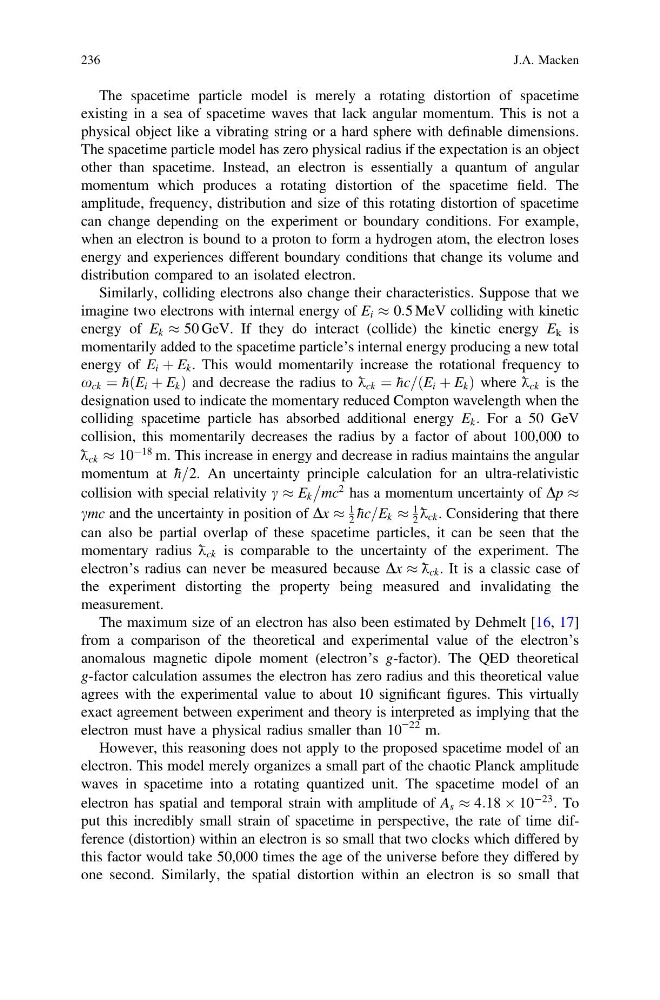
The spacetime particle model is merely a rotating distortion of spacetime
existing in a sea of spacetime waves that lack angular momentum. This is not a
physical object like a vibrating string or a hard sphere with definable dimensions.
The spacetime particle model has zero physical radius if the expectation is an object
other than spacetime. Instead, an electron is essentially a quantum of angular
momentum which produces a rotating distortion of the spacetime field. The
amplitude, frequency, distribution and size of this rotating distortion of spacetime
can change depending on the experiment or boundary conditions. For example,
when an electron is bound to a proton to form a hydrogen atom, the electron loses
energy and experiences different boundary conditions that change its volume and
distribution compared to an isolated electron.
Similarly, colliding electrons also change their characteristics. Suppose that we
imagine two electrons with internal energy of E i % 0:5 MeV colliding with kinetic
energy of E k % 50 GeV. If they do interact (collide) the kinetic energy E k is
momentarily added to the spacetime particle’s internal energy producing a new total
energy of E i þ E k . This would momentarily increase the rotational frequency to
x ck ¼ h E i þ E k
ð
Þand decrease the radius to
k ck ¼ hc= E i þ E k
ð
Þwhere
k ck is the
designation used to indicate the momentary reduced Compton wavelength when the
colliding spacetime particle has absorbed additional energy E k . For a 50 GeV
collision, this momentarily decreases the radius by a factor of about 100,000 to
k ck % 10
À18 m. This increase in energy and decrease in radius maintains the angular
momentum at h=2. An uncertainty principle calculation for an ultra-relativistic
collision with special relativity c % E k
mc
2 has a momentum uncertainty of Dp %
cmc and the uncertainty in position of Dx %
1
2 hc=E k %
1
2
k ck . Considering that there
can also be partial overlap of these spacetime particles, it can be seen that the
momentary radius
k ck is comparable to the uncertainty of the experiment. The
electron’s radius can never be measured because Dx %
k ck . It is a classic case of
the experiment distorting the property being measured and invalidating the
measurement.
The maximum size of an electron has also been estimated by Dehmelt [16, 17]
from a comparison of the theoretical and experimental value of the electron’s
anomalous magnetic dipole moment (electron’s g-factor). The QED theoretical
g-factor calculation assumes the electron has zero radius and this theoretical value
agrees with the experimental value to about 10 significant figures. This virtually
exact agreement between experiment and theory is interpreted as implying that the
electron must have a physical radius smaller than 10
−22 m.
However, this reasoning does not apply to the proposed spacetime model of an
electron. This model merely organizes a small part of the chaotic Planck amplitude
waves in spacetime into a rotating quantized unit. The spacetime model of an
electron has spatial and temporal strain with amplitude of A s % 4:18 Â 10
À23 . To
put this incredibly small strain of spacetime in perspective, the rate of time difference (distortion) within an electron is so small that two clocks which differed by
this factor would take 50,000 times the age of the universe before they differed by
one second. Similarly, the spatial distortion within an electron is so small that
236
J.A. Macken
existing in a sea of spacetime waves that lack angular momentum. This is not a
physical object like a vibrating string or a hard sphere with definable dimensions.
The spacetime particle model has zero physical radius if the expectation is an object
other than spacetime. Instead, an electron is essentially a quantum of angular
momentum which produces a rotating distortion of the spacetime field. The
amplitude, frequency, distribution and size of this rotating distortion of spacetime
can change depending on the experiment or boundary conditions. For example,
when an electron is bound to a proton to form a hydrogen atom, the electron loses
energy and experiences different boundary conditions that change its volume and
distribution compared to an isolated electron.
Similarly, colliding electrons also change their characteristics. Suppose that we
imagine two electrons with internal energy of E i % 0:5 MeV colliding with kinetic
energy of E k % 50 GeV. If they do interact (collide) the kinetic energy E k is
momentarily added to the spacetime particle’s internal energy producing a new total
energy of E i þ E k . This would momentarily increase the rotational frequency to
x ck ¼ h E i þ E k
ð
Þand decrease the radius to
k ck ¼ hc= E i þ E k
ð
Þwhere
k ck is the
designation used to indicate the momentary reduced Compton wavelength when the
colliding spacetime particle has absorbed additional energy E k . For a 50 GeV
collision, this momentarily decreases the radius by a factor of about 100,000 to
k ck % 10
À18 m. This increase in energy and decrease in radius maintains the angular
momentum at h=2. An uncertainty principle calculation for an ultra-relativistic
collision with special relativity c % E k
mc
2 has a momentum uncertainty of Dp %
cmc and the uncertainty in position of Dx %
1
2 hc=E k %
1
2
k ck . Considering that there
can also be partial overlap of these spacetime particles, it can be seen that the
momentary radius
k ck is comparable to the uncertainty of the experiment. The
electron’s radius can never be measured because Dx %
k ck . It is a classic case of
the experiment distorting the property being measured and invalidating the
measurement.
The maximum size of an electron has also been estimated by Dehmelt [16, 17]
from a comparison of the theoretical and experimental value of the electron’s
anomalous magnetic dipole moment (electron’s g-factor). The QED theoretical
g-factor calculation assumes the electron has zero radius and this theoretical value
agrees with the experimental value to about 10 significant figures. This virtually
exact agreement between experiment and theory is interpreted as implying that the
electron must have a physical radius smaller than 10
−22 m.
However, this reasoning does not apply to the proposed spacetime model of an
electron. This model merely organizes a small part of the chaotic Planck amplitude
waves in spacetime into a rotating quantized unit. The spacetime model of an
electron has spatial and temporal strain with amplitude of A s % 4:18 Â 10
À23 . To
put this incredibly small strain of spacetime in perspective, the rate of time difference (distortion) within an electron is so small that two clocks which differed by
this factor would take 50,000 times the age of the universe before they differed by
one second. Similarly, the spatial distortion within an electron is so small that
236
J.A. Macken