

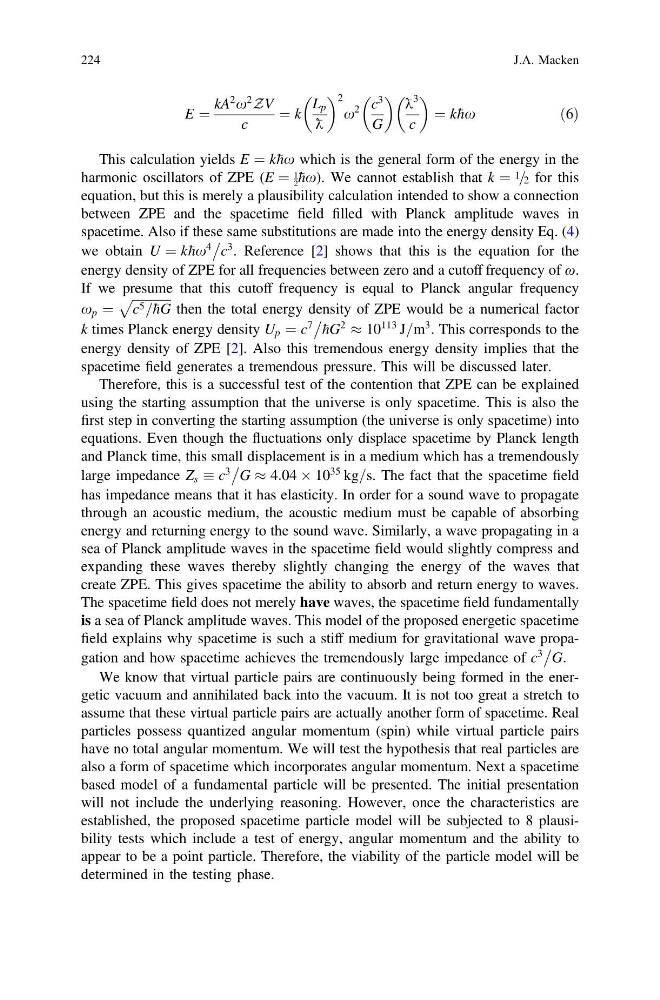
E ¼
kA
2
x
2
ZV
c
¼ k
L p
k
2
x
2 c
3
G
k
3
c
¼ k hx
ð6Þ
This calculation yields E ¼ k hx which is the general form of the energy in the
harmonic oscillators of ZPE (E ¼
1
2 hx). We cannot establish that k ¼ 1 = 2 for this
equation, but this is merely a plausibility calculation intended to show a connection
between ZPE and the spacetime field filled with Planck amplitude waves in
spacetime. Also if these same substitutions are made into the energy density Eq. (4)
we obtain U ¼ k hx
4
c
3 . Reference [2] shows that this is the equation for the
energy density of ZPE for all frequencies between zero and a cutoff frequency of ω.
If we presume that this cutoff frequency is equal to Planck angular frequency
x p ¼
ffiffiffiffiffiffiffiffiffiffiffiffi ffi
c 5 = hG
p
then the total energy density of ZPE would be a numerical factor
k times Planck energy density U p ¼ c
7
hG
2
% 10
113 J=m
3 . This corresponds to the
energy density of ZPE [2]. Also this tremendous energy density implies that the
spacetime field generates a tremendous pressure. This will be discussed later.
Therefore, this is a successful test of the contention that ZPE can be explained
using the starting assumption that the universe is only spacetime. This is also the
first step in converting the starting assumption (the universe is only spacetime) into
equations. Even though the fluctuations only displace spacetime by Planck length
and Planck time, this small displacement is in a medium which has a tremendously
large impedance Z s c
3
G % 4:04 Â 10
35 kg=s. The fact that the spacetime field
has impedance means that it has elasticity. In order for a sound wave to propagate
through an acoustic medium, the acoustic medium must be capable of absorbing
energy and returning energy to the sound wave. Similarly, a wave propagating in a
sea of Planck amplitude waves in the spacetime field would slightly compress and
expanding these waves thereby slightly changing the energy of the waves that
create ZPE. This gives spacetime the ability to absorb and return energy to waves.
The spacetime field does not merely have waves, the spacetime field fundamentally
is a sea of Planck amplitude waves. This model of the proposed energetic spacetime
field explains why spacetime is such a stiff medium for gravitational wave propagation and how spacetime achieves the tremendously large impedance of c
3
G:
We know that virtual particle pairs are continuously being formed in the energetic vacuum and annihilated back into the vacuum. It is not too great a stretch to
assume that these virtual particle pairs are actually another form of spacetime. Real
particles possess quantized angular momentum (spin) while virtual particle pairs
have no total angular momentum. We will test the hypothesis that real particles are
also a form of spacetime which incorporates angular momentum. Next a spacetime
based model of a fundamental particle will be presented. The initial presentation
will not include the underlying reasoning. However, once the characteristics are
established, the proposed spacetime particle model will be subjected to 8 plausibility tests which include a test of energy, angular momentum and the ability to
appear to be a point particle. Therefore, the viability of the particle model will be
determined in the testing phase.
224
J.A. Macken
kA
2
x
2
ZV
c
¼ k
L p
k
2
x
2 c
3
G
k
3
c
¼ k hx
ð6Þ
This calculation yields E ¼ k hx which is the general form of the energy in the
harmonic oscillators of ZPE (E ¼
1
2 hx). We cannot establish that k ¼ 1 = 2 for this
equation, but this is merely a plausibility calculation intended to show a connection
between ZPE and the spacetime field filled with Planck amplitude waves in
spacetime. Also if these same substitutions are made into the energy density Eq. (4)
we obtain U ¼ k hx
4
c
3 . Reference [2] shows that this is the equation for the
energy density of ZPE for all frequencies between zero and a cutoff frequency of ω.
If we presume that this cutoff frequency is equal to Planck angular frequency
x p ¼
ffiffiffiffiffiffiffiffiffiffiffiffi ffi
c 5 = hG
p
then the total energy density of ZPE would be a numerical factor
k times Planck energy density U p ¼ c
7
hG
2
% 10
113 J=m
3 . This corresponds to the
energy density of ZPE [2]. Also this tremendous energy density implies that the
spacetime field generates a tremendous pressure. This will be discussed later.
Therefore, this is a successful test of the contention that ZPE can be explained
using the starting assumption that the universe is only spacetime. This is also the
first step in converting the starting assumption (the universe is only spacetime) into
equations. Even though the fluctuations only displace spacetime by Planck length
and Planck time, this small displacement is in a medium which has a tremendously
large impedance Z s c
3
G % 4:04 Â 10
35 kg=s. The fact that the spacetime field
has impedance means that it has elasticity. In order for a sound wave to propagate
through an acoustic medium, the acoustic medium must be capable of absorbing
energy and returning energy to the sound wave. Similarly, a wave propagating in a
sea of Planck amplitude waves in the spacetime field would slightly compress and
expanding these waves thereby slightly changing the energy of the waves that
create ZPE. This gives spacetime the ability to absorb and return energy to waves.
The spacetime field does not merely have waves, the spacetime field fundamentally
is a sea of Planck amplitude waves. This model of the proposed energetic spacetime
field explains why spacetime is such a stiff medium for gravitational wave propagation and how spacetime achieves the tremendously large impedance of c
3
G:
We know that virtual particle pairs are continuously being formed in the energetic vacuum and annihilated back into the vacuum. It is not too great a stretch to
assume that these virtual particle pairs are actually another form of spacetime. Real
particles possess quantized angular momentum (spin) while virtual particle pairs
have no total angular momentum. We will test the hypothesis that real particles are
also a form of spacetime which incorporates angular momentum. Next a spacetime
based model of a fundamental particle will be presented. The initial presentation
will not include the underlying reasoning. However, once the characteristics are
established, the proposed spacetime particle model will be subjected to 8 plausibility tests which include a test of energy, angular momentum and the ability to
appear to be a point particle. Therefore, the viability of the particle model will be
determined in the testing phase.
224
J.A. Macken