

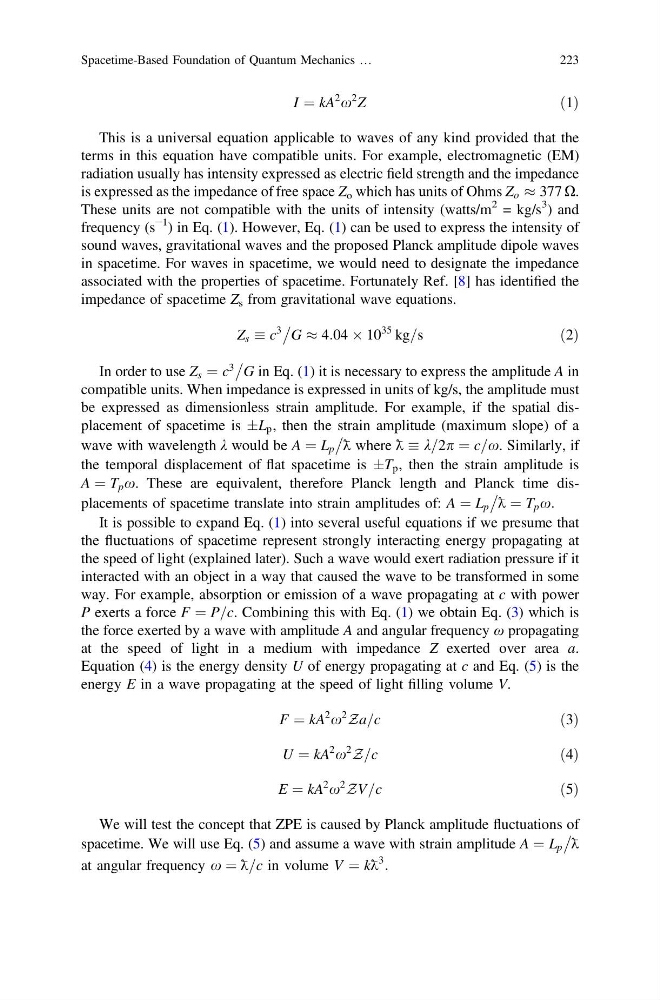
I ¼ kA
2
x
2 Z
ð1Þ
This is a universal equation applicable to waves of any kind provided that the
terms in this equation have compatible units. For example, electromagnetic (EM)
radiation usually has intensity expressed as electric field strength and the impedance
is expressed as the impedance of free space Z o which has units of Ohms Z o % 377 X.
These units are not compatible with the units of intensity (watts/m
2 = kg/s
3 ) and
frequency (s
−1 ) in Eq. (1). However, Eq. (1) can be used to express the intensity of
sound waves, gravitational waves and the proposed Planck amplitude dipole waves
in spacetime. For waves in spacetime, we would need to designate the impedance
associated with the properties of spacetime. Fortunately Ref. [8] has identified the
impedance of spacetime Z s from gravitational wave equations.
Z s c
3
G % 4:04 Â 10
35 kg=s
ð2Þ
In order to use Z s ¼ c
3
G in Eq. (1) it is necessary to express the amplitude A in
compatible units. When impedance is expressed in units of kg/s, the amplitude must
be expressed as dimensionless strain amplitude. For example, if the spatial displacement of spacetime is ÆL p , then the strain amplitude (maximum slope) of a
wave with wavelength λ would be A ¼ L p
k where
k k=2p ¼ c=x. Similarly, if
the temporal displacement of flat spacetime is ÆT p , then the strain amplitude is
A ¼ T p x. These are equivalent, therefore Planck length and Planck time displacements of spacetime translate into strain amplitudes of: A ¼ L p
k ¼ T p x:
It is possible to expand Eq. (1) into several useful equations if we presume that
the fluctuations of spacetime represent strongly interacting energy propagating at
the speed of light (explained later). Such a wave would exert radiation pressure if it
interacted with an object in a way that caused the wave to be transformed in some
way. For example, absorption or emission of a wave propagating at c with power
P exerts a force F ¼ P=c. Combining this with Eq. (1) we obtain Eq. (3) which is
the force exerted by a wave with amplitude A and angular frequency ω propagating
at the speed of light in a medium with impedance Z exerted over area a.
Equation (4) is the energy density U of energy propagating at c and Eq. (5) is the
energy E in a wave propagating at the speed of light filling volume V.
F ¼ kA
2
x
2
Za=c
ð3Þ
U ¼ kA
2
x
2
Z=c
ð4Þ
E ¼ kA
2
x
2
ZV=c
ð5Þ
We will test the concept that ZPE is caused by Planck amplitude fluctuations of
spacetime. We will use Eq. (5) and assume a wave with strain amplitude A ¼ L p
k
at angular frequency x ¼
k=c in volume V ¼ k k
3
:
Spacetime-Based Foundation of Quantum Mechanics …
223
2
x
2 Z
ð1Þ
This is a universal equation applicable to waves of any kind provided that the
terms in this equation have compatible units. For example, electromagnetic (EM)
radiation usually has intensity expressed as electric field strength and the impedance
is expressed as the impedance of free space Z o which has units of Ohms Z o % 377 X.
These units are not compatible with the units of intensity (watts/m
2 = kg/s
3 ) and
frequency (s
−1 ) in Eq. (1). However, Eq. (1) can be used to express the intensity of
sound waves, gravitational waves and the proposed Planck amplitude dipole waves
in spacetime. For waves in spacetime, we would need to designate the impedance
associated with the properties of spacetime. Fortunately Ref. [8] has identified the
impedance of spacetime Z s from gravitational wave equations.
Z s c
3
G % 4:04 Â 10
35 kg=s
ð2Þ
In order to use Z s ¼ c
3
G in Eq. (1) it is necessary to express the amplitude A in
compatible units. When impedance is expressed in units of kg/s, the amplitude must
be expressed as dimensionless strain amplitude. For example, if the spatial displacement of spacetime is ÆL p , then the strain amplitude (maximum slope) of a
wave with wavelength λ would be A ¼ L p
k where
k k=2p ¼ c=x. Similarly, if
the temporal displacement of flat spacetime is ÆT p , then the strain amplitude is
A ¼ T p x. These are equivalent, therefore Planck length and Planck time displacements of spacetime translate into strain amplitudes of: A ¼ L p
k ¼ T p x:
It is possible to expand Eq. (1) into several useful equations if we presume that
the fluctuations of spacetime represent strongly interacting energy propagating at
the speed of light (explained later). Such a wave would exert radiation pressure if it
interacted with an object in a way that caused the wave to be transformed in some
way. For example, absorption or emission of a wave propagating at c with power
P exerts a force F ¼ P=c. Combining this with Eq. (1) we obtain Eq. (3) which is
the force exerted by a wave with amplitude A and angular frequency ω propagating
at the speed of light in a medium with impedance Z exerted over area a.
Equation (4) is the energy density U of energy propagating at c and Eq. (5) is the
energy E in a wave propagating at the speed of light filling volume V.
F ¼ kA
2
x
2
Za=c
ð3Þ
U ¼ kA
2
x
2
Z=c
ð4Þ
E ¼ kA
2
x
2
ZV=c
ð5Þ
We will test the concept that ZPE is caused by Planck amplitude fluctuations of
spacetime. We will use Eq. (5) and assume a wave with strain amplitude A ¼ L p
k
at angular frequency x ¼
k=c in volume V ¼ k k
3
:
Spacetime-Based Foundation of Quantum Mechanics …
223