

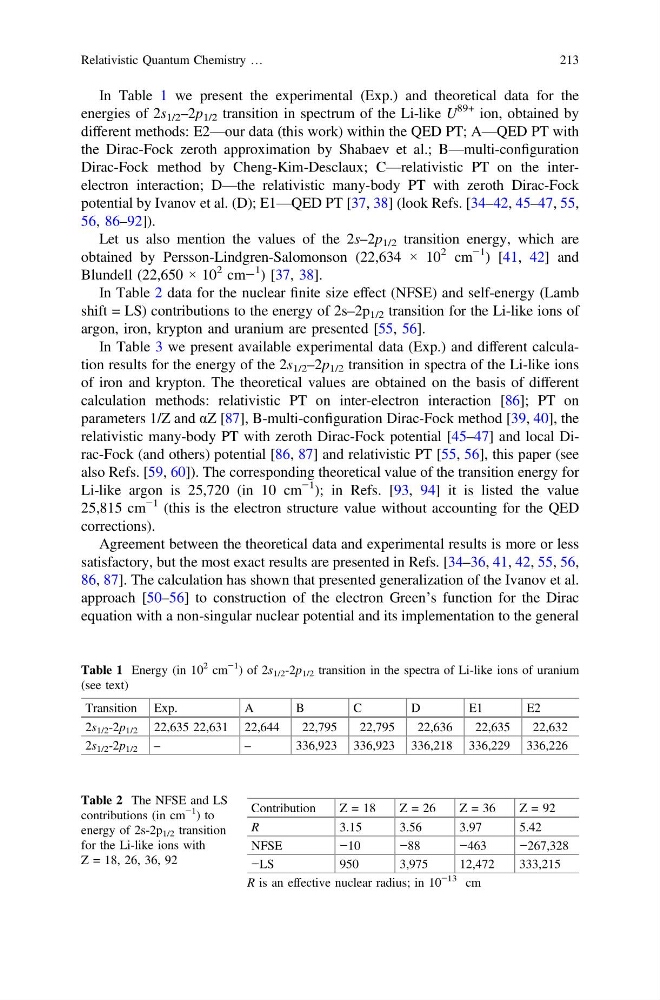
In Table 1 we present the experimental (Exp.) and theoretical data for the
energies of 2s 1/2 –2p 1/2 transition in spectrum of the Li-like U
89+ ion, obtained by
different methods: E2—our data (this work) within the QED PT; A—QED PT with
the Dirac-Fock zeroth approximation by Shabaev et al.; B—multi-configuration
Dirac-Fock method by Cheng-Kim-Desclaux; C—relativistic PT on the interelectron interaction; D—the relativistic many-body PT with zeroth Dirac-Fock
potential by Ivanov et al. (D); E1—QED PT [37, 38] (look Refs. [34–42, 45–47, 55,
56, 86–92]).
Let us also mention the values of the 2s–2p 1/2 transition energy, which are
obtained by Persson-Lindgren-Salomonson (22,634 × 10
2 cm
−1 ) [41, 42] and
Blundell (22,650 × 10
2 cm−
1 ) [37, 38].
In Table 2 data for the nuclear finite size effect (NFSE) and self-energy (Lamb
shift = LS) contributions to the energy of 2s–2p 1/2 transition for the Li-like ions of
argon, iron, krypton and uranium are presented [55, 56].
In Table 3 we present available experimental data (Exp.) and different calculation results for the energy of the 2s 1/2 –2p 1/2 transition in spectra of the Li-like ions
of iron and krypton. The theoretical values are obtained on the basis of different
calculation methods: relativistic PT on inter-electron interaction [86]; PT on
parameters 1/Z and αZ [87], B-multi-configuration Dirac-Fock method [39, 40], the
relativistic many-body PT with zeroth Dirac-Fock potential [45–47] and local Dirac-Fock (and others) potential [86, 87] and relativistic PT [55, 56], this paper (see
also Refs. [59, 60]). The corresponding theoretical value of the transition energy for
Li-like argon is 25,720 (in 10 cm
−1 ); in Refs. [93, 94] it is listed the value
25,815 cm
−1 (this is the electron structure value without accounting for the QED
corrections).
Agreement between the theoretical data and experimental results is more or less
satisfactory, but the most exact results are presented in Refs. [34–36, 41, 42, 55, 56,
86, 87]. The calculation has shown that presented generalization of the Ivanov et al.
approach [50–56] to construction of the electron Green’s function for the Dirac
equation with a non-singular nuclear potential and its implementation to the general
Table 1 Energy (in 10
2 cm
−1
) of 2s 1/2 -2p 1/2 transition in the spectra of Li-like ions of uranium
(see text)
Transition Exp.
A
B
C
D
E1
E2
2s 1/2 -2p 1/2 22,635 22,631 22,644
22,795
22,795
22,636
22,635
22,632
2s 1/2 -2p 1/2 –
–
336,923 336,923 336,218 336,229 336,226
Table 2 The NFSE and LS
contributions (in cm
−1
) to
energy of 2s-2p 1/2 transition
for the Li-like ions with
Z = 18, 26, 36, 92
Contribution
Z = 18
Z = 26
Z = 36
Z = 92
R
3.15
3.56
3.97
5.42
NFSE
−10
−88
−463
−267,328
−LS
950
3,975
12,472
333,215
R is an effective nuclear radius; in 10
−13 cm
Relativistic Quantum Chemistry …
213
energies of 2s 1/2 –2p 1/2 transition in spectrum of the Li-like U
89+ ion, obtained by
different methods: E2—our data (this work) within the QED PT; A—QED PT with
the Dirac-Fock zeroth approximation by Shabaev et al.; B—multi-configuration
Dirac-Fock method by Cheng-Kim-Desclaux; C—relativistic PT on the interelectron interaction; D—the relativistic many-body PT with zeroth Dirac-Fock
potential by Ivanov et al. (D); E1—QED PT [37, 38] (look Refs. [34–42, 45–47, 55,
56, 86–92]).
Let us also mention the values of the 2s–2p 1/2 transition energy, which are
obtained by Persson-Lindgren-Salomonson (22,634 × 10
2 cm
−1 ) [41, 42] and
Blundell (22,650 × 10
2 cm−
1 ) [37, 38].
In Table 2 data for the nuclear finite size effect (NFSE) and self-energy (Lamb
shift = LS) contributions to the energy of 2s–2p 1/2 transition for the Li-like ions of
argon, iron, krypton and uranium are presented [55, 56].
In Table 3 we present available experimental data (Exp.) and different calculation results for the energy of the 2s 1/2 –2p 1/2 transition in spectra of the Li-like ions
of iron and krypton. The theoretical values are obtained on the basis of different
calculation methods: relativistic PT on inter-electron interaction [86]; PT on
parameters 1/Z and αZ [87], B-multi-configuration Dirac-Fock method [39, 40], the
relativistic many-body PT with zeroth Dirac-Fock potential [45–47] and local Dirac-Fock (and others) potential [86, 87] and relativistic PT [55, 56], this paper (see
also Refs. [59, 60]). The corresponding theoretical value of the transition energy for
Li-like argon is 25,720 (in 10 cm
−1 ); in Refs. [93, 94] it is listed the value
25,815 cm
−1 (this is the electron structure value without accounting for the QED
corrections).
Agreement between the theoretical data and experimental results is more or less
satisfactory, but the most exact results are presented in Refs. [34–36, 41, 42, 55, 56,
86, 87]. The calculation has shown that presented generalization of the Ivanov et al.
approach [50–56] to construction of the electron Green’s function for the Dirac
equation with a non-singular nuclear potential and its implementation to the general
Table 1 Energy (in 10
2 cm
−1
) of 2s 1/2 -2p 1/2 transition in the spectra of Li-like ions of uranium
(see text)
Transition Exp.
A
B
C
D
E1
E2
2s 1/2 -2p 1/2 22,635 22,631 22,644
22,795
22,795
22,636
22,635
22,632
2s 1/2 -2p 1/2 –
–
336,923 336,923 336,218 336,229 336,226
Table 2 The NFSE and LS
contributions (in cm
−1
) to
energy of 2s-2p 1/2 transition
for the Li-like ions with
Z = 18, 26, 36, 92
Contribution
Z = 18
Z = 26
Z = 36
Z = 92
R
3.15
3.56
3.97
5.42
NFSE
−10
−88
−463
−267,328
−LS
950
3,975
12,472
333,215
R is an effective nuclear radius; in 10
−13 cm
Relativistic Quantum Chemistry …
213