

7 Calculation Results for Self-Energy Shifts to Atomic
Level Energies: Li-like Ions
In Refs. [55, 59, 60] the calculation of spectra for a number of the Li-like heavy
ions with nuclear charge Z = 18–100, in particular, Li-like argon and uranium, has
been carried out. First of all, let us note that in a concrete calculation transition from
exact Eq. (37) to asymptotical ones (41) and (42) is under simultaneous fulfilling
four conditions
X
0
\0; X
00
[ 0; X
000
\0; X
IV
[ 0:
ð51Þ
Using the exact equations for large r leads to non-fulfilling the third condition and
then first one that is meant the divergence of the function. The attempt to make
more long the chain (51) resulted to sharp increasing of the calculation time and
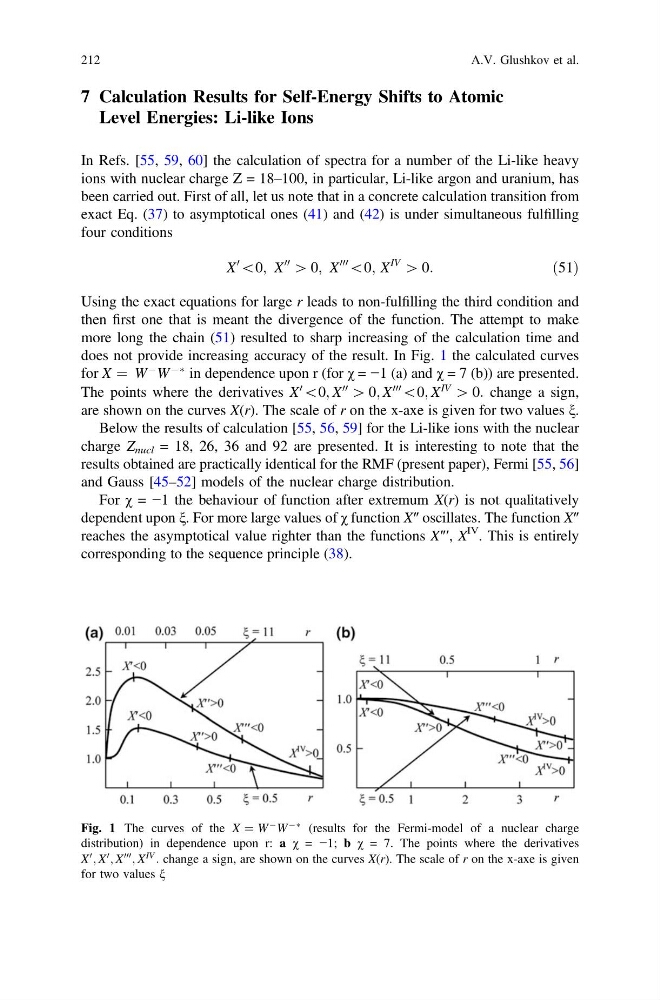
does not provide increasing accuracy of the result. In Fig. 1 the calculated curves
for X ¼ W
À W
ÀÃ in dependence upon r (for χ = −1 (a) and χ = 7 (b)) are presented.
The points where the derivatives X
0
\0; X
00
[ 0; X
000
\0; X
IV
[ 0: change a sign,
are shown on the curves X(r). The scale of r on the x-axe is given for two values ξ.
Below the results of calculation [55, 56, 59] for the Li-like ions with the nuclear
charge Z nucl = 18, 26, 36 and 92 are presented. It is interesting to note that the
results obtained are practically identical for the RMF (present paper), Fermi [55, 56]
and Gauss [45–52] models of the nuclear charge distribution.
For χ = −1 the behaviour of function after extremum X(r) is not qualitatively
dependent upon ξ. For more large values of χ function X″ oscillates. The function X″
reaches the asymptotical value righter than the functions X″′, X
IV
. This is entirely
corresponding to the sequence principle (38).
Fig. 1 The curves of the X ¼ W
À W
ÀÃ (results for the Fermi-model of a nuclear charge
distribution) in dependence upon r: a χ = −1; b χ = 7. The points where the derivatives
X
0 ; X
0 ; X
000 ; X
IV : change a sign, are shown on the curves X(r). The scale of r on the x-axe is given
for two values ξ
212
A.V. Glushkov et al.
Level Energies: Li-like Ions
In Refs. [55, 59, 60] the calculation of spectra for a number of the Li-like heavy
ions with nuclear charge Z = 18–100, in particular, Li-like argon and uranium, has
been carried out. First of all, let us note that in a concrete calculation transition from
exact Eq. (37) to asymptotical ones (41) and (42) is under simultaneous fulfilling
four conditions
X
0
\0; X
00
[ 0; X
000
\0; X
IV
[ 0:
ð51Þ
Using the exact equations for large r leads to non-fulfilling the third condition and
then first one that is meant the divergence of the function. The attempt to make
more long the chain (51) resulted to sharp increasing of the calculation time and
does not provide increasing accuracy of the result. In Fig. 1 the calculated curves
for X ¼ W
À W
ÀÃ in dependence upon r (for χ = −1 (a) and χ = 7 (b)) are presented.
The points where the derivatives X
0
\0; X
00
[ 0; X
000
\0; X
IV
[ 0: change a sign,
are shown on the curves X(r). The scale of r on the x-axe is given for two values ξ.
Below the results of calculation [55, 56, 59] for the Li-like ions with the nuclear
charge Z nucl = 18, 26, 36 and 92 are presented. It is interesting to note that the
results obtained are practically identical for the RMF (present paper), Fermi [55, 56]
and Gauss [45–52] models of the nuclear charge distribution.
For χ = −1 the behaviour of function after extremum X(r) is not qualitatively
dependent upon ξ. For more large values of χ function X″ oscillates. The function X″
reaches the asymptotical value righter than the functions X″′, X
IV
. This is entirely
corresponding to the sequence principle (38).
Fig. 1 The curves of the X ¼ W
À W
ÀÃ (results for the Fermi-model of a nuclear charge
distribution) in dependence upon r: a χ = −1; b χ = 7. The points where the derivatives
X
0 ; X
0 ; X
000 ; X
IV : change a sign, are shown on the curves X(r). The scale of r on the x-axe is given
for two values ξ
212
A.V. Glushkov et al.