

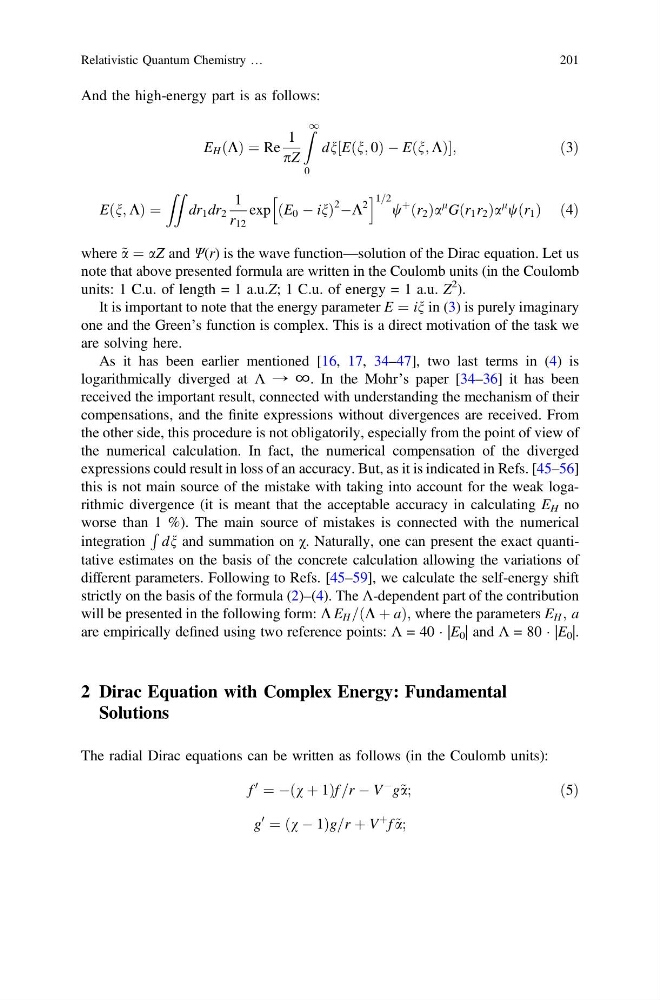
And the high-energy part is as follows:
E H K
ð Þ ¼ Re
1
pZ
Z 1
0
dn E n; 0
ð ÞÀE n; K
ð
Þ
½
;
ð3Þ
E n; K
ð
Þ ¼
ZZ
dr 1 dr 2
1
r 12
exp E 0 À in
ð
Þ
2 ÀK
2
h
i 1=2 w
þ r 2
ð Þa
l G r 1 r 2
ð
Þa
l
w r 1
ð Þ ð4Þ
where ~ a ¼ aZ and Ψ(r) is the wave function—solution of the Dirac equation. Let us
note that above presented formula are written in the Coulomb units (in the Coulomb
units: 1 C.u. of length = 1 a.u.Z; 1 C.u. of energy = 1 a.u. Z
2 ).
It is important to note that the energy parameter E ¼ in in (3) is purely imaginary
one and the Green’s function is complex. This is a direct motivation of the task we
are solving here.
As it has been earlier mentioned [16, 17, 34–47], two last terms in (4) is
logarithmically diverged at Λ → ∞. In the Mohr’s paper [34–36] it has been
received the important result, connected with understanding the mechanism of their
compensations, and the finite expressions without divergences are received. From
the other side, this procedure is not obligatorily, especially from the point of view of
the numerical calculation. In fact, the numerical compensation of the diverged
expressions could result in loss of an accuracy. But, as it is indicated in Refs. [45–56]
this is not main source of the mistake with taking into account for the weak logarithmic divergence (it is meant that the acceptable accuracy in calculating E H no
worse than 1 %). The main source of mistakes is connected with the numerical
integration
R
dn and summation on χ. Naturally, one can present the exact quantitative estimates on the basis of the concrete calculation allowing the variations of
different parameters. Following to Refs. [45–59], we calculate the self-energy shift
strictly on the basis of the formula (2)–(4). The Λ-dependent part of the contribution
will be presented in the following form: K E H = K þ a
ð
Þ; where the parameters E H ; a
are empirically defined using two reference points: Λ = 40 Á |E 0 | and Λ = 80 Á |E 0 |.
2 Dirac Equation with Complex Energy: Fundamental
Solutions
The radial Dirac equations can be written as follows (in the Coulomb units):
f
0
¼ Àðv þ 1Þf =r À V
À g~ a;
ð5Þ
g
0
¼ ðv À 1Þg=r þ V
þ f ~ a;
Relativistic Quantum Chemistry …
201
E H K
ð Þ ¼ Re
1
pZ
Z 1
0
dn E n; 0
ð ÞÀE n; K
ð
Þ
½
;
ð3Þ
E n; K
ð
Þ ¼
ZZ
dr 1 dr 2
1
r 12
exp E 0 À in
ð
Þ
2 ÀK
2
h
i 1=2 w
þ r 2
ð Þa
l G r 1 r 2
ð
Þa
l
w r 1
ð Þ ð4Þ
where ~ a ¼ aZ and Ψ(r) is the wave function—solution of the Dirac equation. Let us
note that above presented formula are written in the Coulomb units (in the Coulomb
units: 1 C.u. of length = 1 a.u.Z; 1 C.u. of energy = 1 a.u. Z
2 ).
It is important to note that the energy parameter E ¼ in in (3) is purely imaginary
one and the Green’s function is complex. This is a direct motivation of the task we
are solving here.
As it has been earlier mentioned [16, 17, 34–47], two last terms in (4) is
logarithmically diverged at Λ → ∞. In the Mohr’s paper [34–36] it has been
received the important result, connected with understanding the mechanism of their
compensations, and the finite expressions without divergences are received. From
the other side, this procedure is not obligatorily, especially from the point of view of
the numerical calculation. In fact, the numerical compensation of the diverged
expressions could result in loss of an accuracy. But, as it is indicated in Refs. [45–56]
this is not main source of the mistake with taking into account for the weak logarithmic divergence (it is meant that the acceptable accuracy in calculating E H no
worse than 1 %). The main source of mistakes is connected with the numerical
integration
R
dn and summation on χ. Naturally, one can present the exact quantitative estimates on the basis of the concrete calculation allowing the variations of
different parameters. Following to Refs. [45–59], we calculate the self-energy shift
strictly on the basis of the formula (2)–(4). The Λ-dependent part of the contribution
will be presented in the following form: K E H = K þ a
ð
Þ; where the parameters E H ; a
are empirically defined using two reference points: Λ = 40 Á |E 0 | and Λ = 80 Á |E 0 |.
2 Dirac Equation with Complex Energy: Fundamental
Solutions
The radial Dirac equations can be written as follows (in the Coulomb units):
f
0
¼ Àðv þ 1Þf =r À V
À g~ a;
ð5Þ
g
0
¼ ðv À 1Þg=r þ V
þ f ~ a;
Relativistic Quantum Chemistry …
201