

ðu g ju g Þ ¼
Z 1
0
dRu g ðR; tÞu g ðR; tÞÞ
ð22Þ
On the other hand we have
i h
@UðR; tÞ
@t
¼ e
À
i
h
R t
0
E F ðt
0 Þdt
0
½i h _
AðtÞ þ AðtÞE F ðtÞ
u g ðR; tÞe
ixðtÞt
u u ðR; tÞ
!
þi hAðtÞ
½i _
xðtÞt þ ixðtÞu g ðR; tÞ þ _
u g ðtÞe
ixðtÞt
_
u u ðR; tÞ
! !
ð23Þ
so that
u g ðR; tÞe
ÀixðtÞt
; u u ðR; tÞ
h
i
ji h
@UðR; tÞ
@t
¼ e
À
i
h
R t
0
EF ðt
0 Þdt
0 Â ½i h _
AðtÞ þ AðtÞE F ðtÞ½ðu g ju g Þ
þðu u ju u Þ þ i hAðtÞ½ði _
xðtÞt þ ixðtÞÞðu g ju g Þ þ ðu g j _
u g Þ þ ðu u j _
u u Þ
Ã
ð24Þ
A quantity such as ðu g j _
u g Þ is
ðu g j _
u g Þ ¼
Z 1
0
dR u g ðR; tÞ
@
@t
u g ðR; tÞ
ð 25Þ
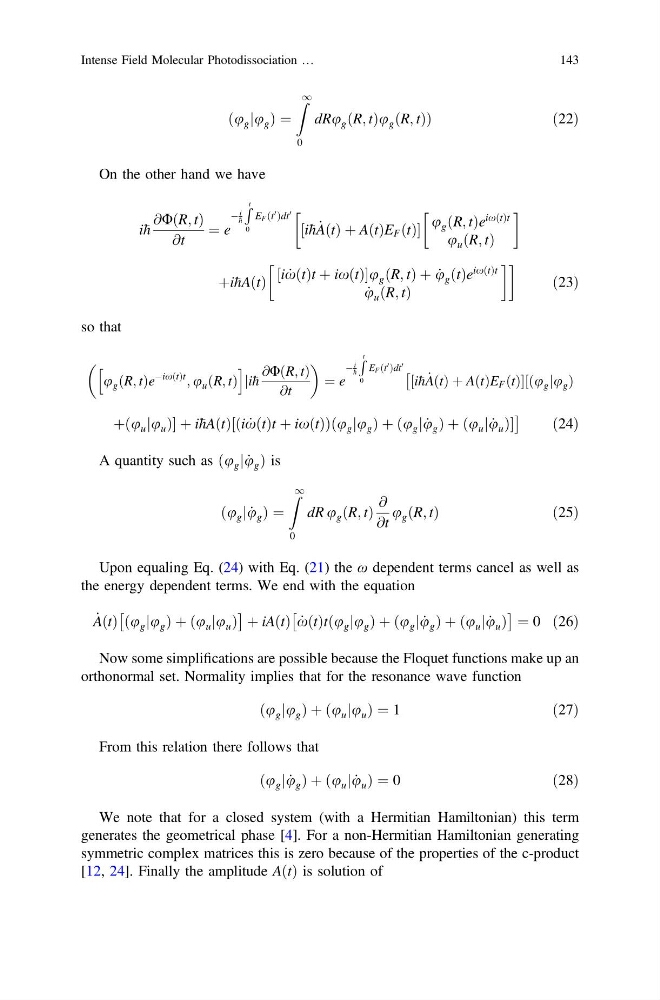
Upon equaling Eq. (24) with Eq. (21) the ω dependent terms cancel as well as
the energy dependent terms. We end with the equation
_
AðtÞ ðu g ju g Þ þ ðu u ju u Þ
Â
à þ iAðtÞ _
xðtÞtðu g ju g Þ þ ðu g j _
u g Þ þ ðu u j _
u u Þ
Â
à ¼ 0 ð26Þ
Now some simplifications are possible because the Floquet functions make up an
orthonormal set. Normality implies that for the resonance wave function
ðu g ju g Þ þ ðu u ju u Þ ¼ 1
ð27Þ
From this relation there follows that
ðu g j _
u g Þ þ ðu u j _
u u Þ ¼ 0
ð28Þ
We note that for a closed system (with a Hermitian Hamiltonian) this term
generates the geometrical phase [4]. For a non-Hermitian Hamiltonian generating
symmetric complex matrices this is zero because of the properties of the c-product
[12, 24]. Finally the amplitude AðtÞ is solution of
Intense Field Molecular Photodissociation …
143
Z 1
0
dRu g ðR; tÞu g ðR; tÞÞ
ð22Þ
On the other hand we have
i h
@UðR; tÞ
@t
¼ e
À
i
h
R t
0
E F ðt
0 Þdt
0
½i h _
AðtÞ þ AðtÞE F ðtÞ
u g ðR; tÞe
ixðtÞt
u u ðR; tÞ
!
þi hAðtÞ
½i _
xðtÞt þ ixðtÞu g ðR; tÞ þ _
u g ðtÞe
ixðtÞt
_
u u ðR; tÞ
! !
ð23Þ
so that
u g ðR; tÞe
ÀixðtÞt
; u u ðR; tÞ
h
i
ji h
@UðR; tÞ
@t
¼ e
À
i
h
R t
0
EF ðt
0 Þdt
0 Â ½i h _
AðtÞ þ AðtÞE F ðtÞ½ðu g ju g Þ
þðu u ju u Þ þ i hAðtÞ½ði _
xðtÞt þ ixðtÞÞðu g ju g Þ þ ðu g j _
u g Þ þ ðu u j _
u u Þ
Ã
ð24Þ
A quantity such as ðu g j _
u g Þ is
ðu g j _
u g Þ ¼
Z 1
0
dR u g ðR; tÞ
@
@t
u g ðR; tÞ
ð 25Þ
Upon equaling Eq. (24) with Eq. (21) the ω dependent terms cancel as well as
the energy dependent terms. We end with the equation
_
AðtÞ ðu g ju g Þ þ ðu u ju u Þ
Â
à þ iAðtÞ _
xðtÞtðu g ju g Þ þ ðu g j _
u g Þ þ ðu u j _
u u Þ
Â
à ¼ 0 ð26Þ
Now some simplifications are possible because the Floquet functions make up an
orthonormal set. Normality implies that for the resonance wave function
ðu g ju g Þ þ ðu u ju u Þ ¼ 1
ð27Þ
From this relation there follows that
ðu g j _
u g Þ þ ðu u j _
u u Þ ¼ 0
ð28Þ
We note that for a closed system (with a Hermitian Hamiltonian) this term
generates the geometrical phase [4]. For a non-Hermitian Hamiltonian generating
symmetric complex matrices this is zero because of the properties of the c-product
[12, 24]. Finally the amplitude AðtÞ is solution of
Intense Field Molecular Photodissociation …
143