

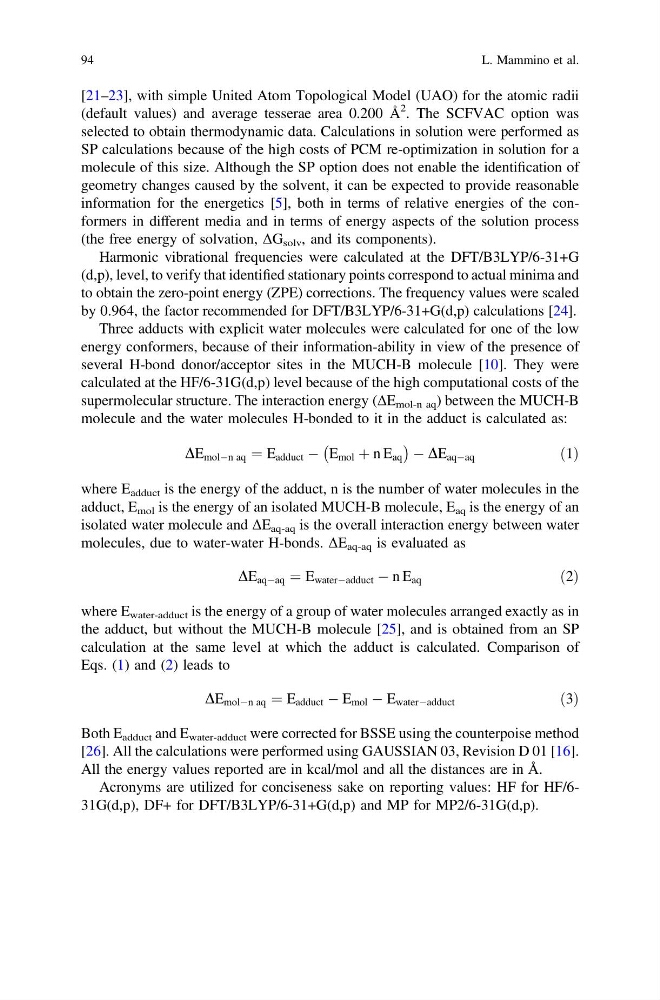
[21–23], with simple United Atom Topological Model (UAO) for the atomic radii
(default values) and average tesserae area 0.200 Å
2 . The SCFVAC option was
selected to obtain thermodynamic data. Calculations in solution were performed as
SP calculations because of the high costs of PCM re-optimization in solution for a
molecule of this size. Although the SP option does not enable the identification of
geometry changes caused by the solvent, it can be expected to provide reasonable
information for the energetics [5], both in terms of relative energies of the conformers in different media and in terms of energy aspects of the solution process
(the free energy of solvation, ΔG solv , and its components).
Harmonic vibrational frequencies were calculated at the DFT/B3LYP/6-31+G
(d,p), level, to verify that identified stationary points correspond to actual minima and
to obtain the zero-point energy (ZPE) corrections. The frequency values were scaled
by 0.964, the factor recommended for DFT/B3LYP/6-31+G(d,p) calculations [24].
Three adducts with explicit water molecules were calculated for one of the low
energy conformers, because of their information-ability in view of the presence of
several H-bond donor/acceptor sites in the MUCH-B molecule [10]. They were
calculated at the HF/6-31G(d,p) level because of the high computational costs of the
supermolecular structure. The interaction energy (ΔE mol-n aq ) between the MUCH-B
molecule and the water molecules H-bonded to it in the adduct is calculated as:
DE molÀn aq ¼ E adduct À E mol þ n E aq
À
Á À DE aqÀaq
ð1Þ
where E adduct is the energy of the adduct, n is the number of water molecules in the
adduct, E mol is the energy of an isolated MUCH-B molecule, E aq is the energy of an
isolated water molecule and ΔE aq-aq is the overall interaction energy between water
molecules, due to water-water H-bonds. ΔE aq-aq is evaluated as
DE aqÀaq ¼ E waterÀadduct À n E aq
ð2Þ
where E water-adduct is the energy of a group of water molecules arranged exactly as in
the adduct, but without the MUCH-B molecule [25], and is obtained from an SP
calculation at the same level at which the adduct is calculated. Comparison of
Eqs. (1) and (2) leads to
DE molÀn aq ¼ E adduct À E mol À E waterÀadduct
ð3Þ
Both E adduct and E water-adduct were corrected for BSSE using the counterpoise method
[26]. All the calculations were performed using GAUSSIAN 03, Revision D 01 [16].
All the energy values reported are in kcal/mol and all the distances are in Å.
Acronyms are utilized for conciseness sake on reporting values: HF for HF/631G(d,p), DF+ for DFT/B3LYP/6-31+G(d,p) and MP for MP2/6-31G(d,p).
94
L. Mammino et al.
(default values) and average tesserae area 0.200 Å
2 . The SCFVAC option was
selected to obtain thermodynamic data. Calculations in solution were performed as
SP calculations because of the high costs of PCM re-optimization in solution for a
molecule of this size. Although the SP option does not enable the identification of
geometry changes caused by the solvent, it can be expected to provide reasonable
information for the energetics [5], both in terms of relative energies of the conformers in different media and in terms of energy aspects of the solution process
(the free energy of solvation, ΔG solv , and its components).
Harmonic vibrational frequencies were calculated at the DFT/B3LYP/6-31+G
(d,p), level, to verify that identified stationary points correspond to actual minima and
to obtain the zero-point energy (ZPE) corrections. The frequency values were scaled
by 0.964, the factor recommended for DFT/B3LYP/6-31+G(d,p) calculations [24].
Three adducts with explicit water molecules were calculated for one of the low
energy conformers, because of their information-ability in view of the presence of
several H-bond donor/acceptor sites in the MUCH-B molecule [10]. They were
calculated at the HF/6-31G(d,p) level because of the high computational costs of the
supermolecular structure. The interaction energy (ΔE mol-n aq ) between the MUCH-B
molecule and the water molecules H-bonded to it in the adduct is calculated as:
DE molÀn aq ¼ E adduct À E mol þ n E aq
À
Á À DE aqÀaq
ð1Þ
where E adduct is the energy of the adduct, n is the number of water molecules in the
adduct, E mol is the energy of an isolated MUCH-B molecule, E aq is the energy of an
isolated water molecule and ΔE aq-aq is the overall interaction energy between water
molecules, due to water-water H-bonds. ΔE aq-aq is evaluated as
DE aqÀaq ¼ E waterÀadduct À n E aq
ð2Þ
where E water-adduct is the energy of a group of water molecules arranged exactly as in
the adduct, but without the MUCH-B molecule [25], and is obtained from an SP
calculation at the same level at which the adduct is calculated. Comparison of
Eqs. (1) and (2) leads to
DE molÀn aq ¼ E adduct À E mol À E waterÀadduct
ð3Þ
Both E adduct and E water-adduct were corrected for BSSE using the counterpoise method
[26]. All the calculations were performed using GAUSSIAN 03, Revision D 01 [16].
All the energy values reported are in kcal/mol and all the distances are in Å.
Acronyms are utilized for conciseness sake on reporting values: HF for HF/631G(d,p), DF+ for DFT/B3LYP/6-31+G(d,p) and MP for MP2/6-31G(d,p).
94
L. Mammino et al.